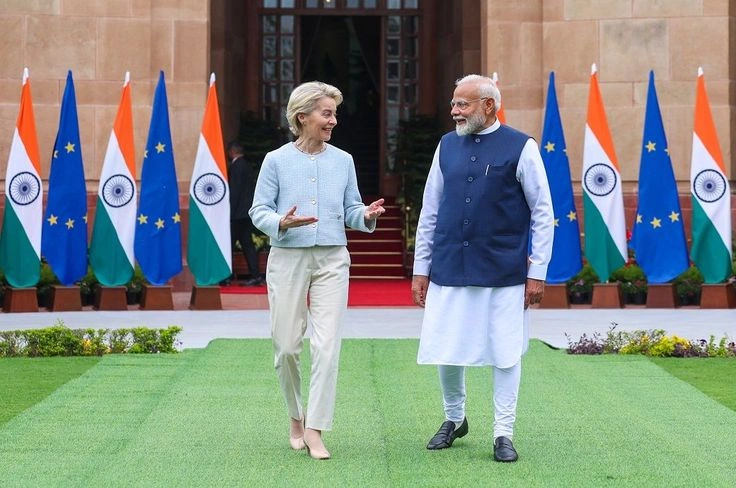
India and the European Union have unofficially agreed to make India the “Most Favored Nation” (MFN) for five years in their draft free trade pact. This is a big move that might revolutionize how trade works all throughout the world. There was a lot of disagreement about this trade deal between India and the EU. It seeks to decrease tariffs on an amazing 96% of commodities. This is a big step forward for trade between the two countries. India and the EU do more than €120 billion in trade each year, but high tariffs and other trade barriers make it impossible for them to do business. Both India and the EU will get “most favored nation” (MFN) status from this arrangement. This might change things and open up new markets. The arrangement is quite important for Indian exporters, especially those in promising fields like textiles, gems, and jewelry. It might bring in billions of dollars and help the economy thrive in a way that lasts. As the talks get closer to a settlement, people are questioning how a full India-EU free trade agreement (FTA) will affect jobs, new ideas, and supply chains.
The textile sector in India is getting ready to send a lot more goods abroad.
The trade deal between India and the EU will be good for textiles. After oil, textiles are India’s second biggest export. In FY2024, textiles will bring in $16.4 billion for the EU. High tariffs have made it challenging for enterprises to compete with those in Bangladesh and Vietnam for a long time. Clothes can be taxed at a rate of up to 12%, while materials can be taxed at a rate of up to 8%. The MFN status breakthrough between India and the EU will solve these concerns for 96% of textile lines.This will likely add $5 to $7 billion to India’s textile exports per year.
Ready-made garments (RMG), which account for 45% of India’s textile trade with the EU and are taxed at an average of 9.7%, are one of the main sub-sectors that could profit. People want ethnic garments and cotton that is cultivated in a way that doesn’t hurt the environment, so when tariffs go down, Indian companies like Arvind Ltd. and Raymond might get 15–20% more of the EU’s €200 billion textile industry. India has a 25% share of the world’s market for household textiles and fabrics, like curtains, bed linens, and yarns. Last year, these goods brought in $3.2 billion in exports. This number could go up by three times as more EU purchasers get interested in ethical sourcing because of green laws like the EU’s Carbon Border Adjustment Mechanism (CBAM). The EU is seeking for new ways to make money, and technological textiles like medical fabrics and geotextiles might bring in $1 billion.
The effects are more than just on exports. Textiles are the main source of income for more than 45 million Indians. People in Tamil Nadu, Gujarat, and Uttar Pradesh are about to acquire jobs in groups of two to three million. The Production Linked Incentive (PLI) plan, which offers the government ₹10,683 crore in incentives, would make this much bigger. It would provide the government money to spend on dyeing and automation that is good for the environment. But there are still issues. To follow the EU’s requirements for workers’ rights and traceability, changes need to be taken right away. Anurag Sehgal, who is the vice president of Welspun India, adds, “Textiles will be the most important part of this deal, but quality is more important than quantity.”
The Gems and Jewelry Industry: Making the High-End Market Easier to Reach
The free trade deal between India and the EU will be good for the gems and jewelry business, just like it will be good for the textile business. In 2024, it will be India’s third largest export to the EU, at $10.5 billion. India now has to pay 5% to 12% in taxes on diamonds, gold jewelry, and gems that were produced in a lab. Indian enterprises will be able to compete better with businesses in Thailand and Hong Kong because of the lower prices.
The EU’s tariffs have stopped the diamond market from growing to 12%, even though Surat, India, cuts 90% of the world’s jewels. Experts estimate that if MFN status is given, the market for gems and jewelry will rise by 25% to 35%, bringing in an extra $3 to $4 billion in sales. If there were no tariffs on polished diamonds, exports could go up by 40%. This is because European jewelers like stones that are certified and don’t have any problems, while G7 sanctions are in place on Russian roughs. Fashion jewelry and gold from Jaipur and Mumbai that mix ancient and new trends would be great for the €50 billion luxury business in Europe. If you don’t have to pay taxes, you could be able to work with companies like Zalando on e-commerce. India’s new lab-grown diamond center might earn 10% of a market that is growing at 18% a year since more individuals in the EU desire ethical options.
Five million people work in the crafts industry, and most of them work for small and medium-sized businesses (SMEs). The Gems and Jewelry Export Promotion Council (GJEPC) might utilize the contract to keep workers employed and pay for training to help them do their jobs better.But there are risks because the price of gold can vary quickly and the EU doesn’t allow money laundering. “This deal takes us from processors to value creators,” said Vipul Shah, who is in charge of GJEPC.
Other people who make money and how it affects the economy as a whole
The trade deal between India and the EU will help many industries flourish, not only those that make textiles and jewelry. Pharmaceuticals get expedited approvals since they send $8 billion worth of goods to the EU. Tata Motors and other companies don’t have to pay tariffs on 90% of their car and car parts lines. Leather goods and apparel for the sea are also selling well. By 2030, the total value of items sold is predicted to rise from €100 billion to €150 billion. FIEO, GJEPC, and the EU Trade Directorate all think that textiles will grow by 30–40% ($5–7 billion), diamonds and jewelry by 25–35% ($3–4 billion), medicines by 15–20% ($1.5–2 billion), and auto parts by 20–25% ($1–1.5 billion). This means that the total amount of money produced each year will go up by $15 to $20 billion.
Over the next five years, foreign direct investment (FDI) is estimated to bring in €20 billion. This will support projects in “China+1.” There is also rumors of a deal between the two countries to invest in each other, which might make this even greater.
Issues and the state of the world
Realism and hope are two different ways of looking at the same thing. If there are no agreements on mutual recognition, non-tariff barriers like EU requirements on health and safety, data localization, and sustainability might hold things down. It’s hard currently because India won’t accept tariffs on steel and carbon levies. The deal goes against China’s dominance in world affairs and is in line with the EU’s Global Gateway and India’s plans for the Indo-Pacific.
The India-EU Trade Agreement Makes Big Promises for MFN Status There are tariff reduction on 96% of commodities, which helps the jewelry and textile industries.