My grandfather lived to be 94 years old and was smart till the end. When I asked him what his secret was, he smiled and said he had never had breakfast since he was “too busy working.” I assumed he was just lucky at the time. Now I wonder if his unintentional intermittent fasting had a bigger impact than we all thought.
We spend billions on lotions, vitamins, and procedures that promise to slow down aging because we are preoccupied with finding the fountain of youth. In the meantime, one of the best ways to live longer is entirely free and has been used by people for thousands of years.
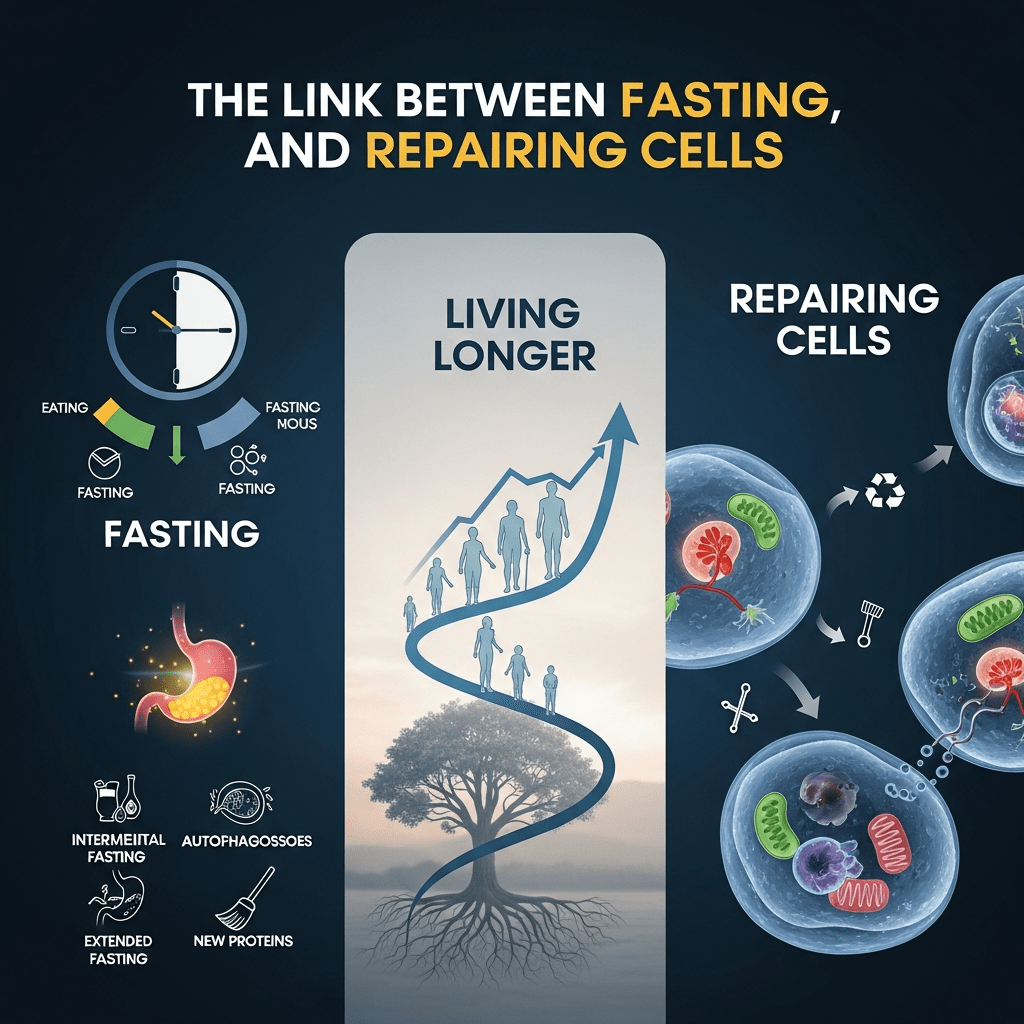
Fasting can do more than only help you lose weight or lower your blood sugar. It starts up old cellular repair systems that can actually slow down aging, keep you from getting sick, and maybe even add healthy years to your life. I’ll show you how this works. Once you know what’s going on within your cells when you fast, you’ll never want to skip a meal again.
Your cells are always under attack.
Your cells get hurt every single day. They can get hurt from normal metabolism, contaminants in the environment, stress, a bad diet, and just living.
Imagine that your cells are vehicles. As they run, they become hurt: proteins that have oxidized, mitochondria that don’t work right, DNA that has been damaged, and proteins that have misfolded and stuck together. This would be like rust, worn-out brake pads, and dirty engine parts in an automobile.
When you’re young, your body is good at getting rid of this cellular trash. But as you become older, the cleanup takes longer. The damage builds up faster than it can be fixed. At its most basic level, aging is the buildup of cellular waste.
This is where diseases like cancer, Alzheimer’s, heart disease, and diabetes come from. These things aren’t just terrible luck. Your body couldn’t keep up with the cleanup and repair work, so years of cellular damage built up.
I was amazed when I first learnt this: you can turn a switch that signals your body to speed up certain cleaning processes. And that switch is not eating.
I remember reading about Yoshinori Ohsumi, the scientist who won the Nobel Prize in 2016 for his work on autophagy. His studies highlighted how important this mechanism is for staying healthy and avoiding sickness. One of the best ways to start it is to fast.
My friend’s dad was told that he was showing early signs of cognitive decline. He began fasting for 18 hours three times a week. His neurologist was shocked at how much better he was six months later. I’m not saying that fasting fixed anything; there were other things at play. But I can’t help but wonder if increasing autophagy helped get rid of the trash that was building up in his brain cells.
How Fasting Really Fixes Your DNA
Your DNA gets struck thousands of times a day. Radiation from the sun, chemicals in your environment, and even regular cellular metabolism can make compounds that hurt your DNA. Most of this damage gets fixed on its own, but some doesn’t. These DNA breaks that don’t be fixed can add up over time and cause mutations, cancer, and aging.
Fasting makes your body’s DNA repair systems work better. When you fast, your cells turn on genes that help with DNA repair and stability. It’s like your body suddenly gets the time to conduct the maintenance it has been putting off.
Oxidative stress is another thing that happens when free radicals, which are unstable chemicals, make your cells rust from the inside. This oxidative damage is a big reason why people get older and sick.
When you fast, your body makes less free radicals since it doesn’t have to metabolize food all the time. Fasting also makes your body make more antioxidants and defensive enzymes at the same time. You’re both making your defenses stronger and doing less harm.
I used to take antioxidant vitamins every day, thinking they would keep me from getting older. Then I found out that fasting causes a lot stronger antioxidant response than any prescription could. When you give your body the correct conditions, it generates its own antioxidants that work much better than anything you can consume.
The Mitochondria Connection: The Power Plants of Your Cells
Your cells have tiny power plants called mitochondria that make energy. They’re good for you and work well when you’re young. As you become older, they break down and stop working, making less energy and more cellular waste.
Dysfunctional mitochondria are linked to almost every disease that becomes worse with age, like heart disease, neurodegenerative diseases, diabetes, and cancer. They also make you feel more fatigued and sluggish as you get older.
When you fast, it does something amazing for your mitochondria. First, it starts the process of mitophagy, which is a specific type of autophagy that gets rid of damaged mitochondria. Your cells find the weak and broken mitochondria and break them down.
Second, fasting makes your body make new, healthy mitochondria. It’s like getting rid of old, broken machines and putting in new ones.
Before I even knew the science, I saw this in my own life. After a few weeks of regular intermittent fasting, I had a lot more energy. I wasn’t dragging through the afternoons anymore. I was getting more sleep. I felt more awake. I believed it was only because I lost a few pounds, but now I realize it was probably because my mitochondria were working better.
Inflammation: The Quiet Killer That Fasting Stops
Chronic inflammation is like a fire that burns slowly inside your body and hurts your organs and tissues over time. It’s linked to almost every disease that comes with getting older, such arthritis, Alzheimer’s, heart disease, diabetes, and cancer.
When you eat a lot, especially processed meals and sugars, you keep setting off inflammatory responses. Your immune system is always a little active and making chemicals that cause inflammation.
Fasting provides your body a respite from being in a state of continual inflammation. Research shows that even fasting for a short time can greatly lower levels of inflammation markers such as C-reactive protein, interleukin-6, and TNF-alpha.
But it does more than merely lower inflammation. Fasting impacts how your immune system works on a cellular level. It helps old, damaged immune cells die and makes new, healthy ones grow. It’s like giving your immune system a fresh start.
For years, my sister suffered joint discomfort that never went away. Doctors couldn’t detect anything wrong, so they merely told her it was “probably inflammation.” She started following 18:6 intermittent fasting, which means she only ate during a six-hour window. Within two months, her discomfort was practically gone. She hasn’t been in pain for more than a year. That’s how powerful it is to lower chronic inflammation.
Your body’s repair crew gets to work with stem cells.
Fasting can actually trigger your stem cells, which seems like something out of science fiction.
Your body’s repair and regeneration team is made up of stem cells. Your body can use them to make new blood cells, neurons, and stomach lining. Your stem cells become less active and less useful as you get older. This is one reason why it takes longer to heal from an injury or disease as you become older.
Studies have shown that fasting, especially for prolonged periods of time (48 to 72 hours), can “wake up” latent stem cells and start the process of regeneration in many systems. Your immune system heals itself, your gut lining heals itself, and even your brain makes new neurons.
A study found that fasting before and after chemotherapy helps protect healthy cells and makes cancer cells more sensitive to treatment. This is partly because fasting activates stem cells and helps the immune system grow again.
I’m not saying that fasting alone is a good way to treat a major illness. That would be risky and irresponsible. But the fact that fasting has such strong healing effects indicates how important it is to our biology.
The genes that help you live longer that fasting turns on
Sirtuins are genes that control how long and how well you live. People sometimes call them “longevity genes” since they help fix DNA, lower inflammation, speed up metabolism, and defend against diseases that come with getting older.
What do you think turns on sirtuins? You got it: fasting.
When you fast, you’re basically telling your body, “Resources are scarce right now, so shift into preservation and repair mode.” Your sirtuins direct your cells to focus on survival and maintenance instead of growth and reproduction.
This is probably why scientists have shown that limiting calories can make almost all living things live longer, from yeast to worms to mice to monkeys. When there isn’t enough food, the body sees it as a sign to focus on long-term survival instead of short-term reproduction.
mTOR is another route that helps cells grow and divide. When mTOR is always on (as when you eat all the time), it speeds up the aging process. When you don’t eat, you stop mTOR from working, which gives your cells a chance to focus on fixing themselves instead of growing.
I see this as a business. If you’re always trying to grow—buying, spending, and expanding—you don’t take care of things. Things start to fall apart eventually. But if you set aside time for regular maintenance, you’ll stay efficient and functional for a long time. Fasting is like regular maintenance for your body.
What Studies Say About Fasting and Lifespan
The animal studies are quite clear: different types of intermittent fasting and cutting back on calories can add 20–40% to the lifetime of different species. Mice who don’t eat live a lot longer than mice that do. Their organs stay younger, they have less cancer, their brains work better, and they get age-related ailments later.
We don’t have any research on humans that last 80 years yet that prove fasting makes people live longer. It would take 80 years to do that. But we have a lot of shorter-term research that suggest that fasting is good for almost every aspect of human health and longevity.
Intermittent fasting improves heart health, makes insulin more sensitive, lowers inflammation markers, improves brain function, and lowers the risk of cancer and neurological illnesses. All of these characteristics are signs of longer, healthier lives.
There is also observational evidence from persons who fast regularly for religious or cultural reasons. Many of them have lower rates of chronic diseases than people who eat all day long.
For 15 years, I’ve known a man in his 70s who fasts every other day. He looks and moves like he’s in his 50s, doesn’t take any medicines, and just finished a half-marathon. He doesn’t prove that fasting makes you live longer, but he is a really good example of how to age well.
Fasting for Brain Health and Mental Clarity
Your brain uses a lot of energy and is especially sensitive to aging. Alzheimer’s, Parkinson’s, and other neurological illnesses are becoming more widespread, and most of them don’t have a suitable cure.
One of the best things we can do to keep our brains healthy as we get older is to fast. When you don’t eat, your brain cells make more of a molecule called BDNF, which stands for brain-derived neurotrophic factor. This is like fertilizer for your neurons. It helps new brain cells grow and keeps old ones safe.
Fasting also helps get rid of beta-amyloid proteins, which are the garbage that builds up in the brains of people with Alzheimer’s. That cleaning up of cells we talked about? It’s most active in the brain when you’re fasting.
Also, when you’re fasting and your body makes ketones for energy, your brain works better on those ketones than on glucose. Many people say that fasting helps them think more clearly, stay focused, and be more creative.
Every afternoon, I used to suffer brain fog that made it hard to focus on work. My most productive hours are now within my fasting window in the morning. I can concentrate for longer periods of time, my thoughts are clearer, and I’m more creative. I really think I’m saving my brain in the long run while also feeling sharper every day.
How often and for how long should you fast?
The good news is that you don’t have to undergo extreme fasts to live longer. Even a simple 16:8 intermittent fast, where you eat inside an eight-hour window every day, can start many of these cellular repair processes.
Research shows that autophagy really picks up after about 16 to 18 hours of not eating. That means you’re in the right spot if you fast for 16 hours and eat for 8 hours every day.
Fasting for longer periods of time, such 24 to 72 hours, can have even more benefits, such as stronger autophagy, stem cell activation, and immune system regeneration. But you shouldn’t do these things very often. Once a month or a few times a year is best, and if you have any health problems, you should do them with a doctor.
Most days I fast for 16 hours and 8 hours, and once a month I fast for 24 hours. knowing feels like something I can keep doing, and it makes me feel good knowing I’m getting health advantages without making my life terrible.
Being consistent is the most important thing. Fasting once in a while is better than not fasting at all, but regular fasting, such eating just at certain times every day, tends to give the greatest consistent advantages.
The Real-Life Benefits of Fasting for a Long Life
I won’t sit here and tell you that fasting will help you live to be 120. How long you live depends on your genes, where you live, how you live, and even luck. And to be honest, living longer without being healthy isn’t the goal—no one wants to live longer if those extra years are miserable.
Fasting does give you a viable way to improve your healthspan, which is the amount of years you live that are healthy and functioning. It’s about being 70 and still able to hike up mountains, not being 70 and hardly able to get to the mailbox.
When you fast, your cells have a chance to clean up, fix damage, and start again. You’re lowering inflammation, speeding up your metabolism, safeguarding your brain, and activating pathways that literally slow down the aging process.
Is it a magic bullet? No. Should you also eat healthy, work out, deal with stress, get enough sleep, and stay in touch with friends? Yes, for sure. But fasting is a strong tool that makes all of those other good habits even better.
Getting Started with Your Longevity Fasting
If you want to fast for a long time, start with something easy. Start with 12-hour overnight fasts and work your way up to 16 hours. Make it last; this isn’t a two-week challenge; it’s a long-term habit.
Be aware of how you feel. Want more energy? Sleep better? Better concentration? These are signals that wonderful things are happening inside cells as well.
Don’t worry too much about being perfect. It’s okay if you break your fast early one day or don’t fast while on vacation. Being consistent over time is more important than being great every day.
And don’t forget why you’re doing this. It’s not simply about losing weight or fitting into smaller jeans. You’re putting money into the future you, the one who will be 70, 80, or 90 years old and still doing well, being active, and having a bright mind.
That part of you will be thankful that you took the time to turn on those cellular healing systems, which gave your body the rest it needed to stay healthy and fix itself.
Fasting connects us to something old in our biology: survival mechanisms that have developed over millions of years to keep us healthy when food is scarce. We may not have to worry about running out of food anymore, but we may still use strategic fasting to turn on those same protective mechanisms.
Your cells know how to fix themselves, clear up damage, and stay strong. Fasting only gives them the time and tools they need to do their work. And when your cells are healthy, you are healthy—not only today, but for the rest of your life.