A perfect storm of geopolitical tensions, rising freight costs, and broken supply chains is forcing businesses and governments to rethink how goods move across the planet — and the clock is ticking.
Picture a container ship — fully loaded, engines running, schedule tight — forced to turn around and take the long way home. Not because of a storm or a mechanical failure, but because the route it has relied on for years has simply become too dangerous to use. This is not a hypothetical scenario. It is what is happening right now, across some of the world’s most critical maritime corridors, as geopolitical tensions continue to fracture the global trade system that underpins nearly everything we buy, use, and depend on.
The shipping crisis unfolding today is not a single event with a single cause. It is the cumulative result of years of mounting pressure — a combination of Middle Eastern instability, chokepoint vulnerabilities, surging freight costs, and a supply chain system that was already showing cracks long before the latest round of geopolitical tensions pushed it to its limits.
Routes That Once Seemed Unshakeable
For most of the past half-century, global trade operated on a kind of geographic autopilot. Ships moved predictably along well-worn routes: through the Suez Canal connecting Asia to Europe, past the Strait of Hormuz carrying the Gulf’s oil and gas westward, through the Red Sea toward the Mediterranean. These routes were efficient, cost-effective, and — most of the time — safe enough to take for granted.
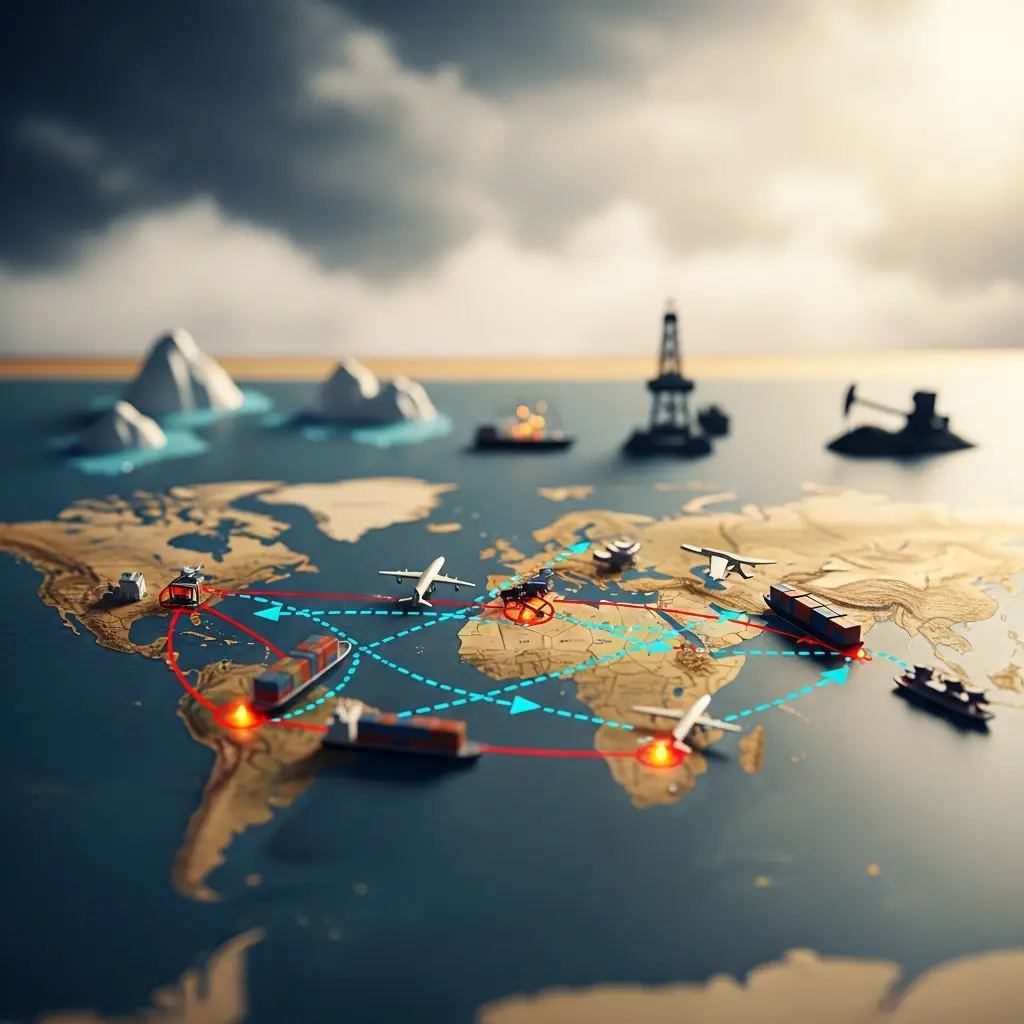
That era of comfortable predictability is now under serious strain. Heightened tensions across the Middle East, particularly the disruption of oil and gas transport through key maritime straits, have made several of these corridors unreliable — or outright hazardous. Shipping companies, which operate on razor-thin margins and depend entirely on route certainty, have been forced to make expensive, complicated choices. Some are rerouting vessels around the Cape of Good Hope, adding thousands of nautical miles and up to two weeks of transit time. Others are paying steep war-risk insurance premiums just to keep existing routes operational.
The bill for all of this — unsurprisingly — does not stay on the shipping company’s ledger. It moves through the supply chain, from manufacturer to distributor to retailer, and eventually lands exactly where it always does: with the consumer.
Freight Costs Are Climbing — and Businesses Are Feeling It
The numbers tell a blunt story. Freight costs on several major trade corridors have risen sharply in recent months, reversing the gradual easing that followed the worst of the post-pandemic logistics crunch. Spot rates — the prices shippers pay for cargo space on short notice — have surged on routes connecting Asia to Europe and the Middle East to global markets. For businesses that depend on just-in-time logistics, where inventory arrives only when it is needed, these increases are not just inconvenient. They are structurally destabilizing.
Small and medium-sized enterprises are absorbing the sharpest pain. Large multinationals often have long-term contracts and diversified logistics networks that provide some buffer against short-term shocks. Smaller businesses — a furniture importer in Germany, a textile exporter in Bangladesh, an electronics retailer in Brazil — typically do not have that luxury. They are paying spot rates in a volatile market, renegotiating contracts with suppliers who are themselves under pressure, and trying to explain to customers why prices are rising again when they only just stopped rising.
“Every week there’s a new variable we’re trying to price in,” said one logistics manager at a mid-sized European manufacturing firm. “It’s not just the freight cost — it’s the uncertainty. You can plan around higher costs. You can’t plan around not knowing whether your shipment will arrive at all.”
The Search for Safer Ground: Alternative Routes and New Alliances
Faced with an increasingly unreliable maritime landscape, several countries and trading blocs are accelerating plans to develop alternative trade routes that reduce exposure to high-risk regions. The International North–South Transport Corridor, connecting India through Iran and Russia to Europe, is being studied with renewed urgency — even as the geopolitical complexity of routing goods through sanctioned territories adds its own layer of risk. Overland rail corridors across Central Asia, long discussed but slow to develop, are suddenly attracting serious investment attention.
For many nations in Asia, Africa, and Latin America, the disruption of existing global trade routes has also reignited conversations about regional trade self-sufficiency — building deeper intra-regional supply chains that are less vulnerable to events unfolding thousands of miles away. It is an appealing idea in theory, but decades of globalized production have created dependencies that cannot be unwound quickly or cheaply. The factories, the ports, the infrastructure — all of it was built around a particular model of global logistics that is now, suddenly, looking much more fragile than anyone anticipated.
Supply Chains Are Not Just a Business Problem Anymore
Perhaps the most important shift happening beneath the surface of this shipping crisis is a change in how governments think about supply chains. For years, logistics was treated as a private-sector concern — something companies managed, optimized, and were responsible for when things went wrong. The pandemic began to change that perception. The current disruptions may cement the transformation entirely.
Governments across Europe, Asia, and North America are increasingly treating supply chain security as a matter of national interest — right alongside energy security and food security. Strategic stockpiling, domestic manufacturing incentives, and bilateral agreements to secure critical supply corridors are all being pursued with a seriousness that would have seemed excessive just five years ago. The lesson being absorbed, slowly and at considerable cost, is that the efficiency gains of hyper-globalized supply chains come with a vulnerability that becomes painfully visible the moment something goes wrong.
Bracing for a New Normal
Businesses worldwide are bracing — a word that keeps appearing in analyst reports and boardroom conversations, and that carries within it a quiet admission that no one is quite sure what is coming next. Delays are expected. Increased operational costs are being built into forecasts. Contingency plans that were once treated as worst-case scenarios are being dusted off and treated as live possibilities.
The deeper truth is that global trade — the vast, intricate system that delivers morning coffee from Ethiopia to a café in London, semiconductors from Taiwan to a car factory in Ohio, medicine from India to a hospital in Kenya — has always depended on a kind of background stability that most people never think about. Right now, that background is anything but stable, and the consequences are beginning to reach every corner of the global economy.