
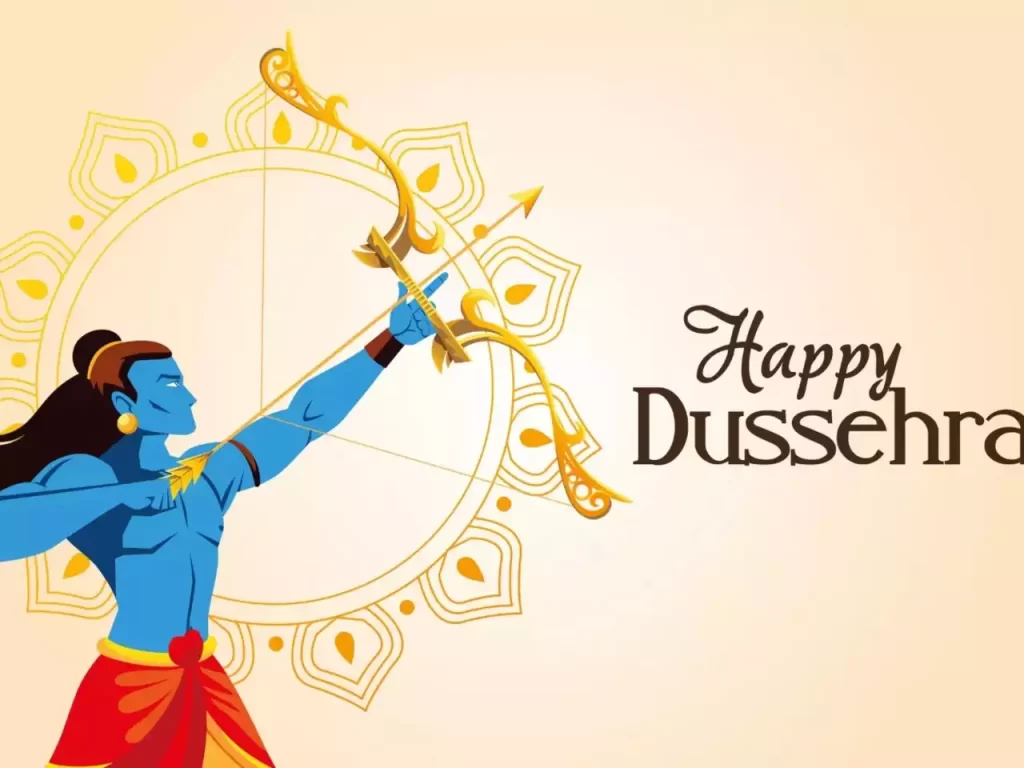
Dussehra, also known as Vijayadashami, is one of the most celebrated festivals in India, symbolizing the eternal victory of good over evil. Rooted deeply in ancient Hindu traditions, the festival draws its significance from sacred texts such as the Ramayana and the Vedic scriptures. It commemorates two legendary triumphs — Lord Rama’s victory over Ravana and Goddess Durga’s conquest of Mahishasura — each carrying profound spiritual and moral meanings.
Lord Rama’s Victory Over Ravana
The story of Lord Rama’s victory is chronicled in the ancient Sanskrit epic Ramayana. Ravana, the ten-headed demon king of Lanka, abducted Sita, the wife of Lord Rama. To rescue her and restore righteousness, Rama — an incarnation of Lord Vishnu — embarked on a fierce battle. Alongside his brother Lakshmana and the devoted Hanuman, Rama waged war against Ravana, ultimately defeating him after an intense struggle.
This victory symbolizes the triumph of dharma (righteousness) over adharma (evil). Dussehra marks the day when Lord Rama restored moral order by ending Ravana’s reign of terror. Across India, this story is celebrated through Ramlila — dramatic enactments of the Ramayana, culminating in the burning of Ravana effigies, symbolizing the destruction of evil forces.
Goddess Durga’s Triumph Over Mahishasura
Parallel to Lord Rama’s story is the legend of Goddess Durga’s victory over Mahishasura, which is narrated in the Devi Mahatmya, a part of the Markandeya Purana. Mahishasura, a shape-shifting demon, brought devastation to both earth and heavens. Unable to defeat him, the gods combined their divine powers to create Goddess Durga, the embodiment of supreme power (Shakti).
Durga fought Mahishasura for nine days and nights, culminating on the tenth day when she vanquished the demon. This victory is celebrated as Dussehra, representing not only the destruction of evil but also the power of the divine feminine and the assurance that righteousness will always prevail.
Cultural Significance Across India
Dussehra is celebrated with great enthusiasm throughout India, with regional variations highlighting different aspects of these legends. In northern India, the festival is marked by grand Ramlila performances, re-enacting Lord Rama’s battle with Ravana. Communities gather to witness the dramatic culmination where effigies of Ravana, Kumbhkaran, and Meghnad are burned, signifying the obliteration of evil.
In eastern and southern India, Dussehra is observed as part of Durga Puja, celebrating Goddess Durga’s victory. Elaborate pandals (temporary temples) are erected, idols of the goddess are worshiped for nine nights, and the festival concludes with immersion ceremonies in rivers and water bodies, symbolizing her return to the divine realm.
Modern-Day Observances and Significance
Today, Dussehra transcends its mythological origins to become a festival of cultural unity and moral reflection. Devotees perform rituals such as Shami Puja, Aparajita Puja, and exchange leaves of the Shami tree as a symbol of good luck and victory. Beyond religious observances, the festival inspires theatrical art forms, folk performances, and community gatherings that preserve cultural heritage.
Ultimately, Dussehra is a reminder that righteousness, courage, and truth will always triumph over evil. Whether through Lord Rama’s valor or Goddess Durga’s divine strength, the festival continues to inspire generations, reinforcing timeless values embedded in India’s cultural and spiritual fabric.

