
When a Smile Becomes the Most Disturbing Confession A chilling case that shook Madhya Pradesh and raised troubling questions about love, obsession, and the darkness that can hide behind a human face. There are moments in a crime case that stop you cold — not the violence itself, but what comes after. The silence. The indifference. Or worse, the smile.
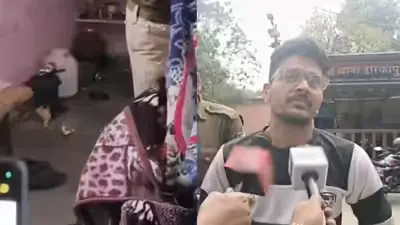
When Indore police paraded 24-year-old MBA student Piyush Dhamnodia before the media after his arrest in Mumbai, reporters did what reporters always do. They asked the obvious question: Why did you do it? What they got back was not guilt, not tears, not even defiance. What they got was a grin — wide, casual, almost amused — as if someone had just told him a mildly funny joke. That image, that smile, is what the people of Indore cannot seem to shake.
A Relationship That Looked Like Many Others
Piyush and his girlfriend — an MBBS student, his classmate — had been together since September. By all outward appearances, they were a young couple with plans. They were in love, or at least something that looked like love. They had even talked about marriage. But families, expectations, and suspicion had been quietly eating away at the relationship for months.
Piyush had grown increasingly convinced that she was in contact with another man. That suspicion — unverified, festering — became a poison inside him. Arguments grew more frequent. The relationship that had once felt like a future started to feel like a threat to him.
On February 10, something snapped.
Inside his rented flat in the Dwarkapuri area of Indore, a dispute broke out. What exactly was said, what final words passed between them, only Piyush knows. What we know is how it ended: he strangled her with a rope.
She was 24 years old.
What He Did Next Is Hard to Process
If the murder itself was horrifying, what followed was something that pushed the case into genuinely disturbing territory. After killing her, Piyush did not call for help. He did not panic and run. He left the flat, reportedly drank alcohol, and then returned.
Police say he then sexually violated her body.
He locked the flat and fled to Mumbai — first to Panvel, then to Nalasopara — where he reportedly performed tantric rituals, attempting to communicate with her spirit using a scarf, vermillion, and bangles. He had watched videos online to learn the rituals.
And before any of that — before leaving Indore — he had already used her mobile phone to send intimate videos of the two of them to their college WhatsApp group. Not out of grief. Not out of confession. Apparently, to defame her even in death.
Her family reported her missing on February 11. Three days later, neighbours noticed a foul smell coming from the flat. Police recovered her body, wrapped in a blanket, with marks clearly visible on her neck. Piyush was arrested in Mumbai’s Andheri area on February 14.
And then came the smile.
What Does a Smile Like That Mean?
Psychologists and criminologists often talk about a concept called “emotional detachment” — a psychological state where a person has so thoroughly disconnected from the consequences of their actions that normal human responses like remorse or fear simply do not surface. Some killers smile not because they are proud, but because they genuinely cannot access the emotional register the situation demands.
Others smile as a form of control — a final act of power over a situation where they have already lost everything.
Then there are those who smile because they believe, at some level, that they were justified. That she deserved it. That the world does not understand what they went through.
None of these explanations comfort us. None of them should.
What that smile communicated to millions of people watching the video clip circulate on social media was something far simpler and far more disturbing: He doesn’t care. And that might be the most frightening thing a human being can show you.
The Bigger Picture We Cannot Ignore
This case did not happen in a vacuum. India has been grappling with a disturbing pattern of intimate partner violence — cases where suspicion, jealousy, and the entitlement some men feel over women they are in relationships with turns deadly. The phrase that keeps appearing in case after case is chilling in its ordinariness: he suspected she was talking to someone else.
That suspicion — even if true — is not a motive. It is not an explanation. It is not a justification. It is a warning sign that we, as a society, have repeatedly failed to recognize early enough.
Piyush was an MBA student. Educated. Urban. Living independently. He was not some caricature of a criminal. He was someone’s classmate, someone’s son. He spoke the same language, used the same apps, lived in the same world as the rest of us.
And yet.
She Deserves More Than a Headline
In the rush to understand the psychology of the killer — the smiling face, the bizarre rituals, the cold calculation — it is easy to lose sight of the person who actually matters most here: the young woman who came to Indore to study medicine, who fell in love, who had a life and a future and a family waiting for her.
She was not just a victim in a crime story. She was a daughter. A student. A person who had done nothing wrong except trust someone she loved.
Her name deserves to be remembered with dignity. Her story deserves more than being an appendage to his.
A City Still Processing the Shock
Indore — a city proud of its cleanliness rankings and its reputation as one of India’s most liveable urban centers — has been left deeply unsettled. The case has sparked conversations in colleges, in homes, and on street corners about what it means to be in a relationship today, about what signs go unnoticed, about what it says about us that a young man could do this and then smile about it.
The investigation continues. The courts will take over. Justice, hopefully, will follow.
But that smile will linger. It will linger because it asks us a question we do not have a clean answer to: How do we build a society where this stops happening?
Until we answer that honestly — not with outrage that fades in a week, but with real change in how we raise boys, how we talk about relationships, how we respond to warning signs — cases like this will keep coming.
And somewhere, someone will smile again.

