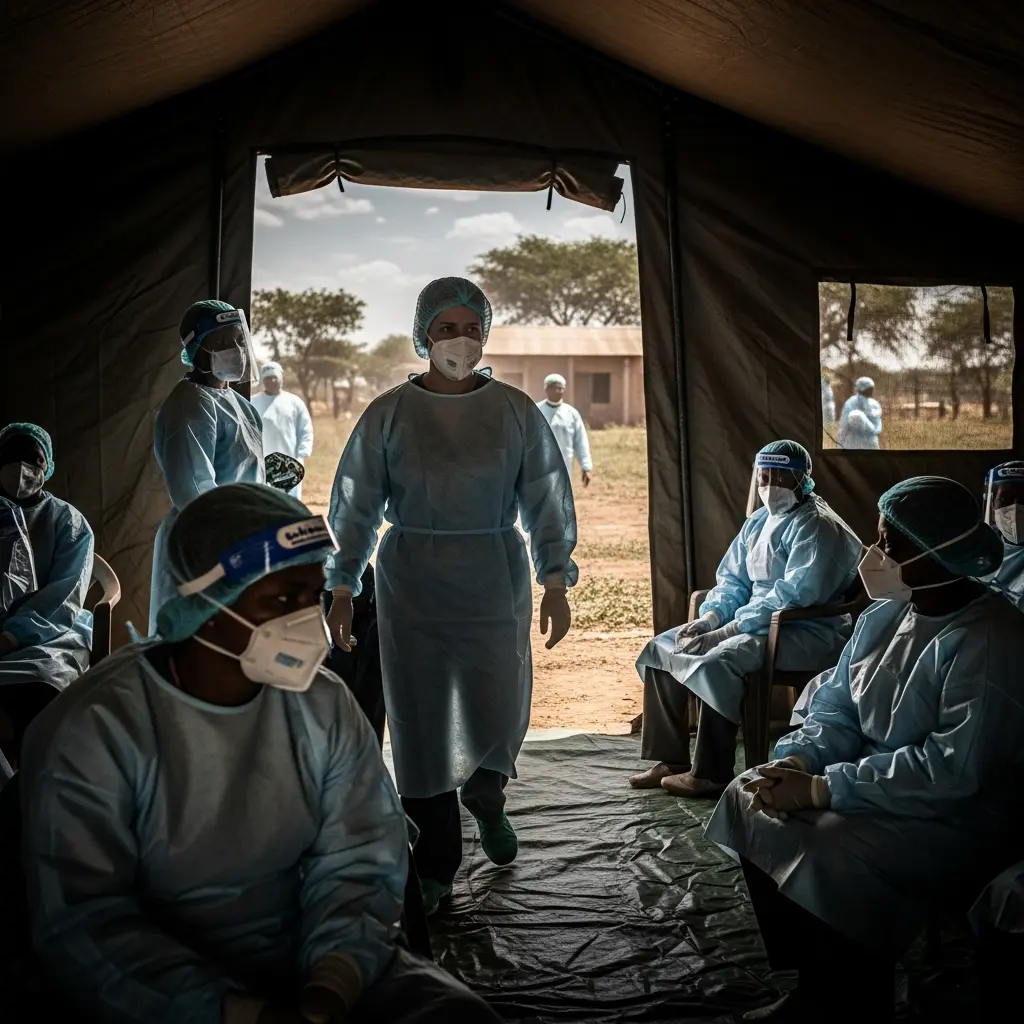
As fresh Ebola cases emerge in parts of Africa, international health agencies are once again mobilizing resources, racing against a disease that kills swiftly and spreads through the most human of acts — touch, care, and grief.
Ebola does not announce itself gently. It begins with a fever that feels like any other — a headache, some muscle ache, the kind of tiredness that sends a person to bed expecting to feel better by morning. What follows, for too many people, is a rapid and devastating cascade of symptoms that distinguishes this virus from almost anything else the human body can face. And now, once again, it has appeared in communities across parts of Africa, setting off the familiar, urgent machinery of international public health response.
The current outbreak has drawn the attention of the World Health Organization, the Africa Centres for Disease Control and Prevention, and a network of international partners who understand from hard experience what it means to respond slowly to Ebola. Health workers are being deployed. Contact tracing operations have begun. Isolation centers are being prepared. Vaccination campaigns, made possible by hard-won scientific breakthroughs developed in the aftermath of the catastrophic 2014–2016 West Africa epidemic, are under way in affected regions.
“Ebola thrives in the gaps — gaps in healthcare systems, in surveillance capacity, in the trust between communities and the institutions meant to protect them.”
What makes Ebola so uniquely difficult to contain is not merely its lethality, though its case fatality rate — which can reach as high as 90 percent in some strains, depending on the outbreak and the quality of medical care available — is alarming enough. The real challenge lies in the conditions under which it spreads. Ebola is transmitted through direct contact with the bodily fluids of infected individuals, including people who have died. In communities where washing and preparing the bodies of loved ones is a sacred and deeply communal ritual, the virus finds pathways that are bound up with the most intimate expressions of human love and loss. Changing those practices requires not just information, but genuine trust — and trust, in communities that have historical reasons to be skeptical of outside intervention, takes time that an outbreak often does not allow.
The vaccine breakthrough
The rVSV-ZEBOV vaccine (Ervebo), developed by Merck and approved by the FDA in 2019, marked a historic turning point in Ebola response. Deployed using a ring vaccination strategy — immunizing contacts and contacts of contacts of confirmed cases — it proved highly effective in the 2018–2020 DRC outbreak. Its existence has fundamentally changed what an Ebola response looks like today compared to a decade ago.
The international public health system has learned painful lessons from previous outbreaks. The 2014–2016 epidemic in Guinea, Sierra Leone, and Liberia — the largest Ebola outbreak in history — killed more than 11,300 people and exposed catastrophic weaknesses in both national health infrastructure and the global response architecture. The WHO was widely criticized for the slowness of its initial reaction. The world watched, largely helpless, as the virus spread through communities and across borders in ways that earlier, smaller outbreaks in more isolated settings had not.
From that tragedy came significant investment: in surveillance systems, in rapid response capacity, in vaccine research, and in community engagement strategies that prioritize listening over lecturing. Whether those investments are sufficient is now being tested again.
WHO response
Deploying rapid response teams, supporting national health ministries with logistics, laboratory capacity, and coordination across the affected region.
Vaccination strategy
Ring vaccination campaigns targeting confirmed contacts using approved vaccines, with cold-chain logistics deployed to reach remote communities.
· · ·
For global health observers, the recurring nature of Ebola outbreaks speaks to something deeper than the virus itself. The Democratic Republic of Congo — which has experienced more Ebola outbreaks than any other country — also lives with chronic underfunding of its health system, decades of political instability, and active armed conflict in some of the regions where Ebola tends to appear. Responding to an infectious disease outbreak in a conflict zone, where health workers face genuine physical danger and displaced populations make contact tracing nearly impossible, is an entirely different order of challenge from a textbook epidemic response.
The global health security community has long argued that the world invests far too little in the foundational infrastructure — trained healthcare workers, functioning laboratories, reliable disease surveillance, and community health networks — that would allow countries to detect and contain outbreaks before they become emergencies requiring international intervention. Each time Ebola reappears, it makes that argument again, more forcefully, in the lives of the people it takes.
There is also the question of international attention and resources. The world has a well-documented tendency to mobilize around health crises and then rapidly lose interest once the immediate threat appears to recede. The funding commitments made in the aftermath of the 2014–2016 epidemic faded faster than the reforms they were meant to support. The pattern risks repeating.
“Every Ebola outbreak is, in part, a referendum on how seriously the world takes the health of its most vulnerable communities between emergencies.”
For now, the focus is on containment. Health authorities in affected countries are working alongside international partners to identify cases, trace contacts, isolate patients, and vaccinate those most at risk. The tools available today — approved vaccines, better protective equipment for health workers, improved clinical care protocols — represent genuine progress. But tools alone do not end outbreaks. The human work of building trust, earning cooperation, and sustaining presence in communities over weeks and months is what ultimately determines whether Ebola is stopped or whether it spreads.
The world is watching again. The question, as it has always been with Ebola, is whether it is watching long enough — and investing deeply enough in the places and the people that need it most — to make the difference before the next outbreak begins.