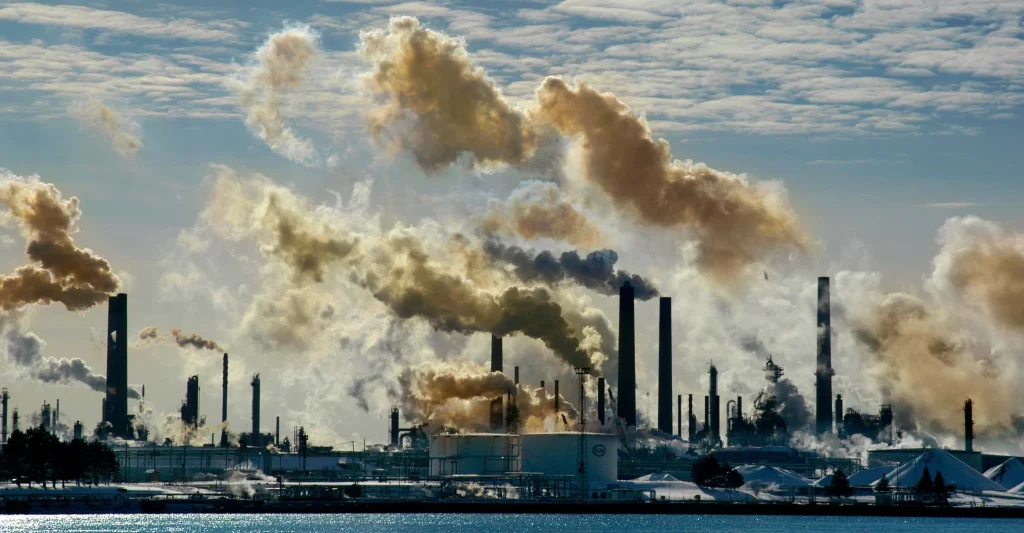
The World Health Organization reports that air pollution kills more than 7 million people every year. This shows that there is still a health crisis going on all across the world that has to be fixed right away. This many deaths shows how bad the threat is, even if it’s not clear, and how it affects billions of people all over the world.
How bad the problem is
The World Health Organization states that every few seconds, someone dies because of bad air quality. The main reason is PM2.5, which are very small particles in the air. These tiny particles can penetrate into the lungs and blood, which can cause cancer, lung disease, and heart disease. Rapid urbanization and industrial growth impact countries with low and moderate incomes the most. This affects people who are already weak, such kids under five and old people.
In places like South Asia and sub-Saharan Africa, air pollution and pollutants from within the home, like cooking with solid fuels, mix together, which makes people more vulnerable. The World Health Organization (WHO) says that 99% of people in the world breathe in air that is excessively polluted. Over the years, this number hasn’t changed much. This disease kills people and costs the economy trillions of dollars every year in lost income and medical bills.
Health effects that are clear
Being around dirty air for a long period can create a lot of health concerns, such asthma attacks, strokes, and lung cancer. The World Health Organization (WHO) says that air pollution causes 25% of all lung disease deaths and 29% of all lung cancer cases in the world. Being around it affects kids’ lungs grow less, and this effect lasts until adulthood. Women who are pregnant and are around a lot of PM2.5 are more likely to have babies that are too small or too early. This keeps the cycle of being weak going.
Lung illnesses, like chronic obstructive pulmonary disease (COPD), contribute more than 40% of deaths caused by pollution.
Effects on the heart: If you live in an area with a lot of pollution, your chances of having a heart attack or stroke go up by 20–30%.
New research suggests that air pollution can make older individuals forget things and make them less smart.
These numbers are horrible, but they are probably low because they don’t tally all the people who are missing in poor countries.
Differences and Hot Spots Between Places
The WHO says that the Eastern Mediterranean and Southeast Asian regions have the highest death rates, with more than 1.5 million deaths each year. Traffic jams, brick kilns, and burning farm waste are just a few of the reasons that make cities like Lahore, Dhaka, and Kolkata go 10 to 15 times over the PM2.5 limit. But since 1990, high-income countries have lowered the number of deaths in half by limiting the sale of certain commodities. But flames and pollution that cross borders are new problems.
India is to accountable for the fact that air pollution kills 21% of all persons in the world. The National Clean Air Program intends to clean up 131 communities, but it’s not easy to get the laws to operate. The “war on pollution” in China has worked; since 2013, PM2.5 levels in Beijing have reduced by 40%. This is a great example for other countries to follow. These differences show how important it is to have treatments that are fair and work for each situation.
What it means for society and the economy
The world’s bad air quality costs more than $8 trillion a year, or 6.1% of its GDP. This includes medical expenditures, time off work, and fatalities that happen too soon. Farming and industry are the two areas that lose the most jobs. persons who work in dirty settings make 10 to 15 percent less than persons who work in clean places. People who live in low-income neighborhoods can’t go to parks or air filters since they are close to highways and industrial. This makes issues in society worse.
The effects are significantly worse because of how men and women get along. For example, women in developing nations are at a higher risk of getting COPD since they breathe in smoke for hours every day. Kids miss school when pollution levels are high, which makes their education even worse. Because of these ripple impacts, health, environmental, and development policies need to work together.
Responses to Global and Policy Efforts
The World Health Organization (WHO) says that the yearly limit for PM2.5 is 5 micrograms per cubic meter in its Global Air Quality Guidelines for 2021. There are only a handful places in the world that fit this condition. The UN’s BreatheLife initiative is only one of many that helps more than 100 communities keep an eye on things, get people to use clean transportation, and deal with trash. The EU wants to have no pollution by 2030 so that 90% of people can breathe clean air. It does this by offering people incentives and penalties.
Electric cars have to follow strict standards in Norway and China that have helped make cities less polluted. India intends to utilize fuel that is 20% ethanol to cut down on the waste that comes from farming. There are other worries, such fossil fuel firms lobbying and the fact that 95% of low-income countries don’t have real-time sensors, so the data isn’t complete. [web::1]
There are new technologies coming out.
There is optimism since there are new techniques to clean the air. For example, there are cheap sensors that let communities keep an eye on the air and AI-powered apps that let people know when levels rise. Electrostatic precipitators can easily get rid of 99% of particles, and trees and green roofs in cities naturally filter PM2.5. New carbon capture technology might stop firms from creating goods, but for now it costs too much to use on a wide scale.
Biotech solutions like genetically modified bacteria that eat up toxins look good in the lab, but they aren’t being used in the real world yet. Satellites can now find PM2.5 all around the world with 80% accuracy. This means that rules can be followed from far away. These tools, together with changes in behavior like carpooling, could help things go along faster.
What Experts Say About Voices from the Frontlines
Dr. Maria Neira, WHO’s Environment Director, adds, “Air pollution is a silent killer, but we can stop it with methods that have worked before.” She also talks about cost-benefit ratios that show that investing $1 on health saves $30. “The way monsoons and pollution interact in South Asia is different from anywhere else,” says Dr. Kalpana Balakrishnan, an epidemiologist. “We need models that are specific to the region.””Sonam Wangchuk and other activists in India who are against climate change say that the air quality is linked to bigger issues of justice and encourage people to take action from the bottom up.
These viewpoints regard air pollution not as an unavoidable phenomenon but as a challenge amenable to resolution via political resolve and ingenuity.
How to Clean Up the Air
The IPCC believes that we need to cut our usage of fossil fuels in half by 2030 to save 7 million lives that happen too soon. Here are some important things to do:
Stopping coal plants and transitioning public transportation to electric.
Giving 2 billion people money to buy stoves that don’t pollute the air.
Always check that the air quality indexes on public dashboards are up to date.
The US-China clean energy deal indicates that pollution that crosses borders needs a coordinated response. Local successes, such as London’s Ultra Low Emission Zone decreasing NOx by 44%, show that it is possible to do so on a bigger scale.
Things That Aren’t Going Right
Political delays and the global reliance on coal subsidies cost $1 trillion a year and slow down progress. individuals can break the rules in informal sectors since there aren’t enough individuals to make sure they follow them. The infrastructure of megacities has to work harder as they get bigger. The outbreak showed us that lockdowns can help clear the air for a short period, but the system needs to change for the long run.
There are big worries about fairness because pollution hurts the Global South while emissions from the North’s past influence the weather. We need climate reparations and the sharing of technologies to make this happen.
The World Health Organization believes that every year, air pollution kills 7 million people too soon.