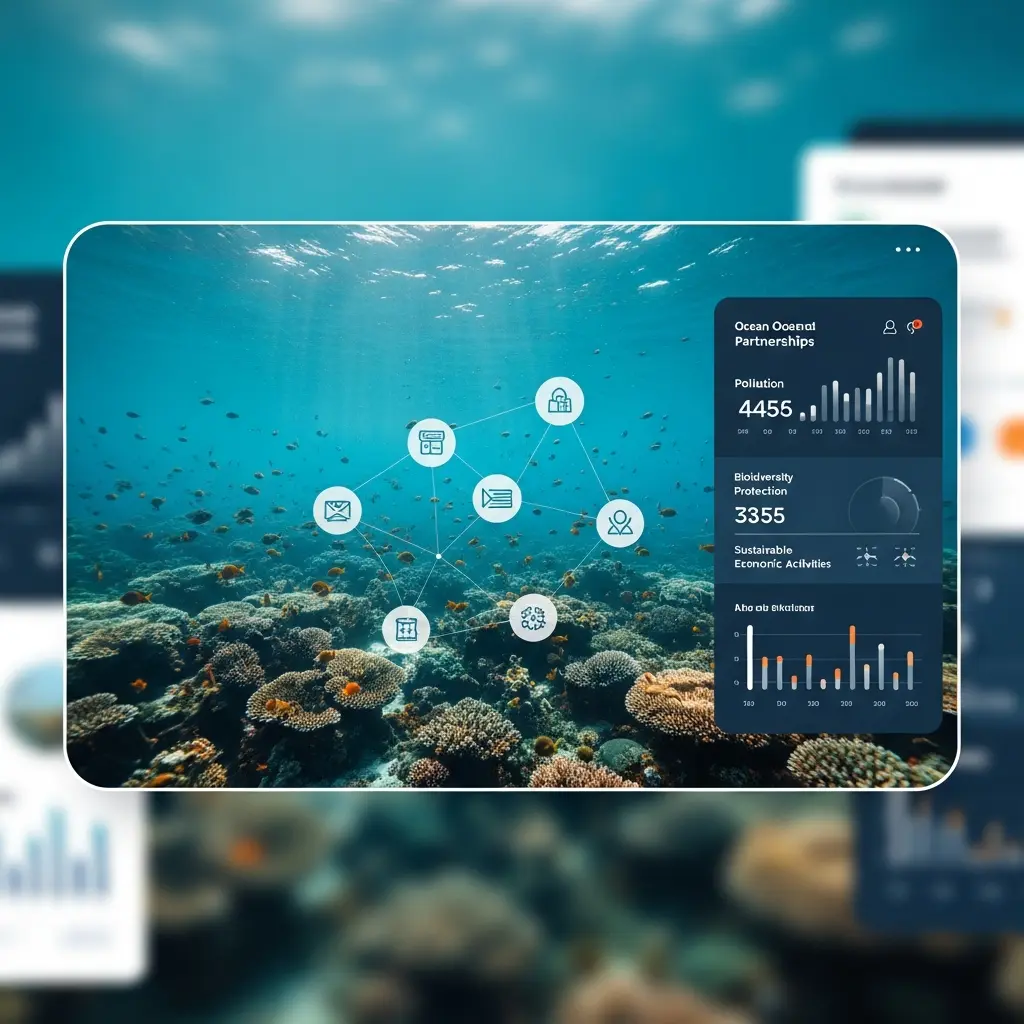
Governments and scientists around the world are working together as never before to protect what is under the waves, from the Arctic to the Coral Sea. But good intentions alone won’t be enough to turn the tide.
71% Of Earth’s surface covered by ocean
3B+ People rely on oceans for food & income
~50% Of Earth’s oxygen produced by marine life
The ocean has always been patient. For decades it absorbed the worst of what the world threw at it — plastic, carbon, chemical runoff, overfishing — with a kind of quiet, tidal endurance. But patience has limits, and the ocean has been telling us it has reached them for some time now. The question is whether humanity is finally ready to truly listen.
By most indications, 2026 is shaping up as a year when the answer shifts — cautiously, imperfectly, but meaningfully — toward yes. Governments and international organizations are deepening their cooperation on ocean conservation at a pace that environmental experts say has no real precedent. The diplomatic machinery that once struggled to agree on even basic frameworks for marine protection is now generating concrete commitments, binding agreements, and shared monitoring infrastructure that would have seemed ambitious just a decade ago.
What has changed — and why now
The acceleration of international collaboration on marine protection is not accidental. It is being driven by a convergence of crisis signals that have become impossible for policymakers to ignore. Coral bleaching events are occurring with greater frequency and severity. Fishery collapses in key commercial zones are threatening both biodiversity and the livelihoods of coastal communities across Africa, Southeast Asia, and Latin America. Microplastic contamination has been found in the deepest ocean trenches and in the bloodstreams of marine mammals that entire ecosystems depend upon.
Climate action and ocean health are now understood to be inseparable. The ocean absorbs roughly a quarter of all human carbon dioxide emissions each year, and more than 90 percent of the excess heat generated by global warming. That extraordinary service — performed silently, without acknowledgment or compensation — is being paid for in ocean acidification, rising sea temperatures, and the disruption of the marine food chains that billions of people depend upon for nutrition and income.
“Protecting the ocean is not an environmental luxury — it is the foundation of food security, climate stability, and the economic survival of coastal nations.”
Recent multilateral discussions have placed pollution reduction, biodiversity protection, and sustainable ocean economies at the center of the agenda. The framing matters: conservation is no longer being presented purely as an ecological obligation but as an economic and security imperative. That shift in language has unlocked new constituencies — finance ministries, trade bodies, and development banks — that previously sat on the sidelines of marine protection debates.
The biodiversity question at the heart of it all
One of the most significant threads in current international negotiations concerns biodiversity — specifically, what share of the ocean should be placed under formal protection to give marine ecosystems a fighting chance to recover and adapt. Scientists have converged around a target of protecting at least 30 percent of the world’s oceans by 2030, a goal that has now been adopted in principle by a large and growing coalition of nations.
The gap between adoption in principle and implementation in practice, however, remains wide. Designating a marine protected area on paper is far easier than enforcing it against illegal fishing fleets, establishing functioning monitoring networks across thousands of square kilometers of open ocean, or resolving the competing claims of coastal communities whose traditional livelihoods depend on access to those same waters.
Fisheries under pressure
Over one-third of global fish stocks are harvested at biologically unsustainable levels, threatening long-term food security.
Plastic pollution Some 8–10 million metric tons of plastic are estimated to be entering the ocean each year, with long-term impacts on marine biodiversity. Ocean warming Recent years have seen record levels of sea surface temperatures, bleaching coral reefs and disrupting migration patterns. Blue economy potential Sustainable ocean industries, from aquaculture to offshore wind, could generate trillions of dollars of economic value if responsibly managed. The promise of sustainable ocean economies Perhaps the most heartening development in recent international discussions is the growing recognition that sustainability and economic vitality are not opposites. The notion of a “blue economy” — sustainable economic activity linked to oceans, from responsibly managed fisheries and marine aquaculture to offshore renewable energy and ocean-based tourism — has moved from niche academic discussions into the mainstream of economic planning.
It is of particular interest to developing countries with extensive coastlines and exclusive economic zones. For many of them the ocean is a huge asset but one that has been historically exploited by richer countries through distant-water fishing fleets and extractive industries. New international frameworks that empower coastal states with stronger tools to manage and benefit from their marine resources represent a meaningful shift in the equity dynamics of ocean governance.
Good intentions meet hard realities
Environmental experts are cautiously optimistic but clear eyed about the gap between where international cooperation is today and where it needs to get to. Pledges and frameworks matter — but oceans don’t recover on the basis of declarations. They recover when fishing pressure actually drops, when plastic actually stops flowing into waterways, when carbon emissions actually fall at the pace that marine ecosystems need.
The encouraging signal of 2026 is that the conversation has genuinely matured. More governments understand the science. More finance institutions are pricing ocean risk into their models. More citizens — especially younger generations who have grown up watching documentaries about dying reefs and plastic-filled seas — are demanding accountability from their leaders.
The ocean has been patient. It may have just enough of that patience left for the world to get this right — if the momentum of this moment is not allowed to drift away like foam on a receding tide.
The world is finally listening to the ocean – now comes the hard work.