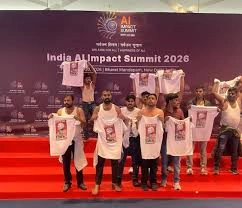
Activists from the Youth Congress attacked an international AI conference, which caused a political firestorm and a lot of arrests in India. The violent fight shows that there is more and more antagonism between the calls for more technology and the demonstrations led by young people.
This AI conference disruption is a clear example of the clash between India’s goal of becoming an AI superpower by 2030 and the progressive youth movements. People were paying more attention to AI ethics at the time of the event. People who were protesting wanted to stop using AI without rules in areas like surveillance and hiring.
How the Protest Began
The Youth Congress said that their protest was against “AI colonialism” and that the people who put together the summit were placing foreign tech corporations ahead of making jobs in the US. The organization wrote a manifesto called “AI for All, Not Few” before the event, and it received more than 50,000 signatures online. Some of the main complaints were fears of mass unemployment (NITI Aayog reports say that AI could automate 30% of India’s 500 million workers by 2030), issues with data sovereignty (which made people worry that global companies could collect Indian user data without enough local oversight), and unfairness in AI benefits (since rural youth already have 15% unemployment rates and feel left out of tech booms that are centered in cities).
A number of people used the hashtags #StopAISummit and #YouthVsAI to coordinate the protests on social media. These hashtags got 1.2 million impressions in 24 hours. The people in charge indicated that the action was part of bigger Youth Congress events, like past protests against the exploitation of gig workers and the loss of farm jobs to technology. Rahul Mehra declared in a video message after he got out of jail, “We will not let AI summits turn into exclusive parties while our generation pays the price.”
Political Reactions Get Hot
The arrests made people on all sides of India’s political spectrum react quickly and in different ways. Party president Mallikarjun Kharge and other Congress leaders denounced the police raid “heavy-handed suppression of democratic dissent.”At a news conference in Bengaluru, Kharge said, “Youth Congress speaks for millions of people who have been left out by the BJP’s obsession with AI.” Modi’s new normal is to arrest people who love their country and are protesting new ideas that cost employment.
BJP officials, on the other side, dubbed the protests “anti-development anarchy.” Union IT Minister Rajeev Chandrasekhar tweeted, “The Youth Congress is stopping the AI summit that was supposed to help India become a $1 trillion digital economy.”” Their Luddite methods threaten the future of young people in India. The minister talked about government programs including the IndiaAI Mission, which put aside ₹10,000 crore to make ethical AI. He added that the protests were meant to stop the government’s work.
Regional allies spoke out strongly. Shiv Sena (UBT) backed Congress and demanded the courts to look into charges of excessive force. Arvind Kejriwal of AAP said on Twitter that instead of arrests, there should be conversations. He said, “AI progress must include youth voices, not silence them.”Derek O’Brien of the TMC argued that the Center was using the gathering to cover up the rise of a surveillance state using AI. #ReleaseYouthCongress brought together supporters of Congress, the SP, and the DMK. By the end of the day, 15 state Youth Congress units had planned solidarity marches. This made people apprehensive that things would get worse before the budget sessions. Congress firmly supports the protests as a democratic way to draw attention to AI disparities. The BJP calls them anarchy against national progress. The AAP gives them conditional support and stresses discussion over detentions. The Shiv Sena (UBT) strongly supports them but asks for probes into police behavior.
What this means for young people who want to make a difference
People may strike back in a different way because of the protests at the Youth Congress AI summit. The 2026 Census says that 65% of Indians are younger than 35. This indicates that getting young people active in politics could be bad for elections. Congress plans to use this to win the state elections in 2027. They are focusing on young people in cities who lost their jobs because of AI in IT hotspots like Nagpur and Pune.
There could be legal problems: leaders who are held could be charged with sedition, which Amnesty International says is a horrible idea. In the meantime, more and more people are supporting it. A quick poll by Morning Consult shows that 62% of people under 25 favor the freedom to protest.
One of the BJP’s counter-moves is the planned “AI Yuva Sammelan,” which claims to help people learn new skills. But there are still gaps in trust. A Pew survey from 2026 found that 55% of young people don’t accept what the government says about AI.
Expert Opinions and a Look at the Data
People in the industry have various ideas. Debjani Ghosh, who is in charge of Nasscom, claimed that protests hurt foreign direct investment (FDI) and urged for “inclusive AI dialogues.” Dr. Arjun Sengupta, a labor economist, on the other hand, shared some numbers: the World Bank says AI could put 69 million jobs at risk by 2028; McKinsey says only 2.5% of the workforce is ready for AI; and 40% of companies have changed their minds about expanding into India after the protests.
Grand View Research says that the AI market would grow by $17 billion by 2027. According to numbers from Congress, the number of young people who are involved in protests has gone up by 35% since 2025. According to CMIE 2026 data, 23% of graduates are out of work. These data help explain why so many people want to know about Youth Congress detentions.
Summit Highlights in the Middle of a Mess
Things were crazy, but genuine results came out. Microsoft and IndiaAI agreed to work together on AI for rural healthcare for $2 billion. Google has offered to train 1 million AI workers. In a video, PM Modi reiterated again that “AI for Amrit Kaal” is part of the Viksit Bharat aim.
The demonstrators’ main demand is a “Youth AI Bill” that would protect jobs, and more and more people are supporting it. After the protests, laws like the Digital India Act may have rules about ethics.
The Youth Congress protests during the AI Summit generated complications, and the arrests made things worse politically.