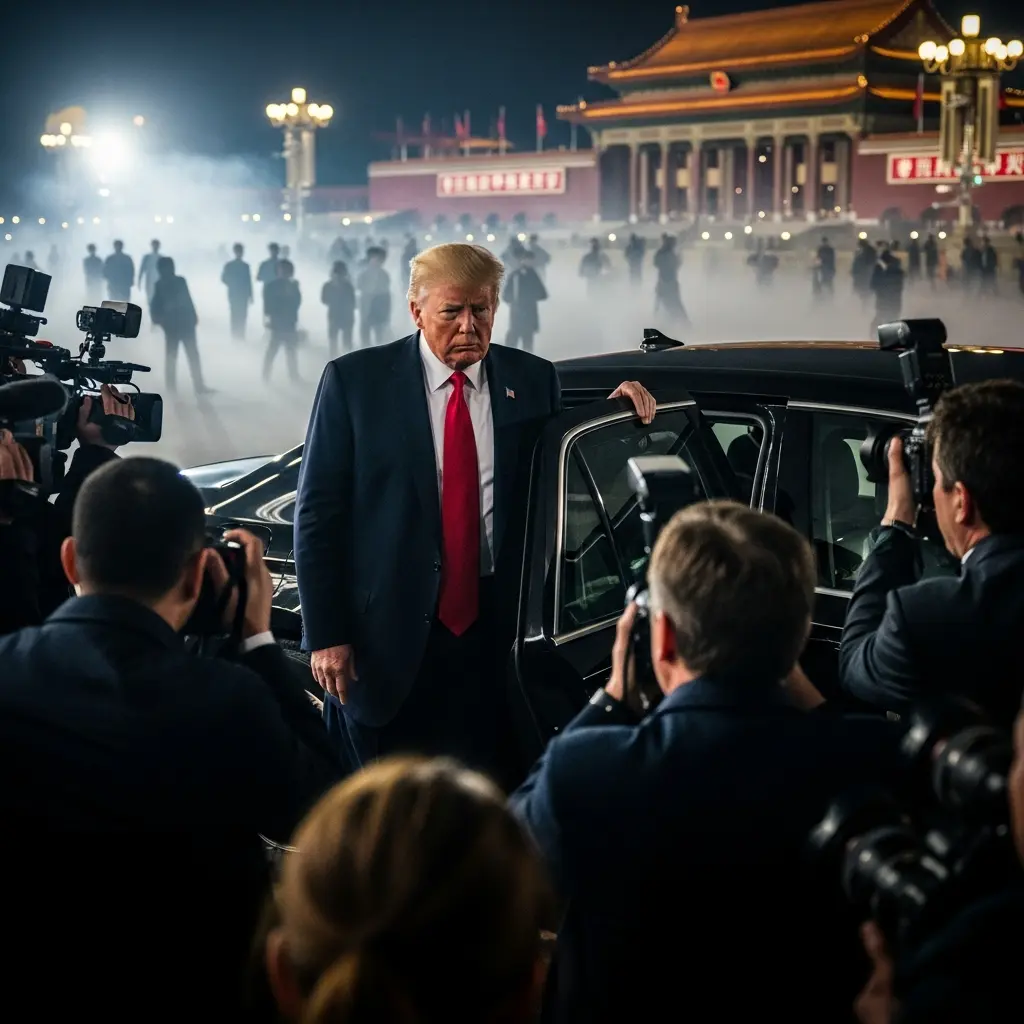
When Air Force One touched down at Beijing Capital International Airport on Wednesday, the world held its breath. President Donald Trump’s arrival in China — his first visit to Beijing since 2017 — wasn’t just a diplomatic photo opportunity. It was the start of what many are calling one of the most consequential summits of the decade, with the future of US-China relations 2026 hanging in the balance.
What made the scene on the tarmac even more striking wasn’t the military honor guard or the rows of Chinese officials lined up to greet the American delegation. It was the company Trump brought with him: Elon Musk of Tesla, Jensen Huang of Nvidia, Tim Cook of Apple — a who’s who of American corporate power, there to help shape a conversation that will ripple across boardrooms and living rooms worldwide.
More Than Just a Trade Trip
On the surface, the Trump China visit is framed around economics — tariffs, manufacturing deals, and semiconductor exports. But anyone watching closely knows the agenda runs far deeper. The Beijing summit is unfolding against a backdrop of geopolitical friction that would have been hard to imagine even a year ago: an ongoing war involving Iran that has spiked oil prices globally, lingering tensions over Taiwan, and a technology rivalry between the two superpowers that shows no sign of cooling.
Trade, though, is where Trump has planted his flag publicly. Before departing Washington, he told reporters he expected “great things” from the meetings, hinting at potential Chinese purchases of American goods — Boeing aircraft, soybeans, and agricultural products. Markets responded with cautious optimism.
For average Americans watching their grocery bills and gas prices rise, these US-China trade talks carry real, everyday heft. The tariff war in 2025 saw some goods hit with tariffs of more than 100 per cent, rattling supply chains and helping to stoke inflation on both sides of the Pacific. A durable deal — or even an extension of the trade truce brokered at last year’s Busan APEC summit — would be a meaningful win for consumers in both countries.
What Beijing Wants
The Chinese side is approaching these talks with clear priorities of its own. Beijing wants the United States to ease restrictions on advanced semiconductor exports — a point that makes the presence of Nvidia’s Jensen Huang particularly symbolic. China has long seen American chip controls as an attempt to cap its technological rise, and Beijing is expected to push hard for relief.
More broadly, Chinese officials see the Beijing summit as a chance to put the relationship on steadier ground. After a turbulent 2025 defined by escalation and retaliation, stability is the goal. As one senior analyst described it, China’s objective is to make the Busan truce last — “anything beyond that is a bonus.”
President Xi Jinping set the tone early in the formal meetings on Thursday, saying that China’s and America’s shared interests “outweigh” their differences. Trump, for his part, was characteristically effusive about his relationship with Xi.
The Ghosts in the Room
No conversation between these two leaders can stay purely economic for long. Taiwan will be discussed — it always is. So will artificial intelligence, where both nations are racing to set the rules of a technology that neither fully understands yet. And hanging over everything is the war involving Iran, which upended the original timeline for this trip and has given China a degree of quiet leverage it didn’t have before.
Beijing’s ties to Tehran, its role as Iran’s largest trading partner, and its potential as a mediator have not gone unnoticed in Washington. Trump acknowledged he’d be having a “long talk” with Xi about Iran, even as he insisted trade would remain the centerpiece.
What makes global diplomacy news around this summit so charged is that the outcomes aren’t just about the two nations sitting across the table from each other. They affect every country whose exports pass through shipping lanes disrupted by the Iran conflict, every factory dependent on a stable semiconductor supply, and every government trying to figure out which way the world’s two dominant powers are leaning.
Why It Matters for the Rest of Us
Geopolitical summits can feel abstract — leaders in suits exchanging words behind closed doors. But the decisions taken in Beijing over these two days will impact the price you pay for electronics, the cost of fuel for your car and the stability of the world economy as we head into the second half of 2026.
The presence of top executives from Apple, Nvidia, BlackRock, Goldman Sachs, Qualcomm, and Meta signals that this isn’t just government business. American corporations have billions at stake in China, both as a manufacturing hub and as a consumer market. They’re not in Beijing to sightsee.
Political observers note that Trump also has domestic motivations for securing visible wins. With midterm elections approaching in November, a splashy trade deal or a large Chinese purchase order would give him a tangible story to tell voters.
Looking Ahead
As Thursday’s meetings stretched into Friday’s working lunch, the world was watching for signals — not just formal agreements, but the tone, the body language, the language used in joint statements. In great-power diplomacy, as one scholar put it, “small words carry large consequences.
” Whether this Beijing summit produces a breakthrough or simply papers over deep structural tensions remains to be seen. But one thing is clear: the era of treating the US-China relationship as a background hum in global affairs is over. It is now the defining dynamic of our time — and what happens in Beijing this week will echo for years to come.
Trump Begins Beijing Visit Amid Global Attention — What’s Really at Stake?