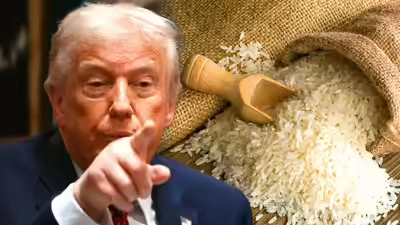
U.S. President Donald Trump has indicated that his administration is considering imposing fresh tariffs on rice imported from India, following intensifying complaints from American farmers who claim that cheaper Indian rice is being “dumped” into the U.S. market. During a White House meeting on December 8, 2025, Trump said the issue would be “taken care of,” adding that tariffs could “solve the problem in two minutes.”
The President’s remarks have sparked renewed tensions in U.S.–India trade relations, already strained by previous rounds of duties imposed on various Indian exports.
American Farmers Raise Concerns Over Low-Cost Imports
For months, rice growers across the U.S. — particularly in southern states — have voiced concerns about declining domestic prices, which they attribute to a surge in subsidized, low-priced rice imported from India and other Asian countries. Industry representatives have warned that local producers are “really struggling” as they face increasing financial pressure and shrinking market competitiveness.
During the White House interaction, Trump referred to a list of countries alleged to be engaging in unfair pricing practices, with India identified as a major contributor. The President also linked the issue to a broader agricultural support plan, highlighting the administration’s intention to safeguard domestic farming interests.
Existing Tariffs and Possibility of New Duties
Indian rice exporters have already been navigating a challenging trade environment. Earlier in 2025, the U.S. implemented a 50 percent duty on several Indian products, including basmati rice. Despite the steep tariff, U.S. farmers maintain that the current measures have not sufficiently curbed the inflow of inexpensive rice imports.
The latest hints of additional, rice-specific tariffs signal a potential escalation, with the administration considering targeted duties that could further constrain Indian exporters. Trade analysts note that new tariffs may influence both raw and packaged rice categories, creating ripple effects across global agricultural markets.
Impact on Indian Exporters and Global Supply Chains
If implemented, the proposed tariffs could significantly affect India’s rice industry, which is heavily reliant on export markets. Companies engaged in basmati and non-basmati rice production may face reduced orders, lower margins, and increased volatility across supply chains.
Potential consequences include:
- Reduced demand from U.S. retailers, prompting exporters to redirect shipments to alternate markets.
- Market instability for Indian rice stocks, with companies likely to see short-term declines.
- Higher prices for U.S. consumers, particularly in areas with strong South Asian and Southeast Asian communities.
- Opportunities for other exporting nations, such as Thailand and Pakistan, to fill potential market gaps in the U.S.
Diplomatic and Trade Implications
The tariff threat surfaces at a delicate period for U.S.–India relations, as both nations work to stabilize trade negotiations following a series of disputes earlier in the year. Additional duties risk triggering retaliatory measures from India, potentially affecting other sectors, from agriculture to technology and services.
Trade experts caution that continued escalation could reshape global rice flows, disrupt international markets, and place pressure on food-dependent communities around the world.