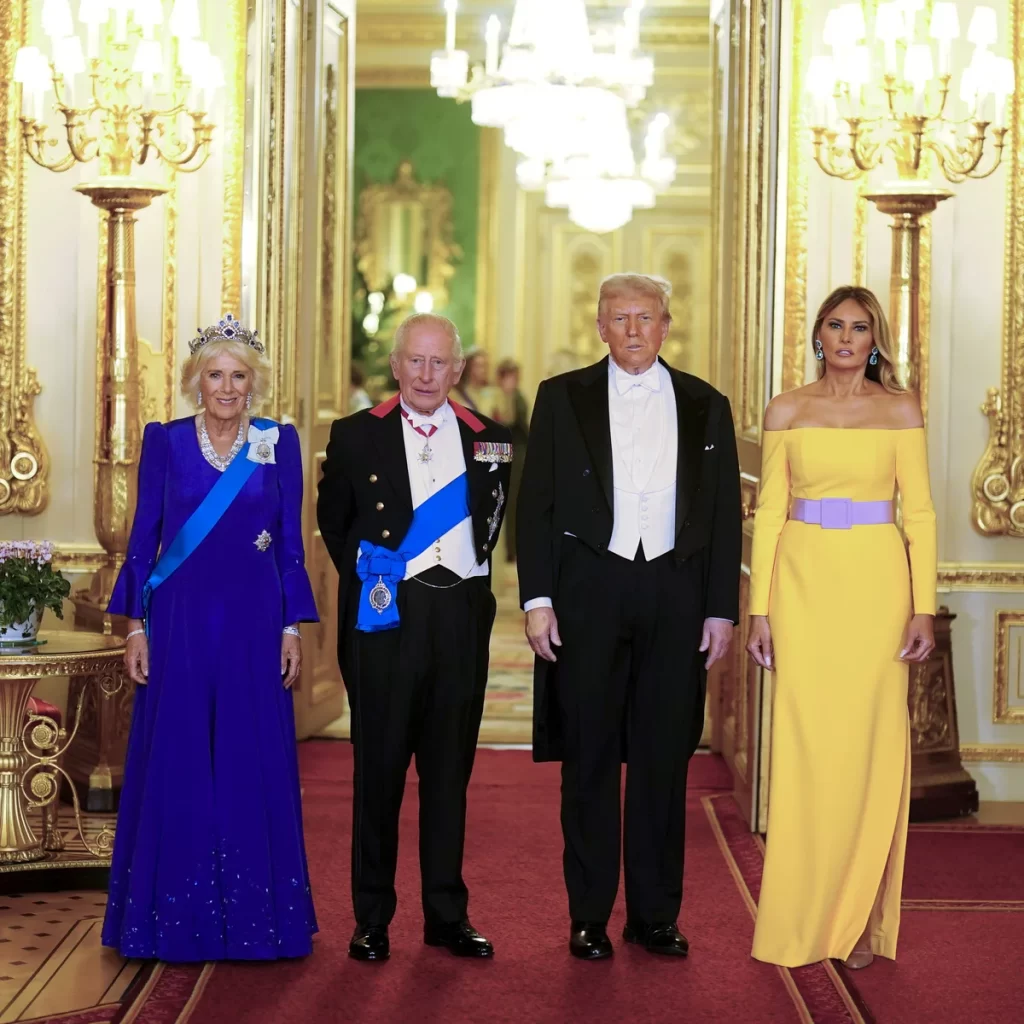
Former United States President Donald Trump arrived in the United Kingdom this week for a state visit that drew both diplomatic attention and public debate. The visit, marked by his meeting with King Charles III, also highlighted Trump’s renewed push to officially classify the anti-fascist movement Antifa as a “terrorist organization,” a proposal that has sparked significant controversy in political and legal circles.
Trump’s arrival in London was met with a mix of ceremony and protest. At Buckingham Palace, King Charles welcomed the former president in a traditional reception that underscored the historic ties between the UK and the United States. The discussions, according to insiders, focused on global security challenges, trade partnerships, and the evolving dynamics of transatlantic cooperation. The meeting was seen as an important gesture of diplomacy, even though Trump is no longer in office, reflecting his continued influence on international politics.
Outside the palace gates, demonstrations erupted as critics of Trump expressed opposition to both his policies and his rhetoric. Protests were particularly fueled by his latest remarks on Antifa, which he described as a destabilizing force. Trump reaffirmed his commitment to designating the movement as a terrorist entity, claiming that such a step was essential to national security and public safety.
Antifa, short for “anti-fascist,” is not a centralized organization but rather a loosely affiliated network of activists and groups. Critics of Trump’s stance argue that labeling it a terrorist organization would be legally complex and politically motivated, potentially targeting dissent rather than addressing legitimate threats. Civil rights organizations have voiced concerns that the move could infringe on freedoms of speech and assembly.
In the UK, Trump’s remarks also drew scrutiny from lawmakers and analysts, with some suggesting that the rhetoric could strain diplomatic relations if framed as an attempt to influence allied nations’ domestic security policies. British officials, however, maintained that the state visit was primarily a symbolic reaffirmation of the “special relationship” between the two nations.
Political observers note that Trump’s visit serves a dual purpose: reinforcing his role on the international stage while bolstering his image among supporters back in the United States. With a potential return to the presidential race on the horizon, Trump’s foreign engagements are being closely watched for their impact on his political narrative.
As the state visit concludes, questions remain about the implications of Trump’s call to categorize Antifa as a terrorist group. While unlikely to gain traction in the UK, the proposal continues to resonate in American political discourse, where debates over security, civil liberties, and ideological extremism remain highly polarized.
The visit underscored the enduring visibility of Trump in global politics, as well as the complexities of balancing ceremonial diplomacy with contentious political agendas.