
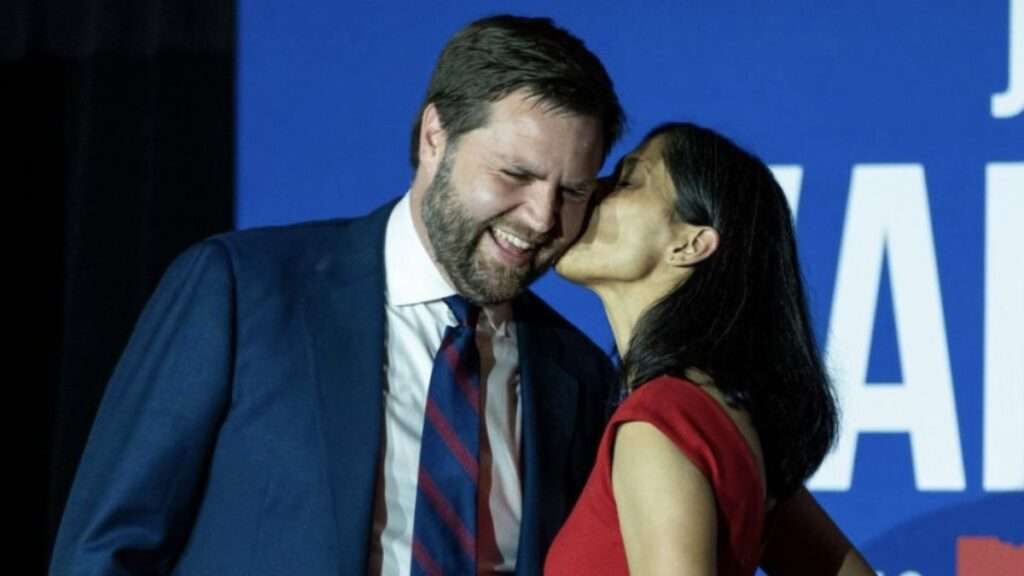
In a recent public appearance, U.S. Vice President JD Vance sparked significant controversy by stating he hopes his wife, Usha Vance — who was raised Hindu — will one day embrace Christianity. His comments, made at a forum hosted by Turning Point USA at the University of Mississippi, ignited a debate over religious freedom, interfaith marriages, and political posturing.
The remarks came during a question-and-answer session in which Vance discussed his marriage and their children’s faith upbringing. He acknowledged that his wife grew up in a Hindu family and that when they met both were “agnostic or atheist.” He went on to say, “Most Sundays, Usha will come with me to church… Do I hope eventually that she is somehow moved by the same thing that I was moved in by church? Yeah, I honestly do wish that… Because I believe in the Christian Gospel, and I hope eventually my wife comes to see it the same way.” He added that if she does not convert, then “God says everybody has free will,” and “that doesn’t cause a problem for me.”
The reaction was swift and widespread. Critics argued that Vance’s remarks were insensitive towards his wife’s heritage and faith tradition, accusing him of treating her religious identity as secondary to his own. The Hindu American Foundation expressed concern that his comments reflected a “compulsion … to convert us to another way of thinking” and urged him to “acknowledge the positive impact of Hinduism on Hindus and the rights of Hindus to practice.” On social media, the incident drew further attention—some calling it “Hinduphobic” or emblematic of religious privileging, while others defended Vance’s right to express his faith convictions.
In response, Vance defended his comments on social media, stating that his wife “is not a Christian and has no plans to convert, but like many people in an interfaith marriage—or any interfaith relationship—I hope she may one day see things as I do.” He affirmed that he considers her “the most amazing blessing I have in my life.” He also described criticism of his remarks as “anti-Christian bigotry.”
Analysts suggest the controversy touches on broader themes. It exposes tensions in interfaith marriages, especially when one spouse belongs to a religious minority, and raises questions about how public officeholders navigate personal faith and public sensitivity. Vance, whose conversion to Catholicism in 2019 is well-documented, has frequently tied his political worldview to his religious beliefs. The incident also reflects the growing visibility of Indian-American public figures and the attendant scrutiny of how their cultural and religious backgrounds are handled in U.S. political discourse.
The Vance comments underscore a delicate intersection of faith, family, and public life. By publicly voicing his hope that his wife will adopt his Christian faith, Vice President JD Vance has triggered a broader conversation about respect for religious identity, autonomy within interfaith marriages, and the role of faith in politics. How he and his office navigate the fallout—and whether the episode influences his standing among conservative religious voters or within the Indian-American community—remains to be seen.

