
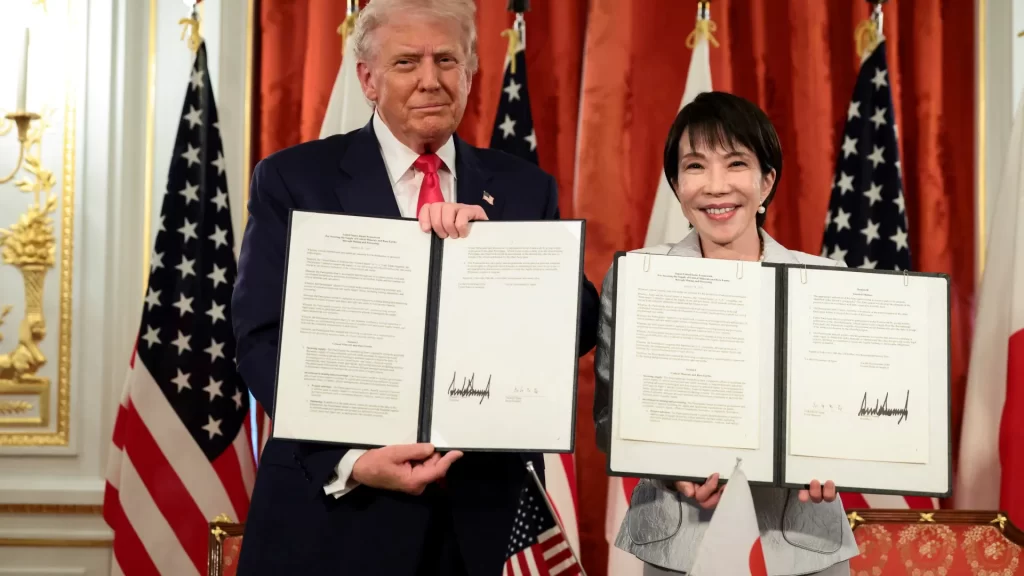
On October 28, 2025, in Tokyo, U.S. President Donald Trump and Japanese Prime Minister Sanae Takaichi signed a landmark framework agreement aimed at strengthening the supply chain of critical minerals and rare earth elements. The pact serves as a cornerstone in the countries’ bilateral economic and strategic agenda, focusing on reducing dependence on dominant foreign suppliers, particularly China, while enhancing resilience across the high-technology, defense, and energy sectors.
The agreement emphasizes supply-chain security for critical minerals and rare earths, both vital for advanced manufacturing, electric vehicles, renewable energy technologies, and defense equipment. The United States and Japan have pledged to develop diversified and fair markets for these materials, ensuring a more balanced and reliable global supply.
The timing of the deal is crucial. China currently dominates more than 90 percent of the world’s rare-earth processing capacity, and its recent tightening of export regulations has raised concerns in both Tokyo and Washington about potential vulnerabilities. Under the new framework, the two countries will coordinate investment strategies, streamline approval procedures, and explore the establishment of joint stockpiling systems. They also plan to collaborate with other like-minded partners to further minimize strategic dependencies.
During their meeting at Tokyo’s state guesthouse, the Akasaka Palace, the leaders highlighted that the agreement represents both an economic safeguard and a strategic realignment. Japan also committed to investing approximately USD 550 billion into the U.S. economy across sectors such as power generation, liquefied natural gas, and infrastructure. This move strengthens economic ties while reinforcing the minerals cooperation framework.
Experts interpret the deal as part of a larger trend in global supply-chain restructuring, with nations diversifying away from heavy reliance on China toward trusted partners in the Indo-Pacific region, including Japan, Australia, and Southeast Asia. The timing of the agreement, just days before President Trump’s planned meeting with Chinese President Xi Jinping at the upcoming APEC summit, adds geopolitical weight, signaling a unified front on resource security.
The accord also showcases Japan’s renewed global role under the leadership of Sanae Takaichi, the country’s first female prime minister. Her proactive approach signals Tokyo’s determination to take on greater responsibility in regional security, technological advancement, and industrial cooperation.
The U.S.-Japan framework agreement marks a significant milestone in strengthening industrial resilience and strategic autonomy. By aligning efforts to diversify sources, increase processing capacity, and secure supply chains, both nations are setting a precedent for collaborative economic security. As global competition intensifies over essential resources, this agreement could serve as a model for other democratic nations aiming to mitigate supply risks and foster stability in an increasingly uncertain geopolitical landscape.

