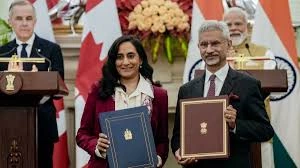
A Look at the Agreement
The arrangement, which was inked in early 2026, specifies that Canada would provide India up to 20 million pounds of uranium concentrate over the next ten years. The purchase is valued roughly $2.6 billion and is expected to support India’s developing fleet of pressurized heavy water reactors (PHWRs). India’s long-term uranium shortages are easier to deal with now that the supply chain has gotten better. This permits reactors like Kakrapar and Rawatbhata stay functioning.
One of the most crucial terms is that deliveries will start in the middle of 2026 and happen every year. Other important terms are quality assurance and compliance with environmental laws. The business Cameco, which is based in Canada and is the world’s biggest producer of uranium, is in charge of the supply because Saskatchewan contains a lot of uranium. The deal is based on smaller contracts that came before it and is expected to assist India meet its goal of 22,480 MW of nuclear power by 2031.
This deal brings back the momentum from the 2015 civil nuclear agreement, getting over reservations about non-proliferation and other issues. It demonstrates that Canada is working with other countries in the Asia-Pacific area on energy issues because of challenges with the global supply.
What this means for trade policy
The uranium deal opens up new areas of trade between India and Canada, beyond the conventional ones like agriculture and IT. Trade between the two countries is worth roughly $10 billion a year, and energy is now a major area of focus. India is now one of Canada’s top ten consumers of uranium. This is good for Canada because the U.S. and European markets are having problems because of political issues.
India obtains inexpensive oil at $130 per pound, which is 15% less than the current price. This deal will save the country $400 million throughout its lifetime. Job creation includes 1,200 new mining jobs in Canada and 50,000 new jobs in India because reactors are being expanded. The pact also makes India less reliant on Russian (30% of current imports) and Kazakh sources, which lessens the possibilities of international penalties.
Trade experts predict that there will be ripple effects, such follow-up deals in rare earths and other critical minerals. This fits with India’s Atmanirbhar Bharat policy, which encourages processing in India while making sure that raw materials may still be brought in.
India’s Energy Safety
Nuclear power is needed since India’s energy needs are growing by 10% every year. Right now, nuclear power makes up 3% of the 1,400 TWh of electricity that is generated. This plan will increase that capacity by five times. The plant could only run at 70% of its maximum capacity in the past since there wasn’t enough uranium. The deal makes this number 90%, which means 15 GW of clean baseload power.
Nuclear power is a steady source of low-carbon energy that can help us attain our net-zero goals by 2070. It is made up of 70% coal. The supply powers 14 new 700 MW PHWRs that are being developed. This saves $1.2 billion a year in import expenses. It safeguards against the ups and downs of fossil fuels, which are exacerbated worse by problems in the Middle East.
One reactor can run on one million pounds of uranium for a year, which keeps 7 million tons of CO2 from being discharged into the air each year. This is like taking 1.5 million cars off the road.
Political and geographical factors
This deal demonstrates that India and Canada are getting along better after issues with Sikh separatism in 2023. When Prime Minister Narendra Modi went to Ottawa in February 2026, the deal was done. He underlined how important it is for both sides to trust one other. Canada, with new government, confronts China’s 40% control of uranium around the world with its own control through Kazatomprom.
India’s relationship with the Quad gets better. The Quad keeps an eye on what Beijing is doing in the Indo-Pacific. Nuclear fuel security makes strategic independence stronger when U.S.-Russia ties change because of the crisis in Ukraine. India is not spreading nuclear weapons, as shown by Canada’s NSG limitation waivers. This makes India one of the major importers, along with Japan and South Korea.
Effects on the market and the economy
Uranium spot prices dropped 5% to $92 a pound after the news. This was helpful for other Asian customers, like South Korea. India’s involvement puts pressure on supply chains to come up with new ideas. This pushes Canada devote more money into eco-friendly extraction.
The 8% rise in NPCIL shares shows that the market is positive. The arrangement will help the economy grow by adding $5 billion to related areas, including as making turbines and picking up trash. It maintains the supply consistent all across the world, even when demand goes up. This helps nuclear energy come back.
New technologies and concepts that expand to other regions
The deal includes the transfer of technologies. Canada will give India CANDU refurbishment processes that can be employed in India’s designs. The goal of working together on small modular reactors (SMRs) is to have prototypes ready by 2030. This will bring together Canada’s knowledge of thorium and India’s 25% of the world’s reserves.
Collaboration centers in Mumbai and Toronto work together to make gasoline, which decreases India’s need for imported enhanced goods by 20%. This makes India’s nuclear technology look better and gives it a chance to export to ASEAN. After Fukushima, safety fulfills IAEA standards, which include passive cooling.
Issues and Dangers
Shipping delays in the Arctic or issues in the Red Sea can make logistics riskier and raise costs by 10%. India’s trash storage is out of date, and Canada’s backend has to be updated.
The U.S. sanctions on Russia could have an indirect influence on flows, but waivers fit with the interests of the Indo-Pacific region. Protests on US land slow down reactors, which could mean that there is too much supply.
Two instances of proactive actions are speeding up the construction of coastal SMR sites in India and improving ports in Canada. Kazakhstan and spot hedges are two kinds of backups that might help you stay safe.
The Environmental and Sustainability Point of View
People are anxious about how mining would affect water and tailings, while Canada’s in-situ leaching uses 40% less water. India said it will create facilities that don’t let out any trash, which is in line with SDG 7 for clean energy.
The deal helps India fulfill its target of getting 500 GW of non-fossil energy by 2030, with nuclear power making up 40% of it.
More general ties between the two countries
Fixing relationships boosts student visas (which have gone up) and investments from those who live abroad. Punjabi festivals in Toronto and other events like them help people get along. It begins talks about a free trade deal that would allow $50 billion in trade by 2030.
What India’s New $2.6 Billion Deal Means for Canada’s Uranium Deal: The India–Canada Uranium Supply Pact