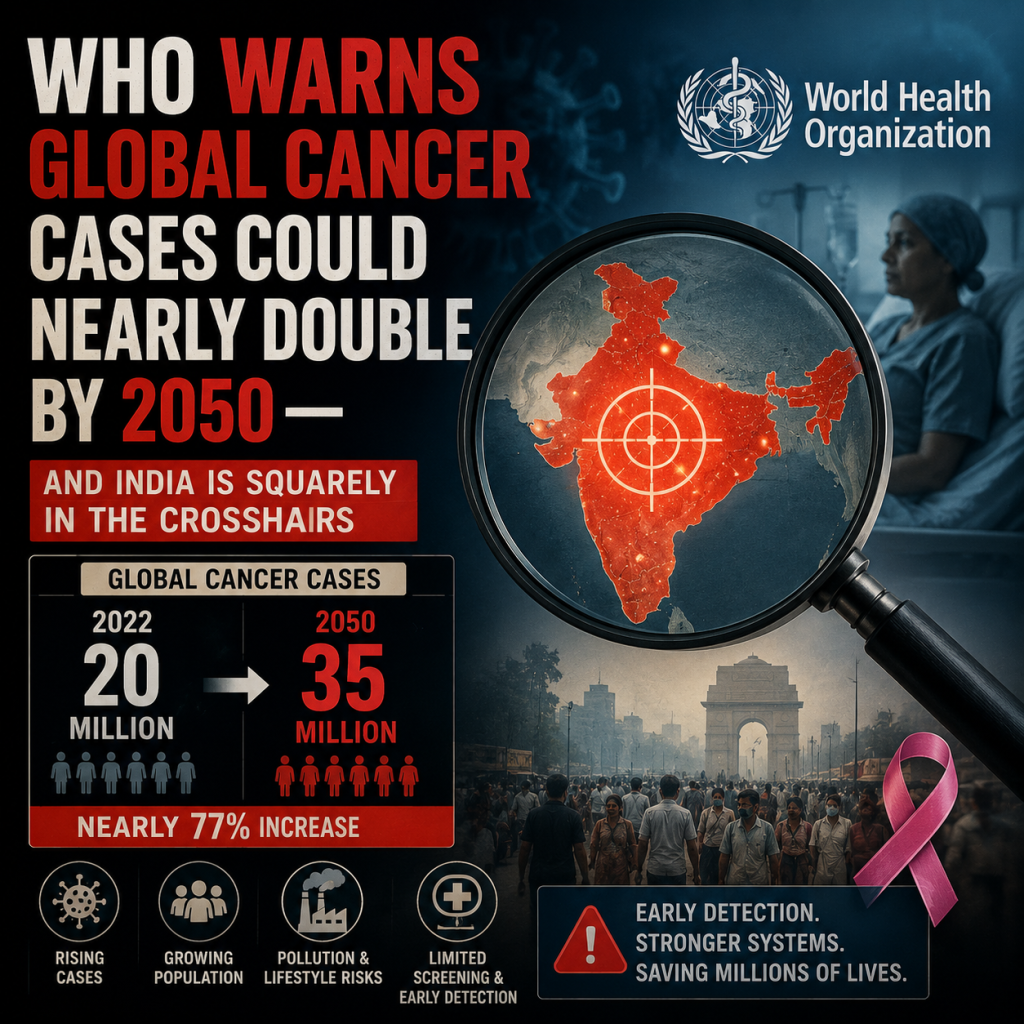
There’s a number in the World Health Organization’s latest cancer report that’s hard to shake off: 26,000. That’s roughly how many people are dying of cancer every single day, worldwide, right now. And according to the WHO’s newly released Global Status Report on Cancer 2026, that number isn’t going to shrink on its own — it’s on track to get dramatically worse.
The Numbers Behind the Warning
The report, published by the WHO alongside the International Agency for Research on Cancer, puts the current global cancer burden at an estimated 20.6 million new cases and close to 10 million deaths every year, making cancer the world’s second leading cause of death after cardiovascular disease. The truly alarming part is the trajectory: without urgent intervention, the WHO projects that annual cancer cases could climb to nearly 35 million by 2050 — an increase of roughly two-thirds from where the world stands today.
Put another way, one in five people alive today will develop cancer at some point in their lifetime. And when you factor in the ripple effect on families, the WHO estimates that cancer will touch the lives of around 92% of the global population in one way or another.
This isn’t a story about a mysterious new disease spreading. It’s largely a story about demographics and inequity colliding. As the report explains, much of the projected surge comes down to population growth and aging — people are simply living longer, and age remains one of the biggest risk factors for cancer. Layer on top of that the continued impact of tobacco use, alcohol consumption, obesity, and air pollution, and the trend line becomes easier to understand, even if it’s no less concerning.
A Growing Burden in India, China, Japan, South Korea, and the US
While cancer is very much a global problem — Asia alone accounted for just over half of all new cases and deaths in 2024 — the report singles out a handful of countries facing a particularly steep climb, and India is among them, alongside China, Japan, South Korea, and the United States.
For India specifically, the picture is complicated. On one hand, the country has expanded several cancer-related health initiatives in recent years, including screening and early-detection efforts under its National Programme for Prevention and Control of Non-Communicable Diseases, financial protection through Ayushman Bharat, and cheaper medicines through Jan Aushadhi Kendras. On the other hand, the report is candid about how much ground remains to be covered. Cancer still isn’t classified as a notifiable disease in India, which makes it genuinely difficult to track the true scale of the problem. Gaps in death registration and cause-of-death certification further muddy the picture. And perhaps most critically, low public awareness combined with limited access to screening means a large share of patients are only diagnosed once the disease has already advanced — a delay that dramatically affects survival odds.
That last point connects to what may be the report’s most sobering statistic: the enormous gap in outcomes between rich and poor countries. Women diagnosed with breast cancer in high-income countries have roughly an 87% chance of surviving five years. In low-income countries, that number drops to around 42%. It’s the same disease, but wildly different odds, depending almost entirely on where you happen to live.
Prevention Still Matters — A Lot
Amid all the alarming projections, the report does offer a genuinely hopeful thread: prevention still works, and works well. The WHO estimates that around 38% of new cancer cases can be traced back to modifiable risk factors — things like tobacco use, alcohol, infections, and excess body weight. That means a meaningful chunk of the projected 2050 burden isn’t inevitable; it’s preventable, provided countries invest seriously in tobacco control, vaccination programs (particularly for HPV), and public awareness campaigns.
The report is also unusually direct about what needs to happen next, framing this less as a call for more research and more as a call for implementation. Its recommendations include strengthening screening and early-diagnosis programs, improving access to surgery, radiotherapy and palliative care, investing in proper cancer registries, and — critically — folding cancer care into universal health coverage systems so that survival doesn’t hinge on a person’s income or postal code.
Why This Matters Beyond the Statistics
It’s easy to read a report like this as an abstract set of projections decades away. But the WHO’s framing pushes back against that instinct. The choices made over the next few years — in tobacco policy, in vaccination coverage, in how quickly countries build out screening infrastructure — will directly shape whether that 35-million figure becomes reality or gets meaningfully blunted.
For India and its regional neighbors, already dealing with large populations, aging demographics, and uneven healthcare access, the report reads less like a warning about some distant future and more like a nudge to accelerate work that’s already underway. The gap between what’s medically possible and what’s actually accessible to ordinary patients remains the crux of the problem — and closing it, the WHO argues, may be one of the most cost-effective investments any country can make in its people’s future.