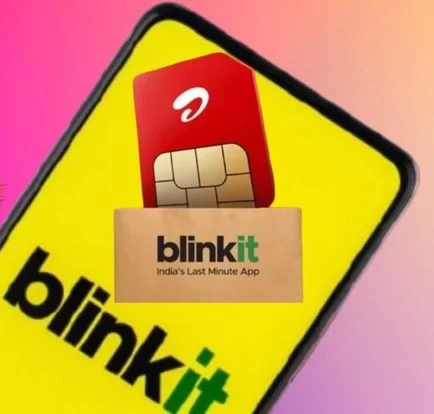
Bharti Airtel has teamed up with Blinkit, a huge quick-commerce company, to change the way people shop. They now deliver 5G SIM cards to clients’ homes in less than 10 minutes. This new Airtel 5G SIM delivery service employs Blinkit’s hyperlocal logistics network to help individuals who want to be online and get goods right away. India is swiftly moving toward widespread use of 5G. This new telecom and distribution service isn’t simply an update; it’s a big transformation in how people access high-speed internet. It might establish new norms for the whole business.
The Start of Very Fast 5G Connections
The telecommunications business in India is changing swiftly, and 5G technology is forming the basis for the country’s future digital infrastructure. Airtel, one of India’s top phone providers, has been in charge of this rollout since October 2022, when it became the first company to offer commercial 5G services in various places. Airtel’s 5G network now spans over 3,000 places and serves more than 50 million people. This shows how quickly consumers want the internet to be quicker and more reliable.
Getting a new SIM card has been a difficulty for a long time, but the new partnership with Blinkit fixes that. Customers used to have to go to Airtel stores, wait in line, fill out documents, and wait for their service to be turned on. This may take hours or even days.People can now order an Airtel 5G SIM through the Blinkit app, pick their favorite 5G package, and have it delivered to their house in less than 10 minutes. This service started in big cities like Delhi-NCR, Bengaluru, and Mumbai. It will be available all over the country by the middle of 2026.
Experts say this is a great step forward in telecom innovation. Rohan Malhotra, a telecom analyst, says, “Airtel’s partnership with Blinkit is a game-changer at a time when customers expect Amazon-level speed from every service.” “It gives everyone access to 5G, especially urban millennials and Gen Z, who value smoothness above all else.”
What Makes New Things Happen in Delivery and Telecom
A lot of things have come together to make it possible to buy Airtel 5G SIMs. To begin with, India’s digital economy is growing very quickly. There were 15 billion UPI transactions every month in 2025. Streaming services like Netflix and JioCinema need networks that don’t slow down too much.5G promises speeds of up to 10Gbps, which will make gaming, AR/VR, and IoT apps feel more real.
There is also a lot of competition. Companies like Jio and Vodafone Idea are moving faster to build out 5G. With 150 million members, Jio has the most. Airtel’s approach goes against this by focusing on customer experience (CX), which is where it currently does well. NielsenIQ says Airtel has the top network satisfaction.
There are also regulatory tailwinds. The Telecom Regulatory Authority of India (TRAI) has made it easy to follow eKYC standards. Activation delays have gone from days to minutes. The Department of Telecommunications’ push for 5G spectrum auctions, which are valued ₹1.5 lakh crore, also makes sure that carriers like Airtel have enough bandwidth for a lot of people to use it.
But there are still issues. By early 2026, just 20% of India’s 1.4 billion people had access to 5G. This means that rural areas still don’t have much coverage. People may not be able to utilize them because hardware (5G phones start at ₹10,000) and data subscriptions are so expensive. Airtel fights back by offering cheap plans and working with companies like Samsung and Xiaomi to help users pay for their devices.
Wider Effects on the Economy and Expectations for Services
People’s expectations of services in various areas are shifting because of this interaction. It’s hard to distinguish which companies are which because of new telecom and delivery technologies like these. This leads to similar business models. For instance, Swiggy Instamart might sell insurance or banking kits right away. This means that users will have an easier time getting started with 5G, which will enable more people go online. A NASSCOM study says that 5G will add $450 billion to India’s GDP by 2025 through areas including healthcare (telemedicine) and manufacturing (smart factories).
The most people will benefit from this are the 500 million individuals who live in cities in India. For instance, in Pune, where you work as a content creator, consumers can now get Airtel 5G SIMs delivered even when there is a lot of traffic. This makes it simple to post to social media and stream material that is good for search engines. You, as a digital marketer, will employ low-latency 5G to execute real-time analytics and advertisements with augmented reality on sites like Facebook and X.
Blinkit’s rider network gives you more job possibilities. Airtel has said that it will train 50,000 partners the basics of 5G. According to our own calculations, better dark store logistics might cut last-mile emissions by 15%, which is in line with India’s goal of achieving net-zero.
Some people, meanwhile, think that relying too much on quick commerce is a terrible idea.Priya Sharma, a cybersecurity expert, says that hurried KYC is easy but could lead to data privacy problems. Airtel said it follows the DPDP Act 2023 regulations with end-to-end encryption.
With Blinkit’s help, individuals in India may now acquire phone service in a whole new way: Airtel 5G SIM delivery in 10 minutes.