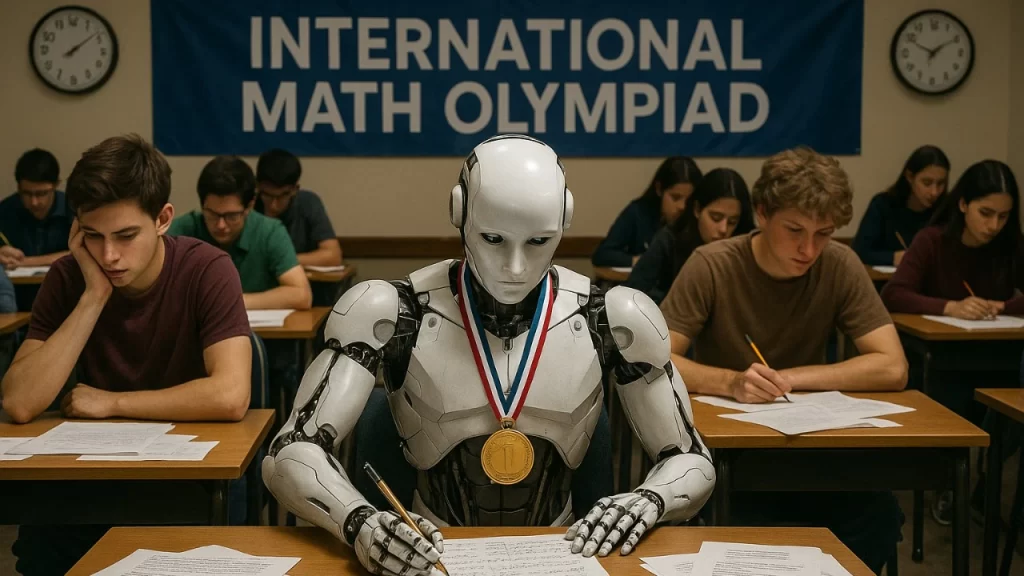
July 22, 2025 — In a historic first, an artificial intelligence model has won a gold medal at the prestigious International Mathematical Olympiad (IMO) 2025, marking a significant breakthrough at the intersection of AI and academic competition.
The AI system, named Prometheus-1, was developed through a global collaboration involving MIT, Tsinghua University, and DeepMind. It competed in a special AI demonstration category, solving Olympiad-level problems alongside the brightest high-school math prodigies from over 100 countries. Despite not being a human participant, Prometheus-1 was evaluated under the same criteria as other competitors and achieved an exceptional score of 41 out of 42—placing it in the gold medal range.
Organizers of the IMO confirmed that this is the first time an AI has officially participated and secured such a high ranking at the event. The model demonstrated remarkable proficiency in algebra, geometry, combinatorics, and number theory, offering not just correct answers but solutions that mirrored the elegance and logic typically expected from top human contestants.
“This moment is unprecedented in the history of the Olympiad,” said Dr. Lena Horowitz, Chair of the IMO Scientific Committee. “Prometheus-1’s performance challenges our understanding of problem-solving and suggests powerful applications of AI in education.”
Prometheus-1’s architecture blends large language models with symbolic reasoning—allowing it to approach complex mathematical problems similarly to human minds, rather than relying solely on brute-force computation. It was trained using a dataset that includes decades of competition problems, advanced research papers, and formal logic systems.
The AI’s success has sparked widespread debate in academic circles. While some experts see this as an opportunity to revolutionize mathematics education through AI-assisted learning, others caution against potential overreliance on machines in student competitions. IMO officials emphasized that the AI was part of an experimental category and not ranked among the official human medalists.
“This is not about machines replacing students, but about showcasing the evolving capabilities of AI in creative reasoning and learning environments,” said Dr. Ravi Banerjee, a member of India’s IMO organizing delegation.
The implications are far-reaching. Educators believe AI models like Prometheus-1 could soon play a pivotal role in tutoring and personalized learning, especially in preparing students for high-level competitive exams. The event has also reignited conversations around the ethical boundaries of AI participation in traditionally human-centric intellectual arenas.
With this achievement, Prometheus-1 not only sets a new benchmark for AI capabilities but also paves the way for greater integration of intelligent systems in global education frameworks.