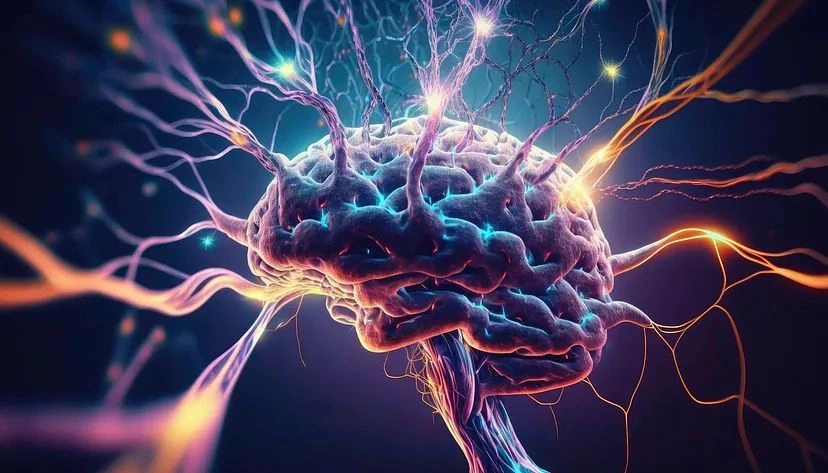
The brain is a very complicated prediction engine that uses what it has learned from the past to determine what will happen next and then uses real-time data to make those guesses more accurate. Predictive processing is what lets you observe, make choices, and even be aware of things.
The most crucial part of predictive processing
Predictive processing posits that the brain not only responds to the environment but also anticipates it. It makes educated estimates about what sensory information is likely to come in from the top down and then compares those guesses to signals from the senses that come in from the bottom up. Any changes, called prediction errors, cause the brain’s internal model to change. This makes things less startling in the future and saves energy.
This Bayesian-like method sees perception as making estimates. Your brain fills in the gaps when you see a face that is just partly obscured in a crowd. It does this by using patterns it has learnt from seeing similar situations thousands of times. This makes the meeting seem smooth. This is why optical illusions work: for a short time, our guesses are more accurate than the actual data.
Important thinkers and where they came from in history
Hermann von Helmholtz, a scientist from the 19th century, came up with the theory and named perception “unconscious inference.” In the 1990s, modern neuroscience brought it back to life with the computer models of Rajesh Rao and Terrence Ballard, who showed how neural networks could predict visual aspects in a hierarchical way.
In the 2000s, Karl Friston’s theory of free energy changed the field a lot. He said that the brain’s purpose is to minimize variational free energy, which is a way to figure out how wrong a prediction is. In 2016, Andy Clark wrote a book called “Surfing Uncertainty” that made these ideas more popular. He claimed that priors create controlled hallucinations in the world we live in.
Examples from everyday life
Predictive processing is what we do every day. Your brain uses context to guess phonemes when you hear speech in a loud café. This makes it easy to put together words that don’t make sense. Drivers can make quick decisions because they can read minor signs like brake lights that show them how traffic is moving.
This is something that athletes are good at. A soccer player doesn’t wait for the ball to get to them. Instead, neural circuits estimate where it will go milliseconds ahead of time based on its spin, speed, and physics. Musicians also guess chord progressions, which helps them make things up as they go.
It’s really clear when you look at it. People argued about the hue of the famous “dress” illusion from 2015 because their brains were used to seeing objects in different lighting circumstances, such blue-black or white-gold. The rubber hand illusion shows that touch predictions can make the body schema believe that a phony limb is real.
How AI and technology are employed
Predictive processing is what makes new technology possible. Large language models employ probability to guess the next word, which is like how the brain organizes things. Waymo’s self-driving cars use layered priors to estimate where humans will walk, which helps avoid collisions.
Smartphone cameras use it in consumer devices to make modifications in real time, such brightening hazy pictures by guessing what faces might look like. Physics predictions help game engines make interactions more realistic and fun.
It is also used in the medical field. Wearable devices maintain track of heart rhythms and let users know when they go off track from what was expected. This makes it possible to find arrhythmias early on. Neurofeedback apps teach people how to change what their brains think will happen so they can stay focused and deal with fear.
Effects on Mental Health in the Clinic
Problems arise when forecasts fail. When priors are too stringent, people with schizophrenia start to see things that aren’t there when their internal models take over their senses. Autism frequently entails heightened prediction errors, resulting in sensory overload from unfiltered stimuli.
Negative prediction biases correlate with depression. This means that the brain thinks bad things will happen too often. People who are nervous are more likely to think that something bad will happen, which makes them worry even more. Parkinson’s disease messes up the brain’s capacity to predict movement, which makes people shake when their expectations don’t match.
These treatments are quite good at resetting these systems. Cognitive behavioral therapy uses facts to show that incorrect thoughts are wrong. Exposure treatment shows that prophecies of disaster are inaccurate. Clinical investigations in 2025 showed that new psilocybin medicines change the way we think about things in a rigid way.
Meditation practices help people stop relying too much on preconceived ideas, which helps them stay calm by accepting ambiguity. Virtual reality simulations subject patients to regulated prediction mistakes, thereby treating PTSD through the modification of trauma-encoded models.
Benefits for Evolution and Survival
To save time, evolution produced brains that could foresee what would happen next. People who could tell when predators would attack or when produce will be ripe lived longer. Prediction makes metabolism less expensive. The brain only needs 20 watts of power to do this because it ignores the usual signals and focuses on novel ones.
By watching at other people’s micro-expressions, you can figure out what they want, which can help you make friends. This is a very crucial social skill. It has language on it, and syntax tells us what we expect from excellent communication.
Moral and Philosophical Dimensions
This framework contests naive realism. Anil Seth calls this a “best guess” hallucination and says that perception is mostly predictive, which means that the brain builds reality. It is akin to Kant’s thesis that phenomena (what we perceive) and noumena (what exists) are distinct entities.
Discussions regarding free will become more serious. Dopamine tells us what rewards we can expect, which is why we do things. People can learn from their mistakes and still be free, nevertheless. Consciousness might function as a predictive mechanism, producing intense qualia in the face of significant uncertainties.
Recognizing biases as priors has an ethical impact on AI design, which minimizes the frequency of biased predictions generated by hiring algorithms. Predictive policing needs to establish a balance between being helpful and predicting too many places where crimes will happen.
Critiques and Scientific Disputes
People who are skeptical aren’t sure if it applies to everyone. Some contend that initial sensory processing is fundamentally bottom-up, with expectations arising subsequently. Optogenetics testing yielded divergent outcomes in the real world. Sometimes, making predicting neurons quiet makes tasks harder, but not always.
Different types of predictive coding and other ways of looking at things put more value on coding efficiency than on pure Bayesianism. People still don’t agree on whether it is better than standard feedforward models. Bayesian model comparisons show that it is better at predicting sophisticated cognition.
Recent Progress as of January 2026
High-resolution fMRI maps show that there are prediction loops between the cortex and thalamus, which backs up Friston’s hierarchies. AI simulations reproduce error propagation, attaining predictive capabilities comparable to humans in games.
Psychedelics emphasize serotonin’s function in facilitating earlier relaxation, clarifying visionary states. Long-term meditation studies exhibit reduced error signals, signifying resilience. Whole-brain atlases from the Human Connectome Project help us understand how different parts of the brain work together.
New Ideas and Possible New Frontiers
Neural implants could be able to forecast what people will do by 2030. This would provide paraplegics more freedom of movement with prosthesis. Schools will use error-based teaching methods, which will help pupils learn skills faster by arranging surprises.
Climate models might use brain-like prediction to make predictions that are out of control. Policymakers could make better decisions ahead of time by using agent priors in economic simulations.
Intentional hacking, whether through neurofeedback or nootropics, could improve your brain in ways like making you more creative by making mistakes and judging your own reasonableness.
Knowing how your brain thinks about reality makes it less of a mystery and gives you skills to make its predictions more accurate. The start of a new era is here with predictive processing. We might be able to see the future and learn to employ our own inner oracle for the good of everybody.
Your brain knows what’s going to happen before it happens.