
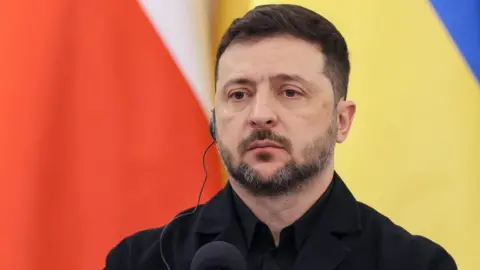
In sharply contrasting New Year’s addresses, Ukrainian President Volodymyr Zelenskyy and Russian President Vladimir Putin presented divergent visions of the war’s trajectory, underscoring the persistent uncertainty surrounding the conflict’s endgame. Zelenskyy claimed that a potential peace agreement is “90% ready,” raising cautious hopes for diplomacy, while Putin projected unwavering confidence in Russia’s eventual victory, signaling no immediate shift in Moscow’s stance.
Zelenskyy’s remarks, delivered at the start of the new year, marked one of his most optimistic public assessments since the war began. Emphasizing Ukraine’s commitment to sovereignty and security, he suggested that months of negotiations, consultations with allies, and battlefield realities have brought a peace framework close to completion. The statement has drawn significant international attention, as global leaders and markets alike remain sensitive to any indication of de-escalation in the Russia–Ukraine war.
In contrast, Putin’s New Year address reflected a continuation of Russia’s wartime narrative. He praised the resilience of Russian forces and framed the conflict as a defining moment for national strength and unity. By expressing confidence in Russia’s victory, the Kremlin signaled that it does not perceive the current moment as one requiring compromise, highlighting the deep gap that still exists between the two sides’ public positions.
Key Takeaways from the New Year’s Addresses
- Peace negotiations were placed at the center of Ukraine’s message, with Zelenskyy stressing readiness for an agreement that safeguards Ukraine’s independence.
- Russian military confidence dominated Putin’s speech, reinforcing domestic support for the ongoing campaign.
- Geopolitical implications remain significant, as allies and adversaries interpret these statements for clues about future escalation or diplomacy.
Comparing the Leaders’ Messages
| Aspect | Volodymyr Zelenskyy | Vladimir Putin |
|---|---|---|
| Core message | Peace deal “90% ready” | Confidence in Russia’s victory |
| Tone | Cautiously optimistic | Defiant and resolute |
| Strategic signal | Openness to diplomatic resolution | Continuation of military objectives |
Analysts note that such contrasting narratives are not unusual at critical junctures of prolonged conflicts. Public statements often serve multiple purposes: reassuring domestic audiences, shaping international opinion, and strengthening negotiating positions. Zelenskyy’s optimism may be intended to sustain public morale and signal seriousness to mediators, while Putin’s rhetoric reinforces Russia’s resolve and bargaining leverage.
High-impact keywords such as Ukraine peace agreement, Zelenskyy New Year address, Putin Russia victory, Russia–Ukraine war update, and peace negotiations have dominated global discussions following the speeches. These phrases reflect widespread interest in whether diplomacy can realistically bring an end to a conflict that has reshaped European security and global geopolitics.
As the new year begins, the gap between a “nearly ready” peace deal and confidence in outright victory illustrates the fragile and complex nature of the situation. While Zelenskyy’s statement offers a glimmer of hope for resolution, Putin’s stance suggests that significant obstacles remain. The coming months will reveal whether diplomatic momentum can overcome entrenched positions, or whether the war will continue to define the regional and global order.

