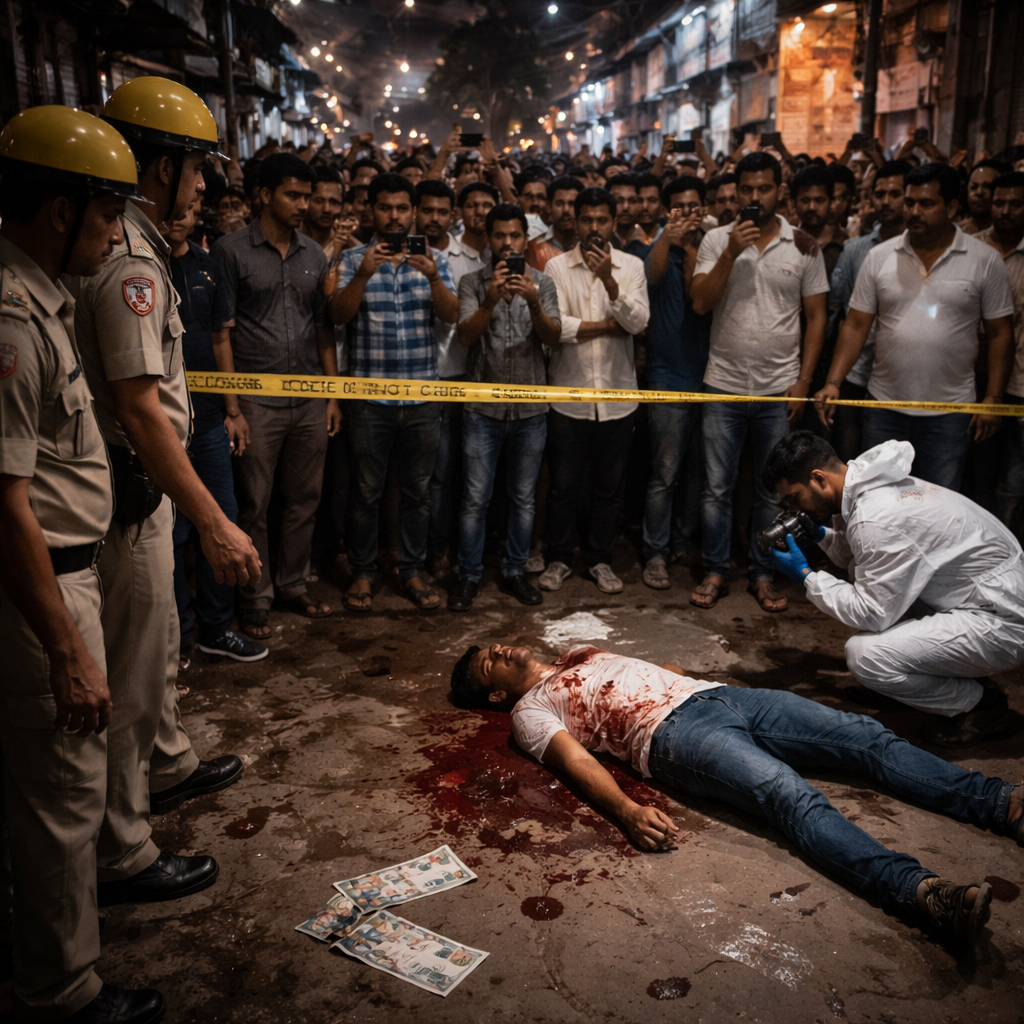
Some crimes are shocking. Others haunt you, not just for the act itself, but for the casualness with which it occurred.
The Delhi stabbing of April 2026, without a doubt, fits squarely into the second category.
It started, as so many tragedies do, with something absurdly small. A debt of ₹400. Less than five dollars. The kind of money most of us wouldn’t think twice about. But for three 16-year-old boys from New Mustafabad in northeast Delhi’s Dayalpur area, that unpaid sum was apparently worth a man’s life.
What Happened in Dayalpur?
Three 16-year-old boys turned a petty ₹400 debt into brutal murder, stabbing 26-year-old Md Kaif multiple times near a shop on 25 Futa Road in northeast Delhi. Herald Goa
The victim, Md Kaif, was a young man from the same neighborhood. He was rushed to Jag Pravesh Chandra Hospital around 4 PM but was declared dead, leaving behind his parents and two brothers.
What elevated this from a horrifying local crime to a nationwide viral incident was what the accused did next. The three teen boys reportedly recorded the entire attack and later shared the video on social media. NewsX The footage — gruesome, cold, and deliberate — showed the boys ambushing Kaif near the shop and attacking him without hesitation.
But it didn’t stop there. The video was captioned with movie-inspired bravado before it went viral. Herald Goa As if this was a scene from an action film. As if the life being taken on camera was fiction.
It was not.
The Investigation — and What the Killers Said
Delhi Police’s Deputy Commissioner Ashish Mishra confirmed the apprehensions were made on Saturday, a day after the incident. Herald Goa All three weapons used in the attack were recovered from the accused.
During interrogation, the juveniles confessed, admitting their rage stemmed from Kaif’s failure to repay the loaned ₹400.
Let that sink in. Three teenagers — barely old enough to vote, barely old enough to drive — made a deliberate decision to end a man’s life over a debt smaller than a movie ticket. And then they filmed it. And then they posted it online, like it was content.
This is what investigators and child psychologists across India are calling a deeply disturbing pattern — the “performance of violence” — where crimes aren’t just committed but staged for social media attention.
A Dangerous New Trend: Filming Crimes for Clout
The Delhi case didn’t exist in isolation. The incident raised serious concerns about rising violence among juveniles and the growing trend of filming crimes for online attention.
India has seen this pattern before — in cities big and small, across age groups, across communities. But what makes the 2026 Delhi case uniquely disturbing is the apparent pride involved. These weren’t teenagers who panicked and ran. They recorded. They captioned. They uploaded. They wanted people to watch.
Experts point to a toxic cocktail of factors: the glorification of violence in certain online content, the collapse of conflict-resolution skills in young people, peer pressure to appear “fearless,” and the dopamine loop of viral engagement. When getting thousands of views feels like a reward, even the most horrific act can feel like a bid for internet fame.
What This Says About Juvenile Crime in India
This case is not just a crime story. It is a social mirror — and the reflection is uncomfortable.
India’s juvenile justice system already walks a tightrope. The law was amended in 2015 to allow heinous crimes committed by juveniles aged 16–18 to be tried as adults in some cases. But legal provisions alone can’t fix what is fundamentally a crisis of upbringing, environment, and values.
Criminologists note that many juvenile offenders in urban India come from overcrowded, economically stressed neighborhoods where conflict often escalates physically, where school dropout rates are high, and where digital content — often violent or hyper-masculine — serves as the primary window to the world.
None of this excuses what those three boys did to Md Kaif. Nothing can. But understanding why this keeps happening is the only way to stop it from happening again.
The Family Left Behind
In the noise of the viral video, the public outrage, the news cycles — it’s easy to forget there is a real family sitting in grief tonight.
Md Kaif was 26 years old. He had parents. He had two brothers. He lived in New Mustafabad, in the same neighborhood as the boys who killed him. Herald Goa These were people who likely knew each other, passed each other on the street, shared the same chai stalls.
And now Kaif is gone. Over ₹400. Over a debt that, had anyone paused for one single moment, could have been resolved with words.
A Verdict the Internet Can’t Deliver
The case is under active investigation. The accused, being minors at the time of the crime, will face the juvenile justice system — a fact that has already sparked fierce debate online about whether the law is equipped to handle such premeditated, brutal violence.
The internet has already delivered its verdict — swift, angry, and loud. But the real questions this case demands are quieter and harder. What are we feeding our children? What are they watching, absorbing, normalizing? And who is responsible when a ₹400 argument ends with a life filmed, ended, and uploaded for likes?
Md Kaif deserved better. His family deserves answers. And India’s streets deserve more than shock — they deserve change.
₹400 and a life — the Delhi murder that went viral and rocked the nation.