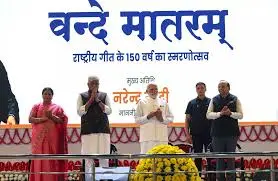
In a landmark ceremony held today at the Indira Gandhi Indoor Stadium in New Delhi, Prime Minister Narendra Modi inaugurated a year-long nationwide commemoration of the 150th anniversary of the national song “Vande Mataram.” The Prime Minister released a commemorative stamp and coin and launched a dedicated portal to mark this major cultural milestone.
The song “Vande Mataram” was composed by Bankim Chandra Chattopadhyay on 7 November 1875, coinciding with the festival of Akshaya Navami. It was published as part of his novel “Anandamath” and later adopted as the national song by the Indian Constituent Assembly in January 1950. The phrase “Mother, I bow to thee” evokes the personification of the motherland and served as a rallying cry during India’s freedom struggle.
At today’s event, the Prime Minister led a mass rendition of the full version of the song alongside citizens from diverse backgrounds. Alongside the cultural tribute, a special postal stamp and commemorative coin were unveiled, and a new digital portal was announced to engage citizens—especially youth and students—in nationwide programmes throughout the coming year.
The year-long celebrations will run from 7 November 2025 to 7 November 2026 and are designed to reach across India. The ruling party has announced activities at 150 locations across the country on the launch date itself, including in states such as Maharashtra, Gujarat, and Uttar Pradesh. Programs include mass singing events, essay and debate competitions in schools, exhibitions on the song’s legacy, and social-media campaigns to engage younger generations.
Commentators note that beyond its historical significance, the 150-year mark is being leveraged to reaffirm the song’s role in inculcating civic pride, national unity, and a shared cultural memory. In his address, the Prime Minister emphasised that “Vande Mataram” is not just a relic of the past, but an active embodiment of patriotism and national purpose.
While the initiative has been broadly welcomed, some concerns and responses have emerged. In certain regions, directives to ensure mass participation have been challenged on grounds of mandatory singing and concerns over inclusivity. Meanwhile, traffic authorities in New Delhi issued advisories in view of the expected large crowds around the stadium and public venues hosting the events.
The year-long national commemoration of “Vande Mataram” launched today marks a significant cultural moment for India—linking a 150-year-old patriotic hymn with contemporary efforts to foster unity, civic pride, and inter-generational connection. With mass public participation, educational initiatives, and digital outreach, the campaign seeks to ensure that the song’s legacy remains alive in the hearts of future generations. As India moves deeper into the commemoration period, how effectively these programmes engage diverse populations—across regional, religious, and linguistic lines—will determine how this milestone is remembered and internalised.