
Introduction
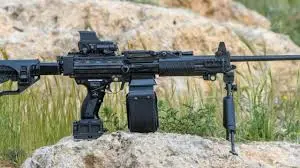
Israel’s defence industry has unveiled a transformative advancement in counter-drone warfare: a system that converts standard infantry rifles into precise drone-interception weapons. This new technology, developed by Israel Weapon Industries (IWI), enhances rifle capabilities through integrated sensors and fire-control intelligence, allowing soldiers to accurately target and neutralise small, fast-moving drones. India is now exploring the possibility of manufacturing this technology domestically under the “Make in India” defence initiative, signalling a major shift in future battlefield preparedness.
A New Approach to Counter-Drone Combat
The innovation, known as the Arbel anti-drone system, is designed to attach to a conventional rifle platform while adding advanced computing and real-time targeting support. It employs algorithms to evaluate multiple variables — including drone speed, trajectory, movement patterns, and environmental conditions — enabling it to determine the ideal firing moment.
Unlike traditional anti-drone systems that rely on heavy machinery or standalone interceptors, Arbel turns an infantry rifle into a smart weapon capable of dealing with low-altitude threats. The technology’s design ensures that while the soldier retains full manual control, the system handles precision timing and shot optimization, significantly improving hit probability.
Drone Warfare: A Growing Global Challenge
The use of small, inexpensive drones in warfare has expanded rapidly in recent years. Non-state actors, hostile forces, and even lone operators now employ drones for surveillance, payload delivery, and targeted strikes. These aircraft are often difficult to detect due to their minimal radar signatures and unpredictable movement.
Traditional methods of neutralising drones — such as missiles, laser systems, or electronic jammers — often come with high operational costs and specialized deployment requirements. In this context, Israel’s rifle-based interception system offers a practical, scalable alternative suitable for frontline troops, border patrols, and quick-response units.
India’s Interest and ‘Make in India’ Prospects
India, which faces drone threats along sensitive border regions, especially near the western and northern frontiers, is actively working to enhance its counter-UAS capabilities. Defence officials and industry stakeholders see strong potential in localized production of Arbel-type systems.
Indigenous manufacturing would support India’s broader goals of reducing dependency on foreign defence equipment, accelerating technology transfer, and strengthening domestic innovation. Several Indian defence firms are already collaborating with international partners on drone technology, ISR systems, and counter-drone solutions. Adding rifle-based interceptors to the production pipeline could further widen India’s anti-drone ecosystem.
Strategic Advantages and Future Considerations
If adopted, the system could significantly enhance infantry mobility and reaction speed in drone-dense combat environments. Its portability and simplicity mean that it can be deployed across various terrains — from deserts and mountains to urban conflict zones.
However, experts caution that rifle-based interceptors are best used as part of a wider, multi-layered defence network. While effective against small, slow, or low-flying drones, they may not replace high-end systems required for sophisticated or high-altitude UAVs. Effective training, seamless coordination with detection networks, and updated tactical doctrines will be essential for optimal use.
Conclusion
Israel’s decision to transform ordinary rifles into drone-interception platforms marks a significant evolution in modern defence strategy. As India explores the possibility of producing such technology domestically, the move could strengthen its defence capabilities and provide its forces with a cost-effective tool to confront emerging aerial threats. With drones becoming central to contemporary warfare, innovations like these are poised to shape the future of battlefield readiness.

