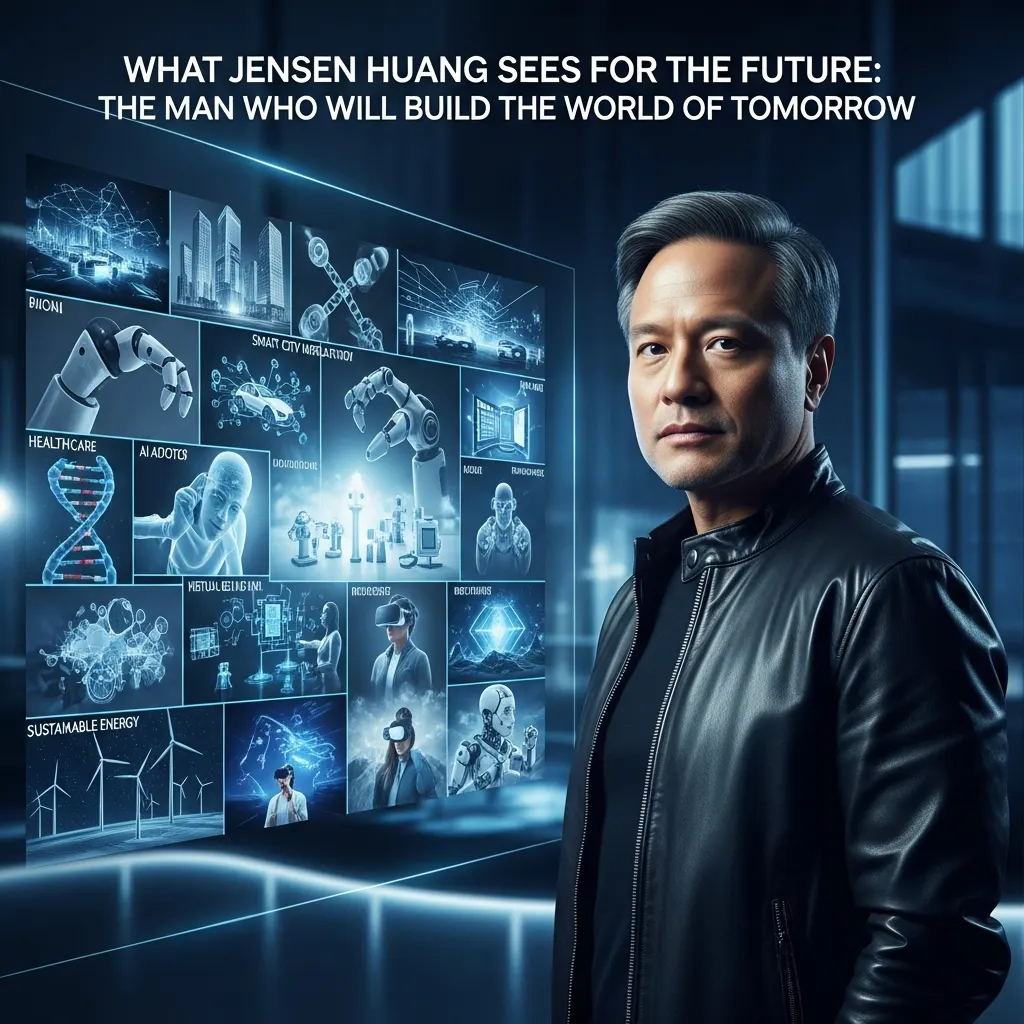
I’ll be honest: when I first heard Jensen Huang speak at a tech convention three years ago, I thought he was being too positive. The CEO of NVIDIA, wearing his trademark leather jacket on stage, talked about AI factories and digital people as if they were just around the corner. It sounded like something out of a science fiction book.
Almost everything he said would happen is either happening now or being created right now. The man isn’t just selling chips; he’s building a whole new way of thinking about technology that will change how we work, make things, and live.
You need to know what Jensen Huang sees when he looks at the future if you want to know where technology is going in the next ten years. And believe me, his vision is more extreme and more likely to happen than most people think.
AI is no longer a tool; it’s infrastructure.
Huang says that AI is like energy and the internet in that it needs factories to make something useful called tokens. He doesn’t mean regular data centers; he calls them “AI factories” since they are very different.
Take a moment to think about what that means. Electricity changed the way things were made. The internet changed the way people talk to one other and do business. AI is now the third building block of modern society, and Huang says this infrastructure will lead to an industry worth trillions of dollars.
I’ve seen this change happen faster and faster in real time. Two years ago, companies were hesitant to invest in AI. Now, they are rushing to construct or rent AI infrastructure. Huang says that customers always underestimate how much AI they need, and that no one ever predicts too high—each year’s projection is behind actual usage growth.
What I find interesting about his idea is that he’s not just making technology; he’s also laying the groundwork for a whole new economy. Like they needed electricity and the internet, every big corporation will need AI factories. The ones that get there first will have a huge edge.
Your IT department is about to become AI’s HR department.
When I originally heard this prediction from Huang, it stopped me in my tracks. Huang said at NVIDIA’s CES 2025 keynote that in the future, the IT department of any company will be the AI agents’ HR department.
Right now, your IT department takes care of servers, fixes PCs, resets passwords, and keeps the infrastructure up to date. Huang thinks that eventually IT personnel will be hiring, training, and managing fleets of digital workers—AI agents that never get sick, never take vacations, and are made to fit each company’s particular language, processes, and culture.
My acquaintance is in charge of IT for a medium-sized business. At first, he shrugged it off when I informed him about it. After then, he began to think about it. His organization started trying out AI agents for customer support within six months. Now he’s already making plans for how to “onboard” and “train” these digital personnel.
This isn’t a long way off. Companies are already using AI agents for things like coding, making content, analyzing data, and helping customers. The change is happening right now, and Huang thinks it will happen much faster in the coming few years.
Physical AI: When Smartness Meets the Real World
Huang’s biggest dream might be what he terms “Physical AI,” which is AI that doesn’t just understand language and pictures, but also the real world.
Huang contends that the intelligence requisite for robotics surpasses that present in extensive language models, elucidating that if an AI can generate a video of an activity, it possesses the knowledge to instruct a robot to execute that action—a notion he refers to as “embodied AI.”
NVIDIA’s plan here is quite smart and well thought out. The method needs three computers: the AI factory for training, the Omniverse virtual world for learning and simulating, and the onboard computer as the robot’s brain.
At COMPUTEX 2025, Huang showed off new tools to speed up the construction of humanoid robots. These included the Isaac GR00T-Dreams blueprint for making fake training data and the Isaac GR00T N1.5 Humanoid Robot Foundation Model for robotic intelligence.
I used to assume it would be decades before we had humanoid robots. I’m not so sure now. It’s amazing to see how far things have come in only the last two years. Huang said that self-driving cars will probably be the first robotics sector worth trillions of dollars.
NVIDIA isn’t just talking about this; the company aims to help Uber develop 100,000 self-driving cars starting in 2027. These cars will use NVIDIA’s CPUs and DriveOS, an operating system for self-driving automobiles. That’s not a test program. That is a full-scale deployment.
The End of General-Purpose Computing
Huang has been saying this for a while, but most people haven’t fully understood it yet: Huang says that general-purpose computing is over, and that search, recommender systems, and huge enterprise workloads are moving to GPUs because AI reasoning, multimodal inference, and large-scale data processing can’t be done without faster computing.
The CPU was the best for a long time. Intel was the king of computers. But that time is coming to an end. Hyperscalers and cloud service providers are underestimating the GPU equipment they will need, which is putting constant pressure on demand.
What does this mean in real life? Every data center, every corporate IT upgrade, and every cloud infrastructure build-out is moving toward faster computing based on GPUs. It’s no longer up to you. You need GPUs to perform modern AI workloads.
Because of this change, I know a lot of CTOs who are completely changing how they plan their infrastructure. One person said, “We thought we could just add some AI features to the systems we already have.” We now know that we have to start over from scratch.
Intelligence isn’t a zero-sum game; it’s generative.
One of Huang’s most important ideas goes against the conventional notion that AI will take away jobs. Huang says that intelligence is generative, not zero-sum. This means that AI doesn’t just take over human jobs; it also makes people more capable.
This speaks to me because I’ve seen it happen. The writers I know who use AI tools aren’t working less. In fact, they’re working more, trying out ideas they wouldn’t have had time to try otherwise, and focusing on the creative parts of writing that they enjoy the most.
Huang sees AI as an enhancement of human intelligence, not a replacement. He believes that by incorporating advanced AI into our daily lives through personalized tutors, smart devices, and better computing systems, we will gain abilities that will allow us to work, learn, and create at levels that were previously impossible.
Ray Kurzweil said that this century would bring together 20,000 years of progress into just 100 years. Huang and investor Brad Gerstner used this to show how hard it is for most people to understand how quickly technology is changing. They pointed out that the rate of AI improvement is already faster than traditional forecasting methods.
Making Supercomputing Available to Everyone: AI for Everyone
Not everything Huang sees is about building billion-dollar infrastructure. He is really excited about making AI available to everyone.
Huang stressed that the goal is to make AI supercomputing affordable. He said they will make $3,000 versions instead of $250,000 versions so that schools may have their own AI supercomputers.
This is a big deal. Think about how every institution, small research facility, and independent developer could use powerful AI processing power. That’s how you make innovation available to everyone. That’s how you obtain new ideas from places you wouldn’t expect.
Last month, I talked to a high school teacher who is already designing lessons around AI when these low-cost systems become accessible. She isn’t waiting for some far-off time; she’s getting her students ready for a world where being able to use AI is as important as reading and writing.
The Quantum-AI Convergence
Huang isn’t only thinking about today’s AI; he’s getting NVIDIA ready for the next big thing in computing. NVIDIA announced the introduction of G-QuAT at COMPUTEX 2025. It is the world’s largest research supercomputer dedicated to quantum computing and has 2,020 NVIDIA H100 GPUs connected by Quantum-2 InfiniBand networking.
The goal is for quantum computing and AI to come together. The quantum-GPU computing infrastructure is meant to speed up research in quantum error correction and the development of applications in the fields of finance, healthcare, and energy.
A lot of people think of quantum computing as a technology that won’t be available for decades. Huang is wagering that by using quantum processors and AI supercomputing together, they can speed up the timeframe by a huge amount.
The Economics of AI: It’s Not a Bubble
People are often worried that AI is a bubble that will burst. Huang knows exactly what to say.
Huang told CNN that he doesn’t think there is an AI bubble. He said that consumers are prepared to pay for AI tools, which shows that the technology is profitable, even though tech companies are now putting their profits back into new infrastructure.
Huang said that AI is now profitable, which means that AIs are now so good that they should be paid for their work.
This is a very important difference. Companies were losing money during the dot-com bubble without a clear way to make money. Customers are eager to pay for AI products that are useful right now. The money is being put back into infrastructure, but it’s there.
The Change in Generative Computing
Huang says that there is a big change from retrieval-based computing to fully generative models. He says that computers in the past made files like web pages and documents, but computers in the future will make everything in real time based on context, just like people do when they talk.
Think about how deep this is. When you search Google right now, it finds web sites that are already there. You open a document that was previously made. Huang, on the other hand, gives examples like Perplexity, which gives solutions instead of links, and Sora, which makes every pixel in a film.
There won’t be anything ready-made anymore. Everything will be made on demand and tailored to your particular needs at that exact moment. Your computer won’t just show you a video; it’ll make one just for you.
I’m still trying to figure out what this means for making content, learning, and having fun. There is no evolution; instead, there is a total change in how computers work.
Taiwan’s Important Role in the Future of AI
One thing that stood out to me about Huang’s recent disclosures is how important Taiwan has become to his plans. NVIDIA and Foxconn Hon Hai Technology Group said they would keep working with the Taiwan government to create a supercomputer with 10,000 NVIDIA Blackwell GPUs in an advanced AI plant.
The project fits with Taiwan’s goal of building an industrial ecosystem focused on AI and turning the island into a “smart AI island” that supports innovation in smart cities, electric vehicles, and manufacturing.
It’s not just about making chips; it’s about building a whole environment for AI to grow. Taiwan wants to be the next Silicon Valley, and Huang is helping make it happen.
The Timeline: Sooner Than You Think
It’s not just what Huang sees that stands out; it’s also when he thinks it will happen. He’s not talking about 2040 or even 2050. A lot of what he talks about is happening now or will happen in the next five years.
Huang said at the FT Future of AI Summit that we are only starting to construct intelligence. He said that most people don’t utilize AI yet, but that in the near future, practically everything we do would entail interacting with AI.
We’re living through that change right now, from using AI only a little bit to using it all the time in every part of life. It’s not coming. It is here.
What This Means for You
Huang’s vision is not just an idea of the future; it’s a plan that is being worked on right now. The choices NVIDIA and its partners are making now will shape the technologies of the future.
If you work in tech, you need to know that things are changing quickly. Computing for general purposes is going away. AI-first architecture is becoming more popular. The skills and infrastructure that have worked for the past twenty years won’t work for the next five.
Huang’s message at CES 2025 was that the AI revolution is here and moving quicker than anyone thought it would. Companies that can change fast will do well. Those that wait will have a hard time.
If you’re a student or early in your career, Huang suggests that if he were a student today, the first thing he would do is learn AI. That’s not simply career advice; it’s counsel about how to stay alive in the new economy.
The Bottom Line: Huang is building the future
It’s not simply that Jensen Huang’s vision is grandiose; it’s that he’s really working on it. NVIDIA is not a group of people who make forecasts. It’s a $3 trillion firm that spends billions of dollars to make this future happen.
Huang made it apparent at NVIDIA’s 2025 conference that the business does a lot more than just build chips. Its semiconductors power most of the world’s AI data centers. They’re making everything that needs to be made for this AI-powered future to work, from hardware to software to platforms to ecosystems.
Every time I hear Huang talk or read about NVIDIA’s latest news, I’m amazed at how well they’re following through on their plan. They aren’t just hoping AI will work; they’re making sure it does by constructing all the infrastructure it needs.
No matter how you feel about this future, one thing is for sure: it’s coming quickly. Jensen Huang isn’t making predictions about the future; he’s making it happen, one AI factory, one robot, and one innovation at a time.
And from what I’ve seen, he will probably be successful.