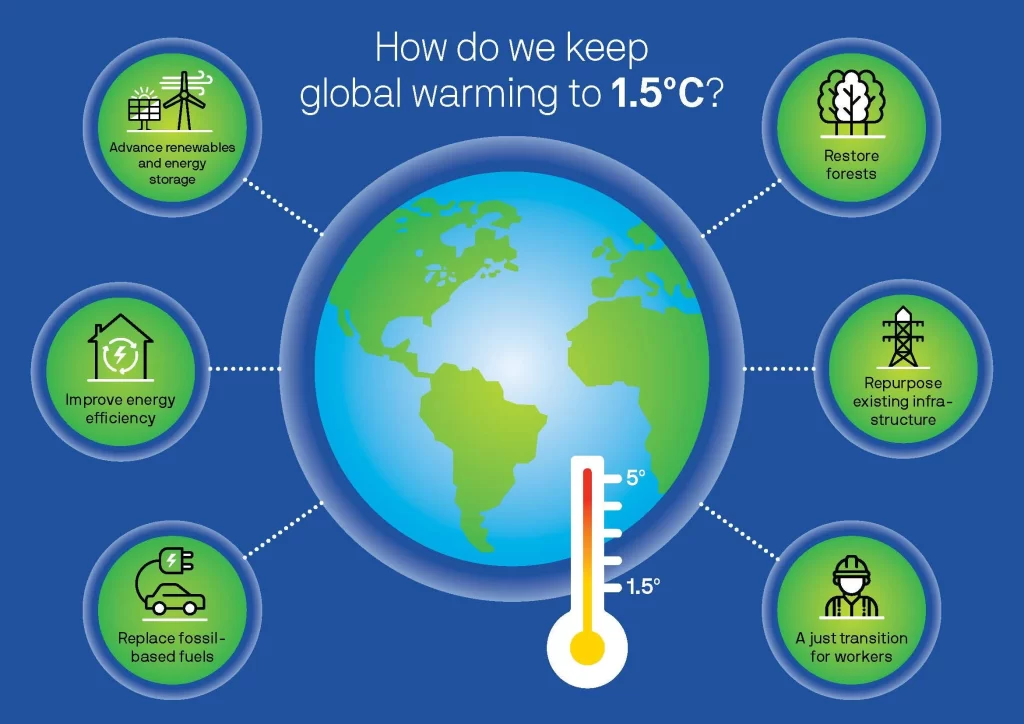
For a long time, scientists and world leaders have been telling us that we need to act quickly to reduce the temperature rise to 1.5°C. The most current assessments make it obvious that all sectors need to make big cuts to their emissions quickly this decade to avert catastrophic climate tipping points.
Why the 1.5°C Threshold Matters
The Paris Agreement of 2015 made the 1.5°C goal a highly critical limit for all of humanity. Going past it could produce changes that can’t be undone, such ice sheets splitting apart or a major loss of species. If nothing is done, the world will be 2.5°C or higher by the end of the century.
This limit isn’t random. Research indicates that each degree is significant. At 1.5°C, coral reefs could lose 70–90% of their coverage, while at 2°C, that percentage goes up to 99%. If the temperature rises by 2°C, sea levels will rise by another 10 cm by 2100, placing 10 million more people at risk of having to move.
We need to start cutting emissions right away, and we need to do it quickly and thoroughly. By 2030, we want to cut global CO2 emissions by 43% from 2019 levels. Delays make the problem considerably worse because the warming will endure for hundreds of years.
Scientific Foundations and Current Evaluations
Recent comprehensive assessments illuminate the path forward. They say without a doubt, “This decade, all sectors must make quick and deep cuts to emissions if we want to keep warming to 1.5°C.” The goal is to get to net-zero CO2 by 2050, but the 2020s are the most essential decade.
After COVID, global emissions reached a short-term peak, but then rose to new highs in 2023, reaching 37.4 billion tonnes of CO2-equivalent. Fossil fuels accounted up 86% of the main energy source, and coal alone caused more pollution than all renewable sources put together. In 2023, renewables grew by 50%, but they only supplied 30% of electricity. This is a long way from the 65% needed by 2030 to stabilize the temperature at 1.5°C.
The disparity is shown by important numbers:
According to the present rules, the temperature will go up by 2.6°C.
If promises are kept, the temperature will only go up by 2.1°C.
Every year, complete execution of national programs is still 15 to 23 gigatons short.
Experts claim that the technology that is available right now affects how possible a project is. For example, the price of solar energy has reduced 89% since 2010, wind energy has dropped 70%, and batteries have dropped 98%.
Reducing emissions by sector
We need to utilize multiple strategies to accomplish substantial and speedy cuts in emissions in different fields. One lever isn’t enough; you need to put them all together.
Energy: Getting Rid of Fossil Fuels
The power sector needs to lower its carbon emissions by 80% by 2030. The first thing on the list is to stop using coal. By 2030, emissions from coal must be cut in half. Renewable energy sources need to be able to produce 11,000 GW more power. Adding electric heating and transportation makes demand go up, but the extra efficiency makes up for it.
– Policies and grids should make solar and wind power 70% of all electricity by 2030.
– When renewable energy sources don’t work, nuclear and hydro fill in the gaps.
– Carbon capture: Necessary for residuals, with an aim of removing 5–15 GtCO2 per year by the middle of the century.
– China contributes the most solar power to the grid, but the grid still has challenges. Plans for renewable energy in Europe speed this further, with the objective of 45% renewables by 2030.
Transportation: Make it better and electric
Transportation is responsible for 24% of emissions, and by 2030, they need to be cut by 80%. In 2022, there were 10 million electric cars sold. That number needs to rise to 65 million a year. By 2030, 20% of all fuels used in aviation and shipping will have to come from renewable sources.
More public transportation means less demand. Buses and trains might cut emissions in cities by 30%. The bike paths in areas like Nagpur, India, appear like they may help the area in a good way.
Change to a Circular Economy in the Industry
Heavy industries like steel, cement, and chemicals generate 30% of their emissions through processes, not only energy. To make a big difference in emissions, we need to electrify (like producing steel using hydrogen) and cut down on demand. The percentage of cement’s clinker substitute that is used needs to go from 10% to 50%.
Roadmaps propose that $4 trillion should be spent every year, and subsidies for fossil fuels should be moved.
Buildings and Farming: First, Fix Things So They Work Better
Buildings use 35% of the energy, so we need to add heat pumps and insulation to them to cut emissions by 60%. Precision farming and changes to plant-based foods are needed in agriculture, which is responsible for 18% of global emissions (mostly methane). Reforestation can get rid of 300 GtCO2 by 2050 if it is done on a wide scale.
Political Realities and Problems
Nothing happens, even when everyone agrees. In January 2026, talks over climate change between countries fall down because President Trump is putting energy independence ahead of cutting back. Tensions between countries escalate, and coal use goes up because of problems with energy.
But there are chances, like how India’s Nagpur region was the first to create solar parks, which gives the area a lot of electricity.
Economic modeling shows that the benefits are twice as big as the costs. There could be 25 million green employment by 2030.
Technological progress that makes things possible
Breakthroughs make it possible to keep the temperature rise to 1.5°C:
Prices for green hydrogen fell by 30% in 2024, and production is rising swiftly.
Plants want to reduce gigatons of direct air capture.
Smart grids: AI cuts waste by 15% by making demand more efficient.
The private sector is picking up speed. In 2025, electric vehicle deliveries and massive offshore wind projects hit new highs.
Spotlights on regions and progress around the world
Rich countries lead but fall behind: Europe plans to cut emissions by 55% by 2030, and the U.S. spends hundreds of billions of dollars. Developing countries are the most affected since they need a lot of money every year to adapt.
India intends to get 500 GW of non-fossil energy by 2030, and Nagpur in Maharashtra would be home to EV facilities. China’s emissions are likely to reach their highest point soon.
Europe: emissions are down 42% from 1990 (2024).
India: 46% of power comes from renewables (2026).
Brazil: Half of the trees were taken down.
Issues with putting it into practice
There are major differences in fairness: underdeveloped countries need trillions of dollars a year. People don’t want to pay for technology transfer, which slows it down. Better communication is needed.
Social tipping points give us optimism since many people around the world want to reach net-zero.
How to Move Forward: Policy and Action
To make sure that all companies cut their emissions rapidly and deeply this decade:
Carbon pricing: By 2030, it should cover 90% of emissions at higher levels.
Change in subsidies: cease giving money to fossil fuels and start giving money to clean technology.
Supply chains: Don’t let new coal funding happen, and make sure that imports don’t originate from places that have been deforested.
Soon, national plans need to work together, and agreements on renewable energy are becoming more popular.
Bigger effects on society and the economy
Success will save trillions of dollars in damages by the year 2100. Health wins: fewer people die from heat. Biodiversity thrives, which means that billions of people have enough food.
Did you not succeed? A lot of people have to leave their homes because of climate change, and the economy is getting worse. Keeping the temperature at 1.5°C is good for the economy.
Last Thoughts
This decade, all sectors need to cut their emissions by a lot so that warming doesn’t go above 1.5°C. If they don’t, they might fail. There is a clear path with proven technologies and political will. Countries need to act soon to develop successful futures in 2026. The time is running out; we need to make a decision.
To prevent global warming to 1.5°C, all sectors need to decrease emissions right away. It’s time to do something.