India’s plans for space are getting more serious again. As the Gaganyaan TV-D2 mission approaches, ISRO is making small changes to the crew escape mechanism that could make the difference between life and death for future astronauts. This test isn’t simply another launch; it’s an important step toward getting Indians into space by 2027.
The Stakes Behind TV-D2
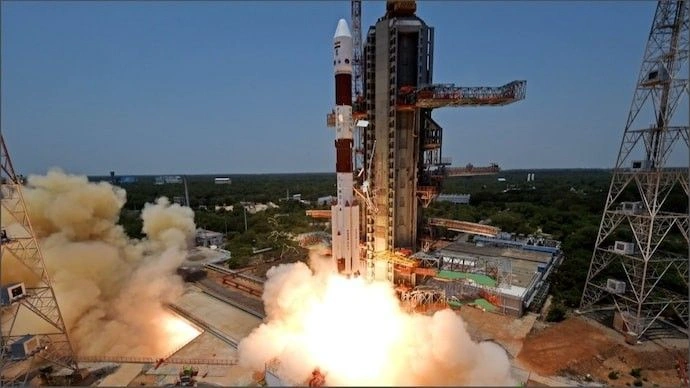
ISRO’s Gaganyaan program has come a long way since it first started, but safety is still the most important thing. The TV-D2 test flight, which should happen soon from Sriharikota, will test the crew escape mechanism at speeds around Mach 1.2, which is where things get tough as the aircraft goes from subsonic to supersonic. The TV-D1 test from 2023 was great at low-altitude abort scenarios, but the TV-D2 test simulates a mid-ascent emergency, climbing to nearly 12 km before initiating the escape.
Imagine this: a rocket breaks down just after it takes off. The CES, which is powered by a Vikas engine on a single-stage test vehicle, blows the crew module away in a matter of milliseconds. First, sensors and AI decide if it’s safer to eject than to ride it out. Then, solid rocket motors ignite, moving the module out of the way. After that, parachutes open to make a soft landing in the water. V. Narayanan, the chairman of ISRO, has said that this might happen as soon as mid-2026, based on recent accomplishments like the second Integrated Air Drop Test on April 10.
What does this mean now? COVID and tech problems caused delays, but Gaganyaan is now in its final prep phase after completing over 8,000 ground tests, including structural qualifications and propulsion inspections. The Satish Dhawan Space Centre has already received the TV-D2 hardware, which means that preparations for the launch have begun.
How the Crew Escape System Works in Real Life
The CES is a great example of how simple and powerful engineering can be. It is on top of the crew module and is ready to launch it from the Human-rated Launch Vehicle Mark-3 if the pressure gets too high or the trajectory goes off. The Low Altitude Escape Motor is one of the most important parts. It was successfully tested in 2022 and gives the module its first thrust to separate early in flight. After separation, eight attitude control motors maintain it stable and turn it upright so the parachute can open.
Next are the parachutes. The drogue chutes slow the fall at first, and then the main chutes bring the speed down to almost zero before hitting the ocean. The recent IADT-02 dropped a 5.7-tonne fake module from 3 km using a Chinook chopper, which exactly confirmed this scenario. Integrated Vehicle Health Management keeps an eye on everything in real time and makes decisions about whether to abort without input from the crew.
In TV-D2, the test vehicle, a cheap liquid-fueled booster, will reach transonic speeds, turn on CES, coast higher, and then drop the module so that Indian Navy and Coast Guard troops may collect it. Tests like TV-D1 in October 2023 proved that the system functions perfectly up to Mach 1.2. However, TV-D2 adds parachute stress under real dynamic stresses. ISRO isn’t done yet. There are more flights planned, TV-D3 and D4, to cover all abort profiles, from liftoff to insertion into orbit. It’s strict, almost obsessive, but that’s what makes Indian space tech stand out: it works well on a tight budget.
A timeline with both successes and failures
Gaganyaan started in 2018 with the intention of sending a crew to space in 2022, however things didn’t go as planned. TV-D1 worked in 2023, showing that the basic CES feature works. Then there were parachute experiments, air-drop tests with help from the DRDO and IAF, and the integration of the Vyommitra robot for the G1 flight without a crew.
It’s already 2026, and IADT-01 and IADT-02 just finished, mimicking splashdowns with full-weight modules. G1 will take Vyommitra to an orbit 400 km above the Earth for three days. It plans to launch HLVM3 from Sriharikota in March. G2 will come out later this year with bigger payloads, while G3 and G4 will be crewed in 2027.
The astronauts—Gaganyatris Shubhanshu Shukla, Prasanth Balakrishnan Nair, Ajit Krishnan, and Angad Pratap—are training hard in India, Russia, and the US. How much did you spend? About Rs 20,193 crore, which is a small part of NASA’s budget because they reused technology from Chandrayaan and Mangalyaan.
Problems? Of course, the epidemic, engine changes, and human assessment of the LVM3 all took time. But every test, like the latest drogue parachute quals, gets closer to the point where you can’t fail.
India’s Role in the Global Space Race
Three countries—Russia, the US, and China—have sent people into space on their own. India wants to be fourth, and Gaganyaan’s CES tech might be sold to private companies through IN-SPACe. It’s happening at the same time as NASA’s Artemis delays and China’s Tiangong station. India’s low-cost concept is getting attention from all across the world.
This really hits home for India. After Chandrayaan-3 landed on the south pole, everyone were really proud. Gaganyaan offers jobs at Bengaluru’s Vikram Sarabhai Space Centre, tech transfers to new businesses, and microgravity experiments through IMEx-2026. It’s a multiplier for the economy—the space sector expanded by 14% last year and is expected to reach $44 billion by 2033.
Every kid in Pune or Mumbai who dreams of stardom receives a boost. Or that engineer in Hyderabad who is working on avionics. What if Indian boots are on orbital grass next Diwali?
There are still problems, though. Re-entry heat shields have to be able to handle temperatures of 4,000°C, life support systems have to be able to recycle air and water for days, and recovery operations have to be perfectly in sync with the Navy and the IAF. What is ISRO’s edge? In-house Vikas engines and crew module structures made from lighter composites.
New technologies that make things safer
ISRO put a lot of clever technology into Gaganyaan. The 5.3-tonne crew module can hold three people for seven days at 400 miles, and the service module provides power and propulsion. CES combines AI-driven IVHM with other technologies to find problems like vibration spikes before people do.
Parachutes? We tested custom drogue and main sets in wind tunnels and drops. Chinooks, ships, and divers all practiced recovery in recent IADTs. Cost hacks, such solid boosters from PSLV, make it cheap.
Human touch: Vyommitra, the half-human, will flip switches, keep an eye on health, and even talk to you through AI—this is the first time teleoperation has been done. Questions like “How’s the cabin pressure?” get genuine responses, which helps them ready for crewed operations.
ISRO Gears Up for Crucial Gaganyaan TV-D2 Test: Validating Crew Escape in High-Stakes Push for India’s Human Spaceflight Dream