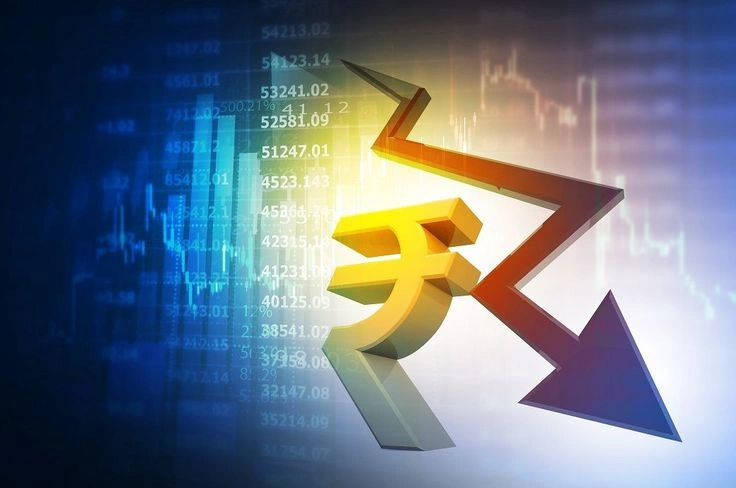
This morning, Indian financial markets awoke to a familiar, but more jittery image. The Indian rupee opened at 94.37 against the US dollar. Traders and commoners are all wondering what this steady decrease means for the overall economic picture. But it’s more than simply a squiggle on a ticker tape. If the first few months of 2026 have been characterized by the complex ballet of global instability, changing patterns of investment and declining market confidence… India has been on a run in terms of macroeconomic momentum, but the current currency turmoil is a reminder of a truism that even the finest rising countries are finding difficult to ignore.
The Anatomy of the Present Depression
To understand why the rupee is in this vulnerable zone, one has to look beyond the daily moves. The prime cause is a textbook case in supply and demand, worsened by a merciless global climate. The US dollar index is trading higher as investors weigh a solid economic data release from the States and an environment of uncertainty globally and capital will naturally migrate towards what is viewed as a safer harbor. This capital outflow, notably by Foreign Portfolio Investors (FPIs), is perhaps the most immediate drag on the currency. These major investors are simply flooding the market with rupees and hurriedly buying up greenback when they sell their Indian equities and bonds to get their money back into dollars.
The burden is reinforced further by rising oil prices, which have been a thorn in the Indian trade balance for long. India imports most of its crude oil needs. Any rise in the worldwide cost of energy then instantly forces the government to pay out more dollars , enhancing the demand for foreign currency and diminishing domestic reserves . Add that to the current geopolitical concerns in the Middle East and the risk aversion seen in the major global markets and you can see why the rupee is trying to find a footing.
View: Domino Effect
A weakening rupee is usually not a spectacular crash but a slow-moving wave, but its reach is wide. For the average Indian consumer, the immediate impact is seen at the petrol pump and the food store. Many basic materials and energy are priced in dollars, thus a weaker rupee means higher pricing for these important imports. Ultimately these prices are passed down the supply chain, adding to imported inflation that can hit household budgets.
Some of the factors that frequently complicate this landscape include:
Bill Inflation Import Rising costs of fuel, electronics and specialty machinery are lifting prices for businesses and families.
Export Competitiveness : Normally a weaker currency is seen as a “ gift ” to exporters , as their products become cheaper for foreign buyers . But the advantage is usually wiped out by the rising cost of importing raw components .
Debt Servicing: Companies and governments with dollar-denominated debt will need to pay more to service that debt, which might constrain balance sheets and expansion plans.
Investor Sentiment Sometimes a declining currency creates a feedback loop, where fear of more depreciation causes investors to sell even faster, making the same scenario they fear worse.
Is this a lasting shift in the market dynamics or is this a rough spot in an otherwise good growth story? We want to blame one bad guy, but the reality is it’s just all of these demands all at once. The Economic Survey 2026 underscored this, citing “disorderly multipolar breakdowns” and supply chain realignments as continual threats. It reminds us that India, for all its relative power, is not immune to the wider, shifting tectonic plates of global finance.
Courage in the Tempest
Stay cool in the headlines. India starts this phase of turmoil from a far better base than in previous decades. The Reserve Bank of India (RBI) remains a key pillar in the story, maintaining a close check on the currency market and stepping in to curb excessive volatility whenever required. Their policy is rarely about protecting any hard figure. It is about smoothing out the peaks and troughs so that the broader economy can operate without the panic that sharp, steep devaluations can create.
India’s new commercial relations with the UK, Oman and New Zealand, which are aimed at diversifying its trading partnerships, are also a type of proactivity in economic diplomacy. The government is progressively creating a buffer against localized disruptions by restricting dependence on one economic corridor. “These structural actions will not eliminate the exchange rate pressures that we see now, but they are an indication of a commitment to stability in the longer term.
The Road Ahead
As we move into the rest of the year, the story of the rupee will likely be driven by domestic policy and the global interest rate cycle. If global tensions ease or there is a change in stance on interest rates by major central banks, the pressure on the currency could ease. But until then the market will likely continue to trade with a good deal of caution.
The goal for businesses and policy makers continues to find this fine balance – to generate growth while controlling the vulnerabilities of an interlinked global economy. It’s a balancing act that demands both patience and quickness. For those of us watching from the sidelines, it’s a reminder that in the interconnected world of modern finance, the local is always closely connected to the global. “The coming weeks will be a litmus test for the rupee and will reveal much about the longevity of this current economic cycle and, more importantly, how fast India can adapt to a world that seems more unpredictable by the day.” This weakening may be the new normal or just a blip, but it will certainly be one of the defining economic stories of 2026.
Riding the Volatile Wave: Why the Indian Rupee is Confronting New Economic Headwinds