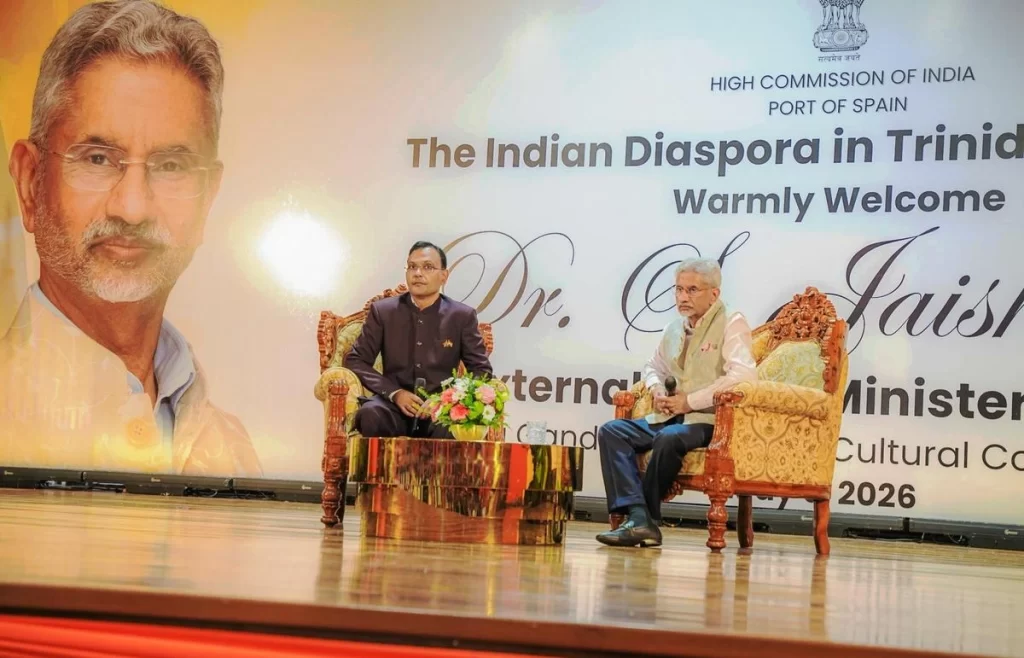
Bilateral relations have received a new impetus with the recent visit of External Affairs Minister S. Jaishankar to Trinidad & Tobago. The two countries inked eight fresh MoUs spanning tourism to renewable energy, highlighting India’s expanding foothold in the Caribbean.
It’s not just paperwork. It’s an acknowledgment of past shared and dreams to come. Almost 40% of Trinidad and Tobago’s 1.4m population are descended from Indian indentured labourers who arrived more than a century ago, so these pacts feel personal. The three-nation Caribbean tour of Jaishankar was concluded with a visit on May 8-9, 2026 that brought concrete benefits such as 2,000 laptops for schoolchildren and a new agro-processing factory.
Jaishankar’s packed schedule
Jaishankar arrived in Port of Spain with big expectations. He met Prime Minister Kamla Persad-Bissessar immediately to discuss strategies of building on the visit of Prime Minister Narendra Modi there in 2025. Discussions ranged from commerce and security to capacity building – real stuff that may make a difference in everyday lives.
Imagine it: the two presidents at the signing ceremony, with pens in hand, as aides shuffled papers. It was a moment that resonated emotionally for Persad-Bissessar, who has her own Indo-Caribbean roots, when Jaishankar handed those laptops over to excited kids. He also cut the ribbon on an Indian-aided agricultural complex in Couva which had $1 million worth of machinery sent last year.
Then came the emotional stop at Nelson Island. This speck off the west coast of Trinidad was a quarantine station for Indian arrivals from 1845 to 1917. More than 134,000 indentured workers came through, their ambitions and struggles imprinted on the country. Today, upgrading it pays tribute to its tradition, and makes it a heritage site.
While Jaishankar termed it as a “quick impact project”, for the diaspora it is more than that—a bridge to the past. They even built a National Prosthetics Centre in Penal, including healthcare help and public relations all in one.
Explainer on 8 MoUs
The agreements cover different areas, each suited to Trinidad and Tobago’s requirements and India’s strengths. Here’s a quick rundown:
Tourism cooperation: To promote cultural sites through visitors’ exchanges, using Trinidad’s Carnival popularity and India’s heritage attractions.
Solarisation of the Ministry of Foreign Affairs building: India will help to solarise the Ministry of Foreign Affairs and CARICOM Affairs building in Trinidad using solar panels to reduce the energy costs and emissions.
Vector Control: Joint work on diseases like dengue, malaria and sharing Indian knowledge of public health.
Nelson Island infrastructure upgrade. Revamping historic site for education & tourism, conserving Indo-Caribbean history.
Indian Chair on Ayurveda at University of the West Indies: Establishing a home for traditional Indian medicine in Caribbean academics through an endowed chair.
Healthcare collaboration: Prosthetics, pharma? India’s generics strength to shine
Green tech sharing outside the government project. Renewable energy projects.
Impact projects: Small visible projects, e.g. the agro plant and laptops.
These are not hollow promises. They are actionable, with implicit timelines in the handovers throughout the visit and .
Why eight in particular? It feeds into Trinidad’s call for development aid in the face of energy sector challenges – volatile oil prices and the need for diversification. India jumps in with technology, know-how and no strings attached.
Indian Diaspora: Roots in History
The story of Trinidad and Tobago and India began in the 1800s. British planters hired labourers from Bihar and Uttar Pradesh to work on sugar estates after the abolition of slavery. The first wave of arrivals came on ships like the Fatel Razack, from 1845 and 1917, and approximately 42% of today’s population may claim this lineage.
These “girmitiyas” (from the indenture agreement, or “girmit”) survived hard conditions but created lively communities. Now they’re physicians and lawmakers and CEOs. This is exemplified in Persad-Bissessar herself, whose grandparents were newcomers. Festivals like as Phagwa (Holi) and Divali light up islands with a blend of Indian traditions and Caribbean flair.
This diaspora is a soft power goldmine for India. New Delhi finds a voice in around 1.5 million Indo-Caribbeans scattered over the region. Events like the Pravasi Bharatiya Divas 2024 only underscored this and Jaishankar’s visit strengthens those ties.
However, issues remain. For the younger generations, identification is an issue – how Indian are they, really? These MoUs, notably on culture and heritage, help to answer that.
Economic Relations Get Hot
Trade between the two has been growing steadily. It grew from $264 million in 2020-21 to $341 million in 2024-25. India exports medications (about $120 million last year), as well as automobiles, iron, steel and plastics. In return Trinidad exports mineral fuels, oils and aluminum, its petrochemical advantage.
1997 Trade Agreement provides Most Favored Nation designation, lowering duties. New MoUs might further boost this, notably in pharma, renewables. Picture this: Indian solar businesses setting up shop in the sunny climes of Trinidad.
India is also huge on Lines of Credit – $100 million for infrastructure pre-visit. They signed agreements on UPI-like digital payments during Modi’s visit. Jaishankar also pressed for cooperation on cyber-security and forensics, with an eye on collaborative training.
Here is the potential for Indian company. “Companies such as Tata and Reliance are already eyeing Caribbean ports. India’s measures are a prudent balancing act against China’s growing regional dominance.
Caribbean strategy play
Jaishankar’s three-nation journey reflects India’s ‘neighbourhood first’ extended to the Global South. The Caribbean counts: 14 votes in UN forums, shared climate vulnerability and small island resilience.
And sometimes Trinidad chairs CARICOM, giving its viewpoint more weight. Both countries agree on UN reforms, debt relief for developing countries. No wonder Jaishankar was pushing for coordination for the Global South.
It’s geopolitical chess. Some islands are dependent on loans from China, India provides grants and technology. Laptops are the avatars of digital inclusion. India’s DPI stack could be next in line. How about Caribbean youth coding apps with Indian tools? Game changer.
Climate is big too. Trinidad fights hurricanes; India’s solar help matches rising seas discussion. Vector control fights mosquito-borne diseases, worsened by warming.
Real-World Impact at Home
This resonates in India. Pune professionals create social media buzz over diaspora stories Movies like Coolie celebrate Indo-Caribbean stories in Bollywood. Travel companies look at packages combining Trinidad Carnival with Goa atmosphere.
Stock market? Pharma exporters like Sun Pharma have better access. Spot contracts for renewables players like Adani Green.
It adds to Modi’s global appeal. Trump’s US-Caribbean ties appeal India’s steady hand post-2024 election
Future Outlook:
These eight MoUs are more than ink, they’re a road map. By next Diwali, expect Ayurveda clinics to come up, solar panels to shine on government roofs and Nelson Island to attract tourists.
India and Trinidad, bonded by sweat and success, now flourish with tech and trade. Will this bring a Caribbean boom? Time will tell, but the momentum is real. For families in the diaspora, it is a complete circle moment, the sacrifices of ancestors fuelling the advancement of tomorrow.
India, Trinidad and Tobago sign 8 key pacts, Jaishankar’s visit strengthens diaspora ties, green cooperation