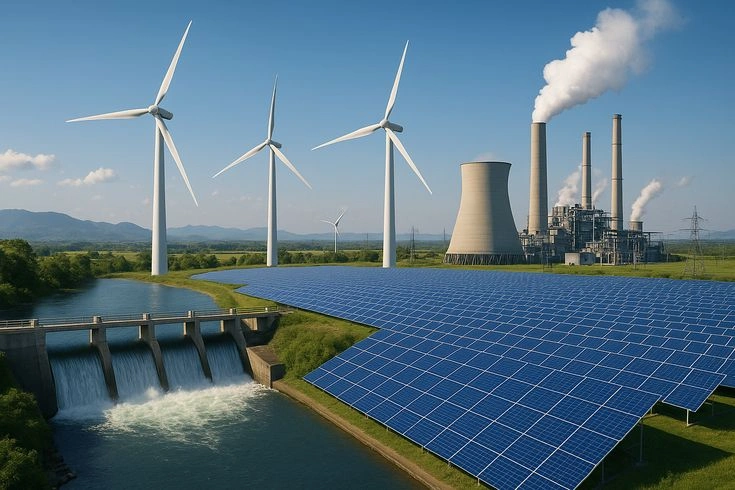
India has reached a key milestone and moved into third place in the world for installed renewable energy capacity. This leap is coming from a tremendous push in clean energy which is transforming the nation’s electricity grid and putting it on the world map for sustainable growth.
The Great Leap Forward”
Come to think of it, India’s renewable set up was small at best, ten years ago. Today, the country has more over 220 GW of capacity as of early 2025, and forecasts suggest that the number would climb even higher in 2026. In FY 2024-25 alone, a massive 29.52 GW was added, raising the total to 220.10 GW from 198.75 GW in the year earlier. Solar led the way with an addition of 23.83 GW, more than double the 15.03 GW added in the previous year, while wind contributed 4.15 GW.
India added another record 51 GW in FY26 by mid-2026, led by solar, wind and hybrid projects, reports said. That puts India ahead of countries like Germany and Japan, just behind heavyweights like China (approximately 1,750 GW) and the US (480 GW). Brazil is close at 210 GW with a hydro-heavy mix but India’s solar tilt gives it a lead in non-hydro renewables. What does this mean for a country like India, where energy demand is soaring?
The numbers in detail
Want to get a sense of scale? Here are some notable data from recent years:
Solar Power – 129.92 GW by end of 2025, approximately 65% of India’s renewables It overcame Japan to become the third greatest solar producer in the world, with more than 108,000 GWh.
Total Renewables Share: Represents over 40% of India’s overall electricity capacity—a ratio that was far lower a decade ago.
Capacity has tripled from 75 GW in 2014 to 232 GW by mid-2025 Annual Growth:
These are not just numbers on a page. They are lighting up homes, factories and cities across a country of 1.4 billion people. In Rajasthan and Gujarat, there are huge solar farms in the desert, converting sunshine into a reliable stream of electricity. Wind turbines in Tamil Nadu and Maharashtra continue to turn steadily, adding to reliability.
India’s No. 3 ranking is not a fluke. Government targets are 500 GW by 2030 and they are on course to meet them. The projected 50 GW in FY26 would be one of the largest annual gains ever.
Government Policies that Fan the Flames
Prime Minister Narendra Modi’s vision has been at the core. National Solar Mission and PM Suryaghar plan have injected investments in rooftops and mega-projects. This has been backed by budgets that incentivise green hydrogen and storage development.
The linked incentives (PLI) for solar module manufacturing have reduced dependence on imports and pushed local manufacturing. We have more than 50 GW of projects in the pipeline, including hybrid solar and wind projects for 24/7 power. States also matter. Andhra Pradesh and Karnataka are leading in new auctions.
But there are still problems. There is a need to improve delays in land acquisition and grid integration to be able to accommodate variable solar and wind.” But offers on battery storage are on the rise, promising a more seamless supply.
Solar: The Star Player
India is proud of Solar’s story. There are panels in dusty Rajasthan fields, and on metropolitan roofs. 58% increase, 23.83 GW added FY24-25. By October 2025, solar had overtaken Japan (129.92 GW) .
Why the boom? Costs have collapsed – solar is now cheaper than coal in many places. Developers have won 10 GW in the recent auctions at record low rates. Take Gujarat’s Charanka park, among Asia’s largest, which powers millions.
But it’s not all smooth sailing.” Monsoon clouds and dust reduce efficiency, therefore cleaning technology and floating solar on reservoirs are technologies gaining popularity. Now India exports modules as well, looking for a global market.
Wind and beyond: Broadening the mix
Last year wind grew 4.15 GW, recovering from slower times. Another 70 GW could be added to the offshore potential off Gujarat and Tamil Nadu shores. Hybrids are crucial — wind and sun complement each other.
Hydro power is still around 50 GW but new big dams are opposed on environmental grounds. Biomass and small hydro bridge the gaps, especially in rural areas. Billion-dollar ambitions to test green hydrogen might alter industry and transit.
Global Standing and India’s Edge
Renewables grew by 585 GW in 2024, taking the global total to 4,448 GW. China remains at the top, but India’s growth rate is remarkable, having overtaken Germany to become the third largest solar-wind producer by 2024.
Rank Country Capacity (GW, ~2026)Major Strengths
1 China 1,750 Solar & Wind
2 USA 480 Wind & Solar
3 Brazil 211 Hydroelectric
4 Canada 185 Hydro
5 India 179 Solar (1)
India at 179 GW here but new data says 220+ GW confirming the 3rd position with recent additions. India’s solar gamble puts it on track for bright tomorrows, unlike hydro-dependent Brazil.
The Ripple Effect of the Economy
This is not only about power, it’s about jobs and growth. Over a million jobs in just solar , from panel manufacturers to installers . Exports of equipment are expanding and lower energy cuts industry costs, helping industries hurt by global competition.
For the average Indian, lower tariffs mean lower bills. Solar pumps electrify rural areas, help agricultural in arid Maharashtra. Exports to neighbors such as Bangladesh over grids build stronger ties.
Coal is still the main fuel mix with 50% capacity, Jharkhand and other coal belt areas need retraining for miners transitioning. There are thousands of green employment that can help. How do you develop quickly while keeping fair labor hours?
The Challenges Ahead
Every success story is bumpy. Transmission lines lag, leaving power stranded on outlying farms. Just 10% of renewables have firm contracts, which might damage investor trust.
Financing is another pinch – green bonds flow but high interest rates punish developers. Chinese panel import penalties spur domestic push, but supply chains take time
Pressure from climate targets. This additional capacity is in line with India’s COP26 commitment of net-zero by 2070. But resilience is tested by harsh weather – last year projects were devastated by floods.
Implications for India and the world
Clean energy is transforming life from Mumbai offices to remote Himalayan hamlets Schools with solar power. No diesel genset noise. Less smog in cities, cheaper EV charging.
India’s approach is a model for the world. Developing nations see how it scales without huge subsidies. With US energy independence a priority for President Trump, India’s renewables provide a joint opportunity – sharing technology might speed up global change.
Looking ahead, FY27 might add 60 GW if auctions hold. Storage and smart grids are game changers. Will India reach 500 GW by 2030? The momentum indicates yes but it’s all in the execution.
This boom puts India in the pole position in clean energy. It’s not ideal, but the path is clear: greener, brighter days ahead. Demand is expected to increase by 2030 with renewables as the backbone. Great days for a country fueling its future, panel by panel.
India Becomes 3rd Largest in Renewable Energy Capacity Globally as Clean Power Boom Continues