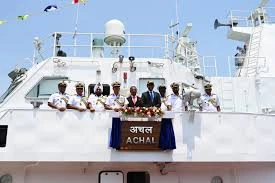
India’s maritime security apparatus has taken another decisive step forward with the formal commissioning of ICGS Achal, a new‑generation Fast Patrol Vessel designed to reinforce coastal surveillance, offshore patrols, and rapid‑response capabilities along the country’s long coastline. The vessel was formally inducted into the Indian Coast Guard (ICG) fleet at Goa Shipyard Ltd, marking a broader push to modernise India’s coastal defence and better protect its offshore energy infrastructure, trade routes, and maritime interests in an increasingly tense regional environment.
More than just another patrol boat, ICGS Achal carries symbolic weight. Its name, which means “firm” or “unshakeable,” reflects the navy’s and Coast Guard’s intent to project a steady, reliable presence in India’s offshore belts even as smuggling, illegal fishing, and maritime threats grow more sophisticated. In a region where the Indian Ocean is becoming a focal point of strategic competition, how India operates its Coast Guard fleet could well shape how safe and secure its coastal economy feels in the decades ahead.
What ICGS Achal brings to the fleet
ICGS Achal is part of the new‑generation Adamya‑class Fast Patrol Vessels, a series being built domestically to reduce reliance on imported platforms and boost India’s shipbuilding ecosystem. At around 50–52 metres long and displacing about 320 tonnes, Achal sits in a sweet spot: large enough to carry meaningful sensors and fuel for extended patrols, yet small and agile enough to operate close to shore and in congested traffic‑heavy zones.
The vessel is powered by two advanced diesel engines, each generating around 3,000 kW, giving Achal a top speed of roughly 27 knots and an operational range of about 1,500 nautical miles. That range allows patrols far beyond the visible coastline, stretching into India’s offshore Exclusive Economic Zone (EEZ) where oil platforms, gas rigs, and underwater infrastructure need constant monitoring.
From a technical standpoint, Achal is built with dual‑class certification (ABS and IRS), which means it meets both international and Indian Register of Shipping standards. Around 60% of the vessel is indigenously content, a figure that signals India’s growing ability to design and assemble complex maritime platforms at home rather than relying on foreign suppliers. This blend of speed, endurance, and domestic design is precisely what the Coast Guard needs to respond quickly to suspicious vessels, suspected smuggling boats, or distress calls.
Strengthening coastal security and offshore assets
ICGS Achal’s immediate mandate is to enhance maritime security and surveillance, especially in the neighbourhood of India’s energy nerve centres and busy coastal stretches. The vessel will be deployed at Vadinar in Gujarat and will function under the Commander Coast Guard Region North West, which is one of the busiest maritime zones in the country. This region is home to major oil refineries and ports and also witnesses substantial movement of fishing boats, merchant vessels and offshore assets, all requiring meticulous observation.
Coastal security is no longer about keeping out gun-toting intruders. It also involves tracking illegal fishing, petrol and diesel smuggling, drug trafficking, and even marine pollution incidents. Achal is expressly equipped for this wide spectrum of tasks: coastal and offshore surveillance, interdiction, search and rescue (SAR), anti‑smuggling operations, and marine pollution response. Think of it as a multi‑task patrol platform that can chase a suspicious vessel, rescue fishermen in distress, or help contain an oil slick—all within a single deployment.
Offshore assets such as oil platforms, gas rigs, and subsea pipelines are particularly vulnerable. These installations lie far from the shore and can be difficult to monitor with static systems alone. A fast patrol vessel like Achal can dart between platforms, respond to tampering or security breaches, and work in tandem with surveillance aircraft and satellites. In an era of rising maritime hybrid threats—where state and non‑state actors blur the line between smuggling, espionage, and low‑intensity conflict—this kind of presence matters more than ever. How resilient can India’s offshore economy be if its platforms remain exposed to sabotage or unchecked illegal activity?
India’s broader maritime security challenge
India’s coastline stretches over 7,500 kilometres, and its EEZ covers an area larger than its landmass. Patrolling this vast expanse with limited resources has always been a challenge. The Indian Coast Guard, along with the Navy and maritime police, has been steadily expanding its fleet, but patrol gaps still exist, especially in the western and eastern coastal belts.
The induction of vessels like Achal is part of a longer‑term fleet‑expansion plan. Over the past few years, the Coast Guard has inducted several new‑generation Fast Patrol Vessels and Offshore Patrol Vessels, each with improved sensors, communication systems, and endurance. These platforms are not just about “showing the flag”; they are about maintaining a continuous presence, collecting real‑time data, and ensuring that suspicious activity does not go unnoticed for days or weeks.
India’s security calculus is also shaped by its neighbours. The western coast faces a complex maritime environment, with smuggling routes, illegal fishing, and cross‑border movements that have long been exploited by hostile actors. The eastern coast, meanwhile, is increasingly relevant as India expands its naval and Coast Guard footprint in the Indo‑Pacific, an area where New Delhi has declared a strong interest in “freedom of navigation” and regional stability.
Against this backdrop, Achal is not just another boat; it is a small but visible piece of India’s maritime footprint. If India can project consistent, visible control over its coastline and offshore zones, it sends a clear message to both potential adversaries and regional partners: that its maritime domain is not up for grabs.
Surveillance, response, and real‑world impact
One of the less‑discussed but critical aspects of Achal’s induction is its surveillance and response capability. Fast Patrol Vessels are typically equipped with modern radar, electro‑optical systems, and communication suites that allow them to track multiple targets, share data with shore‑based command centres, and coordinate with other ships or aircraft. This kind of networked capability is essential if the Coast Guard wants to move beyond reactive patrols and toward predictive, intelligence‑driven operations.
In practice, that means being able to:
Detect and track vessels that are not broadcasting their position (AIS‑off or “dark” ships).
Identify suspicious patterns—such as repeated night‑time movements near ports or oil facilities.
Respond rapidly to distress calls from fishing boats or merchant ships.
For communities near the coast, this means more safety and predictability. A robust patrol presence can deter illegal fishing, which not only harms marine ecosystems but also deprives local fishermen of their livelihood. It can also reduce the risk of piracy‑like incidents or ransom‑driven kidnappings at sea, worries that have occasionally surfaced in Indian and regional waters.
Domestic shipbuilding and “Atmanirbhar” security
ICGS Achal also fits into India’s broader narrative of indigenous shipbuilding and self‑reliance (“Atmanirbhar Bharat”). About 60% of the vessel’s components and systems are domestically sourced, from its hull structure to a significant portion of its machinery and electronics. This is not a fully self‑made ship—certain advanced sensors and weapon systems may still come from abroad—but it reflects a clear shift toward in‑house design and production.
Shipbuilding is one of the few sectors where India can build high‑technology industrial capability while simultaneously strengthening national security. When patrol vessels like Achal are built in Goa or other Indian shipyards, jobs are created, skills are honed, and an ecosystem of suppliers and subcontractors grows around them. Over time, that ecosystem can support not just Coast Guard vessels but also Navy ships and even export opportunities, should India ever decide to compete in the global warship‑export market.
At the same time, there are questions about whether India can sustain this pace. Fleet‑modernisation plans often run into cost overruns, delays, and bureaucratic hurdles. How many more Achal‑class vessels are in the pipeline, and how quickly can they be delivered? Without a steady flow of new ships, even a well‑designed platform like Achal will struggle to close the patrol gaps that currently exist along India’s coasts.
Indian Coast Guard Commissions ICGS Achal to Strengthen Coastal Security and Maritime Surveillance