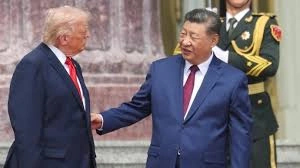
The air inside the Great Hall of the People was grand and ceremonial — military bands, cannon salutes, schoolchildren waving flags — but behind the pageantry, the message from China’s leader was unmistakably blunt. In one of the most consequential diplomatic encounters in recent memory, President Xi Jinping told US President Donald Trump on Thursday that the Taiwan question is not just a bilateral irritant but a potential trigger for war.
“The Taiwan question is the most important issue in China-US relations,” Xi said during a closed-door meeting in Beijing, according to China’s state broadcaster CCTV. “If mishandled, the two nations could collide or even come into conflict, pushing the entire China-US relationship into a highly perilous situation.”
It was a stark opening salvo — the kind of language that diplomats spend months crafting, delivered in the very first hours of a two-day summit. And it came wrapped in an otherwise warm reception for a US president visiting Beijing for the first time since 2017.
—
## A Summit Nine Years in the Making
Trump’s state visit to China marks the first by a sitting American president in nearly a decade. The ceremony alone said something: Xi welcomed Trump with a red-carpet reception, a gun salute, and military fanfare — the kind of welcome that signals China’s eagerness for stability, even as it presses its core interests hard.
“It’s an honour to be with you. It’s an honour to be your friend, and the relationship between China and the USA is going to be better than ever before,” Trump told Xi at the outset. For his part, Xi struck a philosophical tone, invoking an ancient Greek concept to frame the challenge ahead. “Can China and the US transcend the so-called ‘Thucydides Trap’ and forge a new paradigm for major power relations?” he asked, referencing the theory that a rising power challenging a dominant one historically leads to war. “Cooperation benefits both sides, while confrontation harms both. We should be partners and not rivals.”
That sentiment, welcome as it sounds, was quickly tested when the conversation turned to Taiwan.
—
## Taiwan: The Elephant in the Room — and on the Agenda
China has never controlled Taiwan. The self-governing island of 23 million people has operated as a de facto independent democracy for decades, yet Beijing insists it is sovereign Chinese territory and has vowed to bring it under its control — by force if necessary. The United States, while not maintaining formal diplomatic ties with Taipei, remains Taiwan’s most critical security guarantor under the Taiwan Relations Act of 1979, which describes threats to the island as being “of grave concern” to Washington.
That legal and strategic commitment is what makes the US-China-Taiwan triangle so explosive. And right now, it is more charged than ever.
In December 2025, the Trump administration announced a record arms sale package to Taiwan worth approximately $11 billion — described as the largest to date — including rocket systems, drones, and anti-tank missiles. Delivery has not yet moved forward, and Trump’s own words ahead of the summit did little to reassure Taipei. “I’m going to have that discussion,” Trump told reporters before departing for Beijing, when asked whether he would consult Xi about the arms sale. “President Xi would like us not to. And I’ll have that discussion.”
Those words sent a chill through Taiwan’s foreign ministry, even as Taipei’s Foreign Minister Lin Chia-lung publicly maintained confidence that US policy would not change.
Could Taiwan become a bargaining chip in a broader geopolitical deal between Washington and Beijing? That’s the question haunting analysts and policymakers in Taipei — and across much of Asia.
—
## Iran Complicates the Picture
A new dimension has entered this already complex equation: Iran. The United States has been engaged in a military conflict with Iran, and Trump arrived in Beijing partly hoping to enlist Xi’s help in pressuring Tehran toward a deal. China purchases most of Iran’s US-sanctioned oil, giving it unique leverage over the Islamic Republic.
Trump said he expected “a long talk” with Xi about Iran, while simultaneously insisting he doesn’t think the US “needs any help with Iran” from Beijing — a somewhat contradictory position that reflects the awkwardness of asking a strategic rival for diplomatic assistance.
Secretary of State Marco Rubio, long regarded as one of Washington’s most hawkish voices on China, struck a more accommodating tone. He told Fox News that the US hopes to convince Beijing “to play a more active role in getting Iran to walk away from what they are doing now.”
For China, analysts believe the Iran conflict has actually strengthened its negotiating hand. Beijing has demonstrated a willingness to weaponise its economic leverage — from rare earths to oil trade — in ways that have rattled Washington in recent months. Whether Xi will use that leverage to extract concessions on Taiwan, trade, or both remains to be seen.
## The Thucydides Trap — and How to Avoid It
Xi’s invocation of the Thucydides Trap was intended, and it worked on both sides. On one level, it was an appeal for cooperation — a recognition that competition between the world’s two largest economies, if left unchecked, carries catastrophic risks. On another level, it was a reminder of Chinese confidence: Beijing has studied how rising powers have historically navigated — and sometimes failed to navigate — their rivalry with the established order.
What does all of this mean for the world? The honest answer is that few bilateral relationships carry higher global stakes than this one. The US and China together account for nearly 45% of global GDP. Their supply chains are intertwined with virtually every economy on earth. A serious military confrontation over Taiwan would not just devastate the two countries involved — it would shatter global trade, financial markets, and security arrangements that have underpinned relative stability for decades.
—
## What Comes Next
After the first day of talks, Trump and Xi visited the Temple of Heaven, a ceremonial complex dating to the Ming Dynasty — a moment clearly designed to convey historical gravitas. A state banquet followed Thursday evening. A second round of talks was scheduled for Friday.
No joint communiqué or major announcement had been confirmed as of Thursday afternoon, and analysts tempered expectations accordingly. “Although expectations are low and no grand bargain is likely, the welcoming ceremony and initial remarks at the opening session highlight how truly consequential this relationship is for the world,” analyst Scott Kennedy noted.
The outcomes — whether a tariff truce extension, a quiet understanding on Taiwan arms deliveries, or a vague framework for managing tensions — will matter enormously. So will what is not said. In diplomacy between superpowers, silence can be as significant as any public statement.
Taiwan watches. The world watches. And the question Xi posed to Trump on Thursday — whether two great powers can find a way to coexist without sliding toward conflict — may be the defining geopolitical question of this decade.
—
Xi Jinping Warns Trump: Mishandling Taiwan Could Push US and China Into Direct Conflict