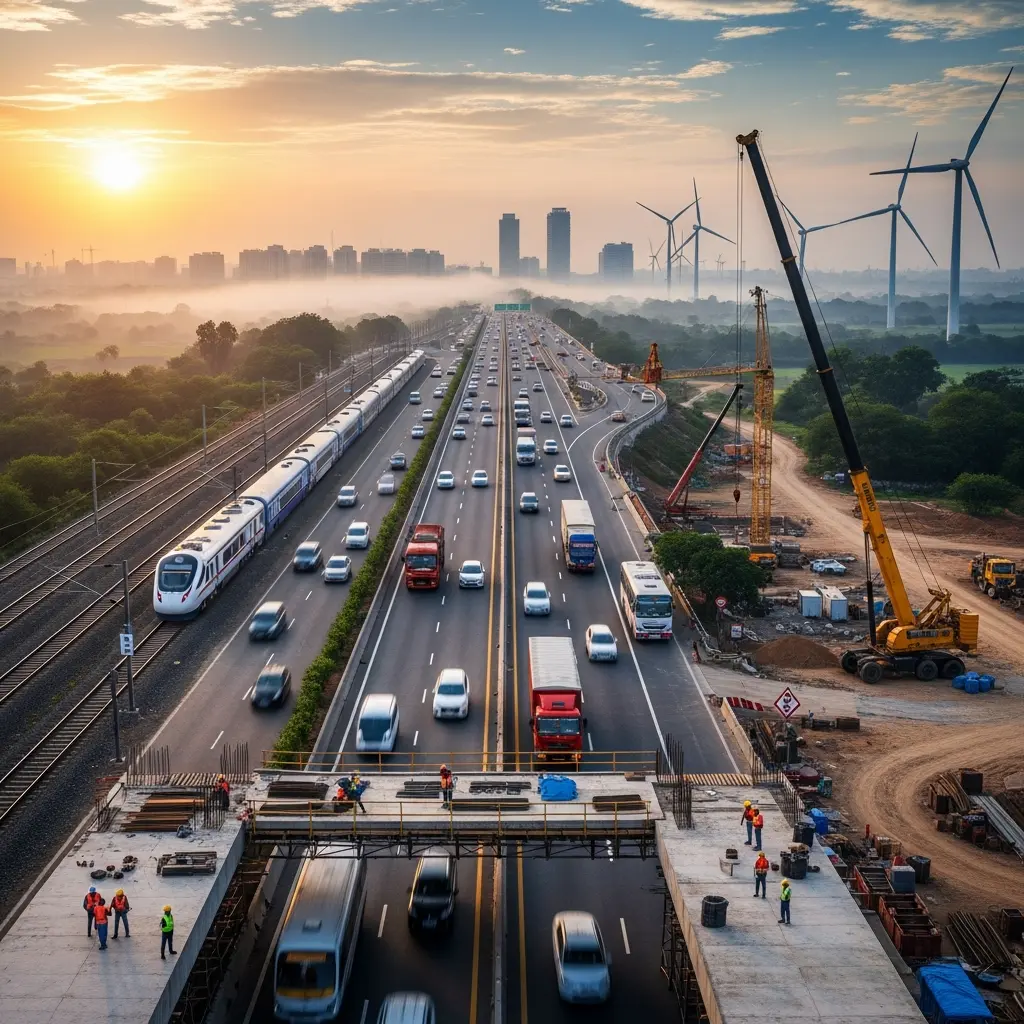
In a world rattled by trade wars, energy shocks, and geopolitical turbulence, most governments are playing defence — trimming budgets, hedging bets, and waiting for the storm to pass. India is doing something different. It’s building.
From six-lane expressways cutting through previously isolated terrain, to metro rail lines threading through tier-2 cities, to solar panels now powering nearly a million rural rooftops — the scale of India’s infrastructure push in 2026 is hard to overstate. And the government has made clear it has no intention of slowing down, regardless of what’s happening beyond its borders.
The Numbers Tell a Story a Decade in the Making
When Finance Minister Nirmala Sitharaman presented the Union Budget in February, the headline figure was striking: ₹12.2 trillion — roughly $133 billion — allocated for capital expenditure in FY2026-27. That’s a 9% increase from the previous year, and a near six-fold rise from the ₹2 lakh crore the government was spending on public infrastructure back in 2014-15.
This isn’t a one-year splurge. It’s the continuation of a deliberate, decade-long strategy. In her budget speech, Sitharaman put it plainly: the government would continue investing to improve infrastructure in cities with a population of more than 500,000. States would also receive interest-free 50-year loans totalling ₹1.5 lakh crore to fund their own capital expenditure programmes and reform incentives.
For anyone tracking India economy news, the consistency of this commitment — year after year, through a pandemic, through global inflation, and now through the geopolitical turbulence of 2025 and 2026 — is arguably as significant as any single budget number. India has effectively made infrastructure spending its primary economic stabiliser.
Railways, Roads, and the Push for Connectivity
The evidence on the ground is real and visible. Infrastructure India 2026 is taking shape across transport networks that would have seemed ambitious even five years ago.
The Railways have been allocated the highest-ever capital investment, with funds allocated for the production of new Vande Bharat, Namo Bharat and Amrit Bharat train sets. The Indian Railways has also attained 100% electrification of its broad-gauge network in most states, resulting in a reduction in diesel consumption by billions of litres and a significant decrease in operational costs.
Road transport has an equally ambitious story to tell. The budget outlay for road development has grown over 860 per cent in the past decade crossing Rs 3 lakh crore in the current cycle. New ring roads, freight corridors, and access-controlled highways are reducing travel times, bringing down logistics costs, and making previously peripheral regions economically viable. When goods can move faster and cheaper, factories follow.
Urban development is receiving parallel attention. The Urban Infrastructure Development Fund — channelled through the National Housing Bank — is being used to build civic infrastructure in tier-2 and tier-3 cities, the places where India’s next wave of urban growth is expected to land. Pune’s metro expansion, approved for ₹9,857 crore, is one of many such projects knitting together city access and economic mobility.
The Green Thread Running Through It All
What distinguishes India investment news in this cycle from earlier infrastructure pushes is how deeply renewable energy has been woven into the fabric of public spending.
At the end of 2025, non-fossil fuel sources now account for more than 51.93% of India’s installed power capacity — a landmark crossed. The country is pressing forward towards its target of 500 gigawatts of renewable capacity by 2030, with solar, wind and green hydrogen all receiving significant policy and financial support.
As many as 14.43 lakh rooftop solar systems have been installed across the country in the past one year under the PM Surya Ghar scheme alone, benefitting over 18 lakh households. These aren’t just energy projects — they’re household income stories, slashing electricity bills for families while feeding surplus power back to the grid. India’s largest green hydrogen plant, announced at the IOCL Panipat Refinery, will produce 10,000 tonnes annually for 25 years using renewable energy.
Union Minister Dr Jitendra Singh summed up the larger vision when he said that India is “standing on the cusp of a major employment revolution” with millions of new jobs in solar installation, battery manufacturing, smart grid management and EV infrastructure. Clean energy, in other words, is not just an environmental choice — it’s a jobs strategy.
What This Means for Growth and Employment
The economic logic behind Indian budget spending at this scale is well-established: public capital expenditure has a multiplier effect. Every rupee that the government spends on a road or a railway triggers private investment in logistics, manufacturing, housing and services in the vicinity. The World Bank has ranked India among the top five countries globally for job creation through infrastructure investment among low and middle-income economies — a validation that this approach is working.
Economists are watching closely to see whether private investment continues to “crowd in” as public projects create confidence. The signals so far are positive: London-based infrastructure investor Actis described India as one of the most attractive infrastructure markets in the world, and real estate private equity flows rose 28% in recent quarters, with cement volumes growing 6-7%, largely on the back of government construction activity.
Economic growth India continues to be driven significantly by this public investment engine, even as external headwinds — from Trump’s tariffs to energy price volatility linked to the Iran conflict — create headwinds for exports and inflation management. Domestically, the infrastructure pipeline provides a reliable floor under growth.
The Honest Challenges
None of this is without complication. Financial experts and independent economists are watching inflation carefully, particularly with global energy markets in flux due to the ongoing disruption around the Strait of Hormuz. Fuel costs affect every segment of the infrastructure supply chain — cement, steel, transport — and sustained price pressure could complicate project timelines and budgets.
There are also questions about execution quality. India has historically been more consistent at announcing and funding projects than completing them on schedule and within cost. As the National Infrastructure Pipeline scales toward a cumulative outlay of $1.4 trillion between now and 2030, the accountability and project management systems will need to match the ambition of the numbers.
At the CII Annual Business Summit earlier this month, Adani Group Chairman Gautam Adani made a point worth noting: India’s next era of growth, he argued, would be defined by the country’s ability to integrate renewable energy, digital infrastructure, and artificial intelligence into a single, coherent economic model. That’s a vision that goes well beyond laying roads and rail lines — it’s a reimagining of what infrastructure means in the 21st century.
A Long Game, Played Deliberately
India is not building for the next quarter. It’s building for the next generation. The country’s ambitious plan to spend approximately $1.7 trillion on infrastructure between FY24 and FY30 is a bet that physical connectivity, clean energy, and urban modernisation are the foundations on which sustained economic growth India will rest.
In an uncertain world, that kind of deliberate, long-horizon investment strategy is increasingly rare — and increasingly valuable.
India Is Betting Big on Bricks and Beams — And the Numbers Back It Up.