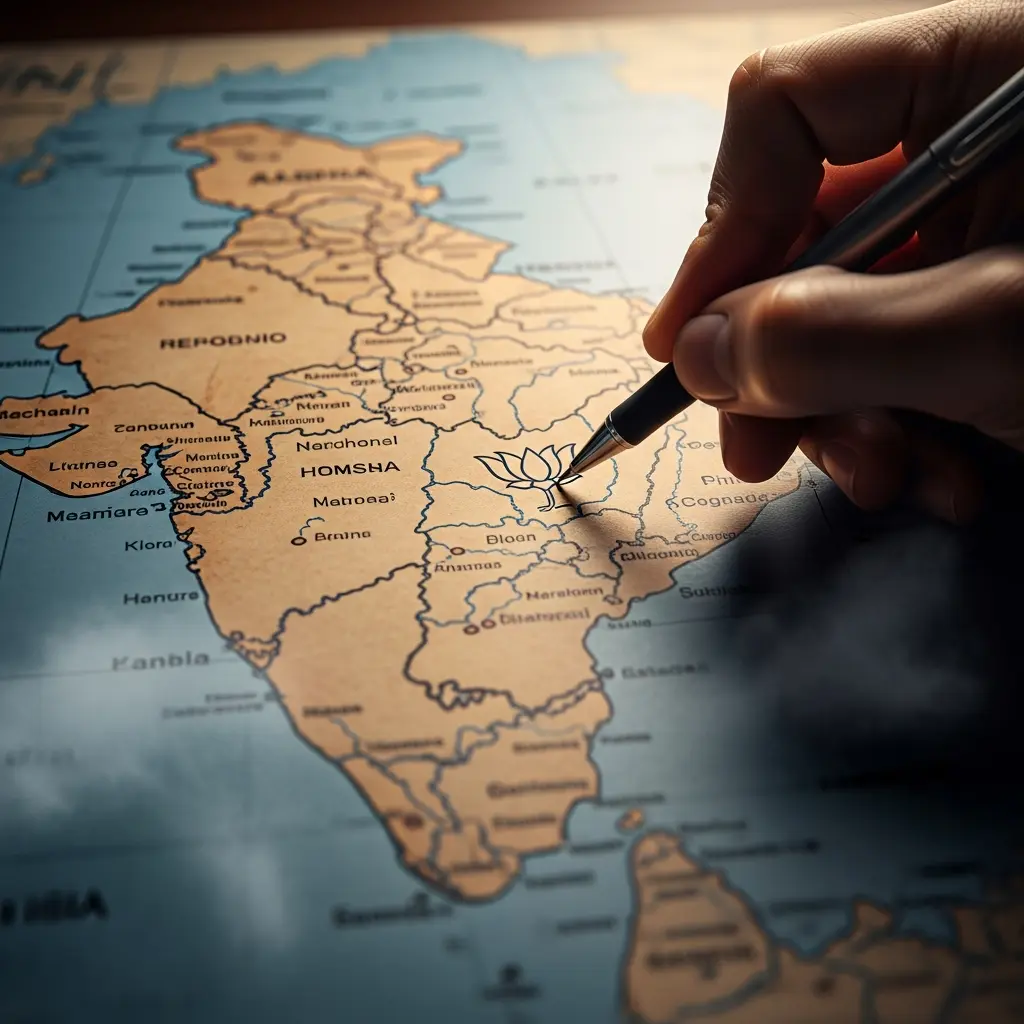
There’s an old saying in Indian politics: the road to Delhi passes through the states. If that’s true, then the Bharatiya Janata Party has just paved a significant new stretch of that road. The results of elections across West Bengal, Assam, Tamil Nadu, Kerala, and Puducherry, counted in the first week of May, have sent tremors through the country’s political establishment — and the aftershocks, as one senior politician noted, may be felt all the way to the 2029 general election.
For a party that faced a notable setback in the 2024 Lok Sabha polls — when it lost its standalone parliamentary majority and Prime Minister Narendra Modi had to lean more visibly on coalition allies — the 2026 state verdicts read like a forceful reply. Not a clean sweep. Not a domination of every corner of the country. But something arguably more meaningful: a demonstration that the BJP remains, by a considerable distance, the defining force in Indian politics 2026.
West Bengal: The Earthquake Nobody Predicted
Of all the BJP latest news to emerge from this election cycle, the result in West Bengal has generated the most astonishment. The state had been governed by Mamata Banerjee’s All India Trinamool Congress for fifteen unbroken years. Before that, the Left had held Bengal for three decades. For the BJP to break through in such historically resistant terrain is being described, by observers across the political spectrum, as nothing short of a political earthquake.
The TMC was one of the central pillars of the opposition INDIA bloc — the alliance that had united diverse parties to challenge BJP dominance in the 2024 general election. Its fall in West Bengal doesn’t just change that state’s political colour. It chips away at the structural foundation of the opposition’s national strategy.
Jammu and Kashmir’s Chief Minister Omar Abdullah was among those who didn’t mince words. A BJP win in West Bengal, he said, would send aftershocks “far and wide for a long time — probably all the way” to the 2029 national election. That assessment is difficult to dismiss.
Assam Holds, South Remains Complex
In Assam, the BJP returned to power for a third consecutive term — a consolidation that speaks to the party’s ability to convert governance into durable electoral loyalty. Chief Minister Himanta Biswa Sarma’s model of welfare populism and regional assertiveness has proven remarkably sticky with voters, and Narendra Modi news around his government’s continued developmental focus in the Northeast has reinforced that narrative.
The southern picture is more nuanced, and that’s worth being honest about. In Tamil Nadu, it wasn’t the BJP that unseated the ruling DMK — it was the newly formed Tamilaga Vettri Kazhagam (TVK), led by actor-turned-politician Joseph Vijay, a party that barely existed two years ago. Dravidian identity politics, linguistic pride, and a social-justice tradition that runs six decades deep have kept the BJP from making direct inroads in the state. Yet the DMK’s fall still matters enormously for Indian election trends, because M.K. Stalin was not just a chief minister — he was one of the loudest and most credible voices in the national opposition. His weakening changes the arithmetic.
Kerala returned a Congress-led government, a genuine setback for the BJP’s southern ambitions. But even here, the BJP secured three Assembly seats in a state long considered a binary contest between the Congress-led UDF and the Left-led LDF. Three seats in Kerala won’t headline any victory speech, but they signal something real: the BJP’s ability to plant ideological and electoral roots even in genuinely resistant soil.
What’s Driving the Expansion?
Political analysts cite several interlocking factors for the BJP’s expanding regional footprint.
The party’s pitch at the state level has revolved around infrastructure and welfare delivery. Schemes around housing, cooking gas, direct benefit transfers and rural road connectivity have created a base among voters who may not follow the grand ideological narrative but feel the tangible difference in their daily lives. This is the machine politics of welfare and the BJP has mastered it.
Digital governance has also played a quiet but important role. The mushrooming of government services on mobile platforms – from applying for scholarships to managing ration cards – has made the state feel more accessible to ordinary citizens, especially in rural and semi-urban areas. It’s not glamorous, but it earns votes.
And then there’s the organisational reality. The BJP’s booth-level machinery, built painstakingly over years of state-level work, remains unmatched by any opposition party. In close contests, that ground-level presence is often the deciding factor.
The Opposition’s Urgent Question
None of this means the opposition is finished — but it does mean the INDIA bloc faces urgent strategic questions. With both the TMC and the DMK weakened, two of the alliance’s most powerful regional anchors have lost ground. Congress, which has been working to rebuild its state-level presence, faces the challenge of holding together a coalition of parties that have very different regional priorities and varying electoral fortunes.
India government updates from New Delhi suggest the BJP is keen to use its expanded state footprint to build policy alignment between the Centre and state governments — fast-tracking infrastructure investment and pushing forward on digital and economic reform agendas where BJP-aligned governments are in power.
For voters watching these developments, the practical question is what stronger BJP dominance at the state level means for governance, welfare delivery, and the balance between national priorities and local needs. Those debates — over economic policy, social spending, and regional autonomy — remain active and unresolved across the country.
A Country Reorganised, Not Conquered
The most accurate reading of these 2026 results isn’t that the BJP has won India. India is too large, too diverse, and too stubbornly regional for any single party to conquer outright. What’s true is something subtler and more consequential: India’s political conversation now organises itself around the BJP. Every state result is read in relation to it. Every opposition strategy is designed in response to it.
That’s what dominant political systems look like in a functioning democracy — not the elimination of opposition, but the reorganisation of the entire political landscape around a single gravitational force. Whether that’s a story of democratic consolidation or of concerning centralisation depends significantly on where you’re sitting.
What isn’t in dispute, heading into the next phase of Indian politics 2026, is that the saffron map has expanded — and the political calculations of every party in the country have shifted accordingly.
India’s Political Map Is Being Redrawn — And the BJP Is Holding the Pen.