Just days after a U.S.-brokered ceasefire offered fragile hopes of a diplomatic path forward, Russia has launched one of the most devastating aerial attacks on Ukraine’s capital since the war began—a crushing reminder that no amount of negotiating table optimism can substitute for genuine political will to stop the killing.
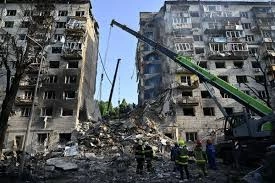
Kyiv was pounded by a coordinated volley of ballistic missiles and attack drones in the early hours of Thursday, May 14, shredding residential districts, collapsing an apartment building and sending rescue workers running through rubble and smoke. Latest reports suggest at least four people have died and more than 44 have been injured, with emergency operations continuing across several parts of the city.
— ## A night that started with sirens and ended with rubble
The onslaught started just before 1 a.m. local time when Ukraine’s air force issued a statewide aerial alert that Russia had deployed MiG-31 planes, placing all regions of the country at risk of ballistic missile strikes. Kyiv was hit by the first explosions around 3 a.m. as Ukrainian air defences scrambled to take down a swarm of drones before the first ballistic missiles arrived mere minutes later.
Six districts in the capital were affected. In Darnytskyi district, part of the structure of a residential building collapsed, individuals were trapped under the rubble. Debris from a downed drone started a fire on the roof of a five-story apartment building in the Dniprovskyi neighborhood, and debris fell on a road in the Holosiivskyi area. In the Solomianskyi area a car was set on fire, in the Obolonskyi district an office building, a car park and a 12-storey residential complex were hit.
First responders worked through the night in a residential area on the city’s eastern bank, rescuing survivors from a massive mound of wreckage. Eleven persons had been evacuated from the scene of the collapse by midnight local time.
Kyiv citizens are tragically familiar with such situations, but familiarity does not make them less painful. Lyudmila Hlushko, 78, recalled the moment an explosion landed close to her home. She said she heard a succession of explosions and rockets whistling at 3 a.m., then the house shook violently and a big bang broke the glass. One of many average Kyiv residents awakened to another night of fear, she was.
— ## The Extent of Damage: 800 Drones in 20 Regions
What happened on Thursday was not an isolated overnight strike. It was the second big bombardment in 24 hours, and together the two raids constitute one of the most continuous aircraft onslaughts Ukraine has seen since the full-scale invasion began in February 2022.
A day before the midnight shelling, Russia launched a rare daytime attack on Kyiv, killing at least six people. That strike featured 800 drones and struck about 20 districts of Ukraine, one of the longest such assaults of the entire war. Ukrainian President Volodymyr Zelenskyy said the daylight strike was intended to create as much “pain and grief” as possible – language that was extremely brutal even by the standards of this ongoing conflict.
The nocturnal strike that targeted civilian infrastructure and residential buildings in several locations. The strike hit the cities of Kremenchuk, Bila Tserkva, Kharkiv, Sumy and Odesa, as well as Kyiv using ballistic and cruise missiles.
The sweep of the onslaught, from the western suburbs of the capital to eastern front-line communities, points to something purposeful. This was not a tactical attack on military installations. It was a message to the entire country, conveyed in fire and smoke.
— #The Bitter Irony of Talk of Peace and Then Acts of War
Why is Russia waging its heaviest strikes in months, just as diplomatic signals seem, at least on the surface, to lead toward a negotiated end to the war? That’s the question much of the world is now asking.
Just days ago, U.S. President Donald Trump engineered a three-day truce that seemed to give a slim but genuine opening. Trump claimed both Putin and Zelenskyy have agreed to cease hostilities from May 9 to May 11, calling it perhaps the “beginning of the end” of a long and bloody struggle. The truce, coinciding with Russia’s Victory Day celebrations, saw an exchange of 1,000 prisoners from each side.
But the Kremlin spokesperson Dmitry Peskov was quick to curb expectations, saying a peace deal was still ‘a very lengthy road with complicated specifics’. That turns out to be an accurate — perhaps even understated — judgment.
Trump said Tuesday he expects Moscow and Kyiv will soon achieve an agreement, while Putin claimed in a speech over the weekend his invasion was possibly “coming to an end.” But neither leader has provided details on what has truly changed to make such a pact conceivable.
U.S.-led diplomatic efforts have been stuck for the past year on key disputes about whether Russia gets to keep Ukrainian land it has conquered and what guarantees will discourage Moscow from invading again. That is no trivial detail. That is the whole point of the conflict.
Russia holds around a quarter of Ukraine but has struggled to take full control of the eastern Donbas region. Meanwhile Ukraine’s counteroffensives have failed to retake significant occupied territory. Both parties are effectively caught in an expensive impasse, with Moscow and Kyiv maintaining mutually contradictory demands about what any compromise would even look like.
— ## What the Attacks Tell Us About Russia’s Strategy
Military analysts and Ukraine watchers have for years said Russia employs mass aerial bombardments not merely for tactical effect but also to break civilian morale and sustain pressure on Kyiv’s Western backers. The timing of this strike – immediately following the expiration of a ceasefire and with diplomatic conversations re-starting – follows that pattern almost to the letter.
The war has killed tens of thousands on both sides, reduced parts of eastern Ukraine to rubble and put major strain on Russia’s $3 trillion economy. The sanctions from the West have only added to the pressure. But Russia is escalating further, signaling that military fatigue has not yet translated into a real political willingness to compromise.
The deployment of ballistic missiles together with swarms of cheaper Shahed-style drones meant to saturate air defenses shows increased sophistication in the aerial warfare playbook. Ukraine’s air defenses have improved dramatically in the last two years with Western help, but the sheer volume of bullets fired at the same time makes full interception very impossible. Some always slip through.
— ### How Zelenskyy Reacted, How the World Reacted
In Bucharest for a regional conference, President Zelenskyy lost no time Wednesday denouncing the attacks and demanding action from Ukraine’s partners. He has frequently asked the West supply more advanced air defense systems and long-range strike capabilities, requests that remain only partly met due to political considerations in Washington and European capitals.
The international response has played out in a familiar way: condemnations from European leaders, demands for responsibility and circumspect statements from the United States that combine moral outrage with political caution. That storyline may be unpleasant for Ukrainians living beneath the bombs, but it captures the tangled reality of a war with the major global powers engaging directly or indirectly, and with stakes that reach far beyond Ukraine’s borders.
— ## The Human Toll, Street By Street
Take away the geopolitical analysis for a moment and all you have is this: people sleeping in their flats in the early morning hours Thursday with buildings falling down around them.
Water service in the eastern portion of Kyiv was lost after the attack. Smoke still rose as rescue personnel went through the rubble, while in the Darnytskyi area alone a multistory residential building was partially split in half.
Emergency services worked through the night and into the morning extracting people from debris, treating burns and battling structural flames at the same time in a half-dozen neighborhoods. Seven persons were wounded in Kyiv oblast, including at least one child.
These figures are buried amid the headlines. But numbers don’t tell you what it means to lose your home, or to pull a neighbor from the rubble, or to wonder if this time the windows will hold when the alarm sounds again.
— ## What’s Next: The Rocky Road to Any Peace
This is not a neat finish to write, because there is no neat ending in sight. This week’s strikes have made it painfully evident that any real truce will require more than phone talks between foreign leaders. It will require solid security guarantees, territorial clarity, and—perhaps hardest of all—a willingness on Moscow’s part to accept an outcome that does not look like total victory.
Analysts say Russia has violated more than 190 treaties that it signed with Ukraine and the international community over the years. Kyiv does not forget that history quickly.
For now, Ukrainians are doing what they have done for more than four years: reconstructing what has been destroyed, burying the dead, and steeling themselves for the next night. The drones will probably be back. The question is whether the world’s diplomats can keep up with them — and so far the data is not encouraging.
—
Russia pounds Kyiv with one of its worst drone and missile barrages as hopes for peace talks fade