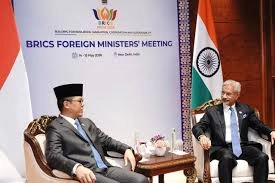
The marble corridors of Bharat Mandapam were resonating to the hushed hum of high-stakes diplomacy on Thursday as India formally launched the two-day BRICS Foreign Ministers’ Meeting – arguably the most crucial event under the 2026 chairship of the expanded grouping. The gathering, with External Affairs Minister Dr. S. Jaishankar at the head of the table, brought together foreign ministers and senior representatives of eleven member nations and ten partner nations to set the stage for what many observers are calling a defining moment for the Global South.
The timing, it couldn’t be more loaded. Geopolitical tensions have been brewing in West Asia for months. Global supply chains are still uneven. And the world’s multilateral organizations – the United Nations, the IMF, the WTO – are increasingly perceived as slow, unrepresentative and not up to the task of addressing the pace of modern crises. BRICS arrived into this atmosphere with the heft of more than half the world’s population and about 37 per cent of global GDP.
— ## Jaishankar Sets the Tone: “We Meet at a Time of Great Flux”
In his opening remarks, Dr Jaishankar did not shy away from pointing out the fault lines. The international order is being tugged in many directions, he said, by continuous armed conflicts, trade disruptions, climate difficulties and uneven access to technologies. His words were carefully chosen, but the message was not soft.“We convene at a period of great change in world relations,” he remarked. Continued conflicts, economic uncertainty and challenges in trade, technology and climate shape the global scene. BRICS countries are increasingly expected to play a positive and stabilising role, particularly from emerging markets and developing countries.
In many respects it was a calling to purpose. Jaishankar said peace and security remain the foundations of any working global order – and the recent conflagrations across several regions only underscore why discussion and diplomacy can’t be put on the backburner. He also highlighted what he characterized as the key development problem for many countries, namely the ongoing pressure on energy security, food security, the availability of fertilisers and health systems.The core of it is development problems. Many countries are still facing issues on energy, food, fertilizer and health security as well as access to financing. BRICS can help them to better respond,” he said.
That statement, short though it was, caught something significant. For countries currently grappling with the supply shocks of global conflicts and pandemic repercussions, access to affordable food and fertilisers is not an abstract policy question. It is reality in a moment, in a day. And BRICS, with its combination of big agricultural producers, energy exporters and developing industrial economies, is particularly placed to assist coordinate responses.
— ## India’s Chairship: Building Resilience, Not Just Rhetoric
India is holding the BRICS chairship for the fourth time — in 2012, 2016 and 2021 — and each tenure has left its mark on the bloc’s orientation. This year’s theme, “Building for Resilience, Innovation, Cooperation and Sustainability” is more than a catch phrase. It is part of a conscious attempt to reposition BRICS as a solutions-oriented platform, rather than just a counter-narrative to Western-led institutions.
India officially took over the chair from Brazil in December 2025, inheriting a bloc that has experienced one of its biggest upheavals in recent years. Egypt, Ethiopia, Indonesia, Iran, Saudi Arabia and the United Arab Emirates joined in 2024 and 2025, while 10 more partner countries including Malaysia, Vietnam, Nigeria and Thailand were introduced to the fold. The enlarged group now embraces an amazing diversity of economies, political systems and strategic interests.
And it’s not easy to hold this together. But India has always seen itself as a bridge-builder, a country with strong linkages to both the Global South and the big Western economies, and a proven ability to broker consensus where others have failed. Perhaps the best example of India’s diplomatic finesse was the unanimous acceptance of the G20 New Delhi Declaration on Ukraine in 2023.
— #The Hormuz Shadow: Iran, UAE and the West Asia Fault Line
One subject that has loomed largest over the New Delhi gathering is the continuing dispute surrounding Iran. The Strait of Hormuz, through which around a fifth of the world’s oil and gas flows, remains heavily pressured and its disruption has rocked energy markets and sent freight costs through the roof.
Jaishankar’s appeal for “safe, unrestricted maritime flows” through international waters had considerable diplomatic heft. Iranian Foreign Minister Abbas Araghchi, arriving in New Delhi ahead of the summit, used the platform to urge on member states to reject what he called illegitimate action against Tehran. The UAE saw itself as a target of Iranian enmity and dispatched a minister of state rather than its top diplomat – a minor but symbolic gesture of its own problems with Tehran.
This is not a new fault line in BRICS. Discussions on the Middle East during a preparatory meeting of BRICS Deputy Foreign Ministers in New Delhi in April reportedly ended without a joint statement after Iran and the UAE could not agree on a common terminology. It’s a reminder that BRICS is not a monolith, and that managing the variety of its membership – especially on sensitive political topics – calls for a fair amount of institutional tolerance.
The war on Gaza by Israel further complicates the situation and is a sticking point inside the bloc. India, which has been carefully calibrating its ties with both Israel and the Arab countries, is once again in the difficult position of trying to steer the group to language that recognises common humanitarian concerns without breaking up the alliance.
So the question worth posing is this: can BRICS – a bloc that includes democracies and authoritarian regimes, energy exporters and energy importers, and countries with serious bilateral problems — genuinely serve as a coherent multilateral voice on geopolitical issues?
— ### Day Two: Governance Reform and BRICS@20 Session
The second day of the meeting revolves around two main sessions. The inaugural, “BRICS@20: Building for Resilience, Innovation, Cooperation and Sustainability” is a reflective milestone for a bloc that began in 2006 as an informal gathering of four economies and has since developed into an eleven-member alliance with ten partner countries.
The second session is dedicated to *“Reforms of Global Governance and Multilateral System”* – possibly the most important agenda item of the entire gathering. India has been a continuous advocate for a more representative UN Security Council, a stronger voice for the developing countries in the IMF and World Bank and more robust international mechanisms for trade and climate funding through BRICS platforms over the years.
In the 2024 Kazan Declaration, under Russia’s BRICS chairship, the bloc reaffirmed its commitment to a more “agile, effective and representative” international order. India’s 2026 chairmanship is likely to build directly on that rhetoric and push for tangible results – not just pronouncements – ahead of the 18th BRICS Leaders’ Summit set for September 2026 in India.
The foreign ministers also met Prime Minister Narendra Modi at Seva Teerth on Thursday afternoon. There were other bilateral talks in parallel to the main sessions – Jaishankar met with Russia’s Foreign Minister Sergey Lavrov, South Africa’s Ronald Lamola, Brazil’s Mauro Vieira, among others.
— ### Why This Meeting Matters Outside the Halls of Diplomacy
It would be easy to dismiss meetings like this as high-level talking shops — elaborate diplomatic theatre where carefully phrased joint statements are made, photographed and filed away. But the New Delhi Foreign Ministers’ Meeting has real strategic heft and here is why.
First, it is a direct forerunner to the BRICS Leaders’ Summit in September that will set the agenda for the bloc for the years to come. Positions taken this week will be the backbone of the summit’s conclusions.
Second, energy, food and fertilizer security – the trinity Jaishankar identified – are not background issues. They are the concerns that make the difference between having enough money to eat, to heat your home or grow crops in countries across Africa, South Asia and Latin America. The BRICS states are a big chunk of the world’s agricultural production and energy resources. If the bloc can better coordinate on supply chain stability and market access, the downstream impact might be real and demonstrable.
Third — and perhaps, more importantly — the gathering sends a signal on India’s view of the multilateralism it wishes to lead. The framing of “Humanity First” is a chosen philosophical attitude. This group is more than a tool for geopolitical competition or dollar-alternative economics, it adds. At its best, it is a place to solve problems together.
The trickier question is whether BRICS can deliver on that ambition — especially while there are divisions inside the group and demands from outside. But the fact that 11 major countries and 10 partners sat down in New Delhi this week, agreed to talk and gave India the job of pushing the topic ahead is not nothing in itself.
— ### Looking ahead: September summit and the road to real results
The gathering of BRICS foreign ministers in New Delhi could be viewed as a warm-up – setting the stage for the bigger symphony that will perform in September. India, the stakes are tremendous. When New Delhi hosts the 18th BRICS Summit later this year, the city has a rare opportunity to influence results at the highest level of global economic and political administration.
India’s agenda – resilience, innovation, cooperation, sustainability – seems good on paper. The real challenge is translating those foundations into choices that member states with very different interests can actually agree to and implement. The food and fertilizer security goal requires financing tools. Technology transfer pledges are needed for the energy transformation agenda. The governance reform agenda requires political resolve beyond any one summit.
Jaishankar asked the delegates to give their viewpoints and work towards “meaningful outcomes”. What these outcomes will look like in September will determine not only India’s BRICS legacy — but the bloc’s relevancy in a world that is evolving faster than its institutions.
—
New Delhi at the Helm: Jaishankar opens BRICS Foreign Ministers’ meet with a stark message for a world in turmoil