New satellite imagery and intelligence assessments reveal a significant expansion of launch facilities near China’s nuclear missile sites — raising urgent questions about deterrence, arms control, and the future of global strategic stability.
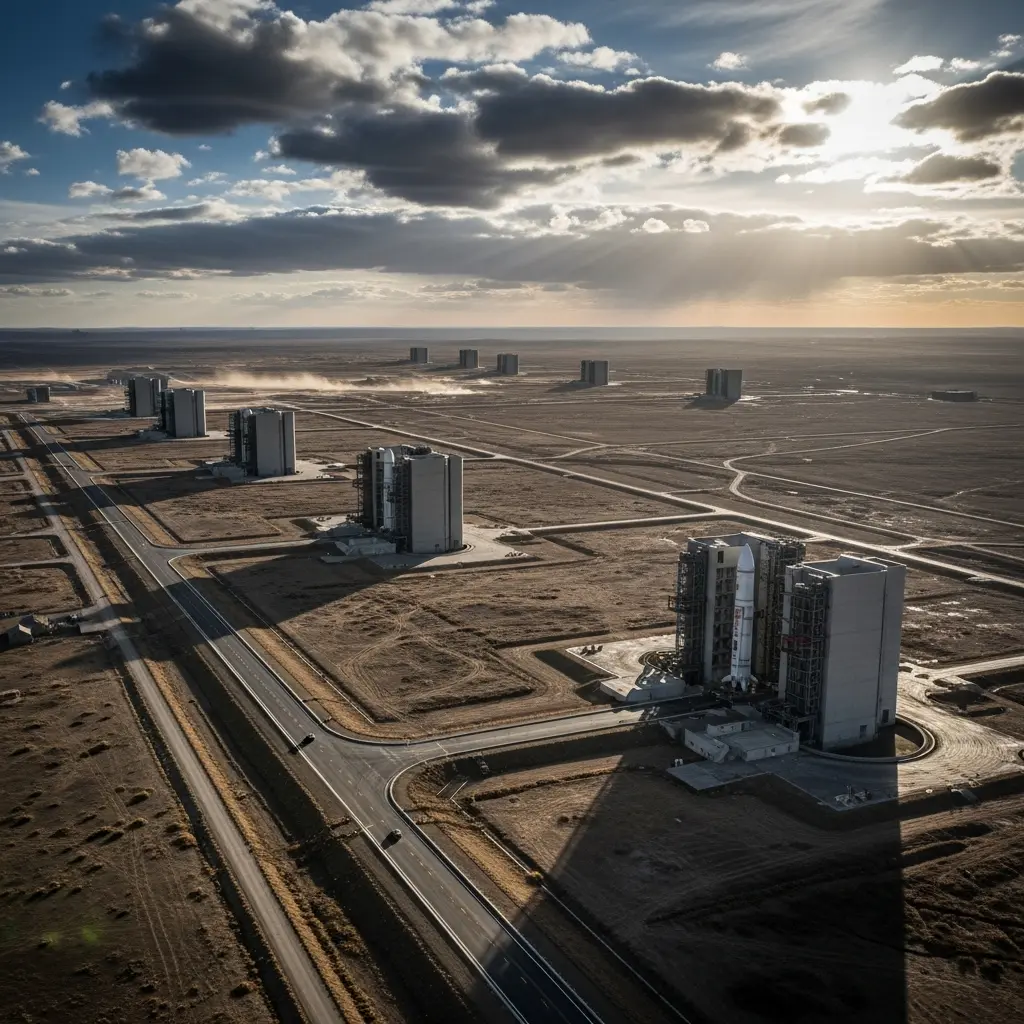
In the arid expanses of western China, far from any city skyline, construction crews have been working at a pace that analysts describe as remarkable. Satellite images reviewed by independent research groups show a pattern of activity that has become impossible to ignore: hundreds of new launch facilities, silos, and support structures emerging near known nuclear missile sites. China has not offered a detailed explanation. The rest of the world is left to interpret concrete and steel from orbit.
What is unfolding is one of the most consequential shifts in global strategic military power in a generation. China’s expansion of its missile launch infrastructure — including intercontinental ballistic missile silos and associated command-and-control facilities — is not happening in secret exactly, but it is happening without the kind of transparency that the international security community has come to expect from nuclear powers. And that ambiguity, many analysts argue, is itself a form of strategy.
“The sheer scale of construction suggests this is not routine modernization — it represents a fundamental change in China’s nuclear posture and strategic intentions.”
The facilities in question span multiple provinces, with significant activity documented in Gansu, Xinjiang, and Inner Mongolia. Researchers from the Federation of American Scientists, the Middlebury Institute of International Studies and other institutions have monitored the construction using publicly available satellite imagery, identifying what appear to be ICBM silos as well as road networks, communication towers and other launch support infrastructure. The layout and spacing of the structures bear the hallmarks of deliberate strategic dispersal — a doctrine designed to ensure survivability in the event of a first strike.
That last point matters enormously. For decades, China maintained what it described as a minimal deterrence posture — a relatively small nuclear arsenal held in reserve, with a formal no-first-use policy. The current expansion challenges the assumption that this posture remains unchanged. A survivable, dispersed, large-scale silo network is not the infrastructure of a nation content with minimum deterrence. It is the infrastructure of a state preparing for a more assertive nuclear role on the world stage.
China has officially adopted a no-first-use (NFU) nuclear policy since 1964, to not use nuclear weapons against non-nuclear states or to strike first in a conflict. But, US and allied defense officials have increasingly questioned whether this policy reflects operational doctrine, especially in light of the scale of recent infrastructure investment.
The international response has been measured but pointed. US defense officials have referenced China’s nuclear buildup in multiple annual threat assessments, projecting that Beijing could possess over a thousand warheads by the mid-2030s — a dramatic acceleration from the roughly 200 to 250 warheads it was estimated to hold just a decade ago. NATO allies have begun factoring Chinese strategic capabilities into their own planning frameworks. Japan, South Korea, and Australia — all of which sit within the reach of China’s intermediate and intercontinental-range missiles — are watching the construction closely.
What makes this expansion particularly difficult to manage diplomatically is the absence of any bilateral arms control framework between the United States and China. The New START treaty, which governed nuclear warhead limits between Washington and Moscow, has no Chinese equivalent. Beijing has consistently declined to enter into formal arms reduction talks, arguing that its arsenal is too small to meaningfully negotiate alongside those of the United States and Russia. That argument becomes harder to sustain as the construction continues.
· · ·
The strategic logic driving China’s expansion is not difficult to understand, even if its precise intentions remain opaque. Chinese military planners have watched the United States invest heavily in precision conventional strike capabilities, missile defense systems, and long-range surveillance technologies. From Beijing’s perspective, a small nuclear arsenal is increasingly vulnerable to a disarming first strike — and the answer to that vulnerability is dispersal, hardening, and numbers. Whether one finds that logic reassuring or alarming depends largely on where one sits.
There is also an unmistakable political dimension. China’s military buildup under President Xi Jinping has been comprehensive — spanning naval expansion, hypersonic weapons development, space and cyber capabilities, and now strategic missile infrastructure. The nuclear expansion fits within a broader pattern of capability development intended to establish China as a peer competitor to the United States across every domain of military power. The message being sent, whether to Washington, Taipei, Tokyo, or New Delhi, is deliberate: China intends to be taken seriously as a full-spectrum military power.
For arms control advocates, the current moment is a source of deep concern. The existing architecture of nuclear risk reduction — the treaties, the hotlines, the transparency measures built painfully over decades of Cold War experience — was designed for a bipolar world. The emergence of a third major nuclear power with an expanding arsenal and no inclination toward formal arms control creates risks that the existing system was simply not built to manage. Miscalculation, misreading of intent, and crisis escalation all become more likely when strategic intentions are unclear and communication channels are thin.
“The world’s nuclear architecture was built for two players. What happens now that there are three?”
None of this means conflict is imminent or inevitable. China and the United States maintain diplomatic channels, and neither side has any interest in a military confrontation that could escalate to nuclear use. But the construction crews in Gansu and Xinjiang are building something that will shape the strategic landscape for decades. Understanding what China is building — and why — is not merely an academic exercise. It is one of the defining security questions of the decade, and the answers will determine how the world manages nuclear risk in an era that looks increasingly unlike anything that came before.