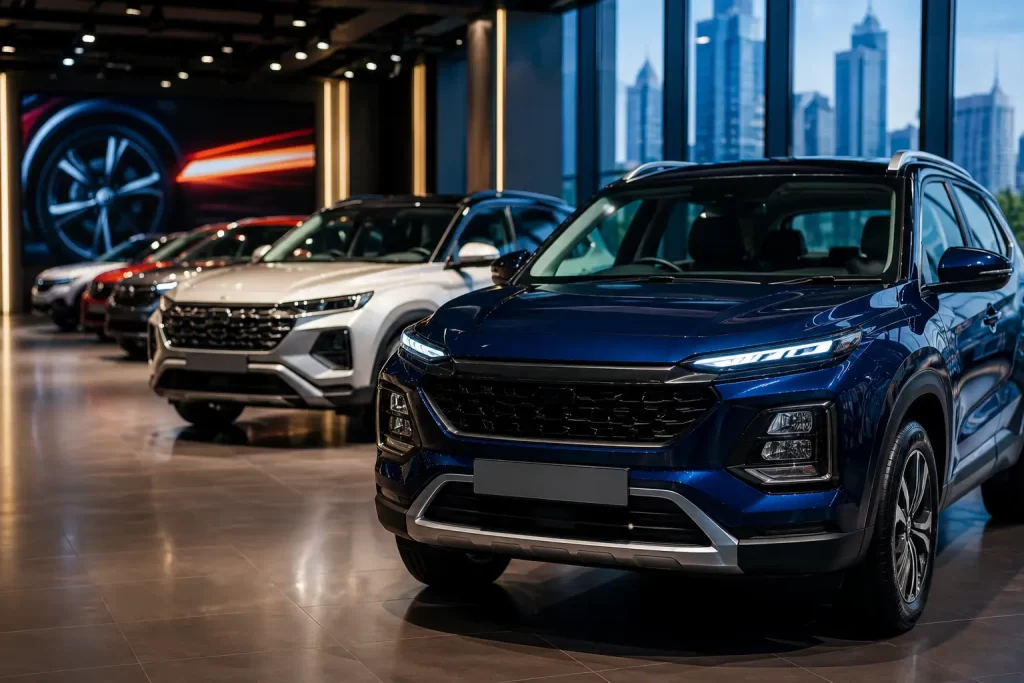
From updated SUVs to smarter sedans and electric-first platforms, India’s automotive sector is in the middle of a genuine product renaissance — driven by rising aspirations, evolving technology, and a consumer base that knows exactly what it wants.
Walk into any showroom across India’s major cities right now and you will feel it immediately — a kind of restless energy that has been building quietly for years and is now arriving at something close to full expression. Customers are coming in better informed than ever before. They have watched review videos, compared specification sheets, and read owner forums before a single salesperson has had a chance to say hello. They know what they want. And what they want, increasingly, is more: more technology, more refinement, more efficiency — and quite often, more car than the generation before them ever expected to own.
The Indian auto industry has responded to this shift with a product cadence that would have seemed improbable a decade ago. Manufacturers — domestic and international alike — are rolling out updated models, new platform derivatives, and feature-packed variants at a pace that keeps the automotive market in a state of almost permanent anticipation. Each vehicle launch now comes with a media event, a social campaign, and a waiting list that forms within hours. The showroom is no longer just a place to buy a car. It has become a destination.
The numbers behind this momentum are genuinely impressive. India has consolidated its position as the world’s third-largest passenger vehicle market, with annual sales running at over four million units and a growth trajectory that has survived interest rate pressures, fuel price volatility, and global supply chain disruptions with surprising resilience. The passenger vehicle segment in particular has become a story of consistent outperformance — driven not by one category or one type of buyer, but by a broadening of the market in almost every direction simultaneously.
“India’s car buyer in 2026 is younger, more aspirational, and more demanding than ever before — and the industry is finally building for exactly that person.”
If there is a single product category that defines the current moment in the mobility sector, it is the SUV — specifically, the compact and mid-size variants that sit at price points accessible to a rapidly expanding middle class. What was once a niche preference has become the default format for millions of buyers across urban and semi-urban India. Manufacturers have responded by layering these vehicles with features that would have been reserved for premium segments just a few years ago: ADAS safety systems, panoramic sunroofs, ventilated seats, wireless charging, and over-the-air software update capabilities that keep the ownership experience feeling fresh long after the purchase date.
The electric vehicle story within the Indian auto industry deserves its own chapter. EV adoption in the passenger vehicle space has moved from symbolic to structural — still a minority of overall volumes, but growing at roughly twice the rate of the overall market and attracting attention from every serious player in the industry. New model introductions have addressed the concerns that historically held buyers back: real-world range has improved, charging infrastructure is expanding in urban corridors, and total cost of ownership calculations are beginning to favour electric in ways that change the conversation at the dealership level.
Charging infra expanding Metro & highway corridors,
EMI-driven purchase surge Tier 2 & Tier 3 cities,
Upgrade cycle accelerating 3–4 year ownership patterns.
Safety ratings mattering Bharat NCAP shaping choices
Beyond the headline products, there is a quieter transformation underway in how consumer demand is being shaped and served. Digital retailing — once an experiment — has become a meaningful part of the purchase journey for a large proportion of buyers. Research happens online, configurations are customised on apps, and financing is often arranged before the customer ever visits a showroom. This shift has forced manufacturers and dealers alike to rethink the role of the physical touchpoint: it is no longer about information delivery, but about experience, trust, and the final emotional confirmation that a significant financial decision deserves.
Tier 2 and Tier 3 cities have emerged as the industry’s most exciting growth frontier. As household incomes rise and road infrastructure improves across India’s smaller urban centres, the aspiration to own a personal vehicle — and increasingly, to own a good one — has translated into sales volumes that were difficult to forecast even five years ago. Manufacturers who have invested in expanding their dealer networks and tailoring their financing products for these markets are now reaping the returns.
“The next chapter of India’s automotive story will not be written on the expressways of Mumbai or Delhi alone — it will be written in the showrooms of Nashik, Coimbatore, and Bhubaneswar.”
The road ahead for the automotive market isn’t without its complications. The transition to electric powertrains requires ongoing investment in infrastructure, battery supply chains and consumer education that no one manufacturer can tackle alone. Regulatory changes around emissions and safety standards will continue to raise the bar — and the cost — of market participation. And the global backdrop of trade policy uncertainty affects the economics of component sourcing in ways that India’s deeply integrated supply chain cannot entirely insulate itself from.
But the fundamental story remains one of momentum and possibility. India’s roads are busier, its buyers are more discerning, and its manufacturers are more ambitious than at any point in the industry’s history. The current wave of product activity is not a marketing cycle. It is the visible expression of an industry that has genuinely grown up — and a country whose relationship with personal mobility is being reimagined, one new model at a time.
India’s Roads Are Changing — And the Cars on Them Are Changing Too.