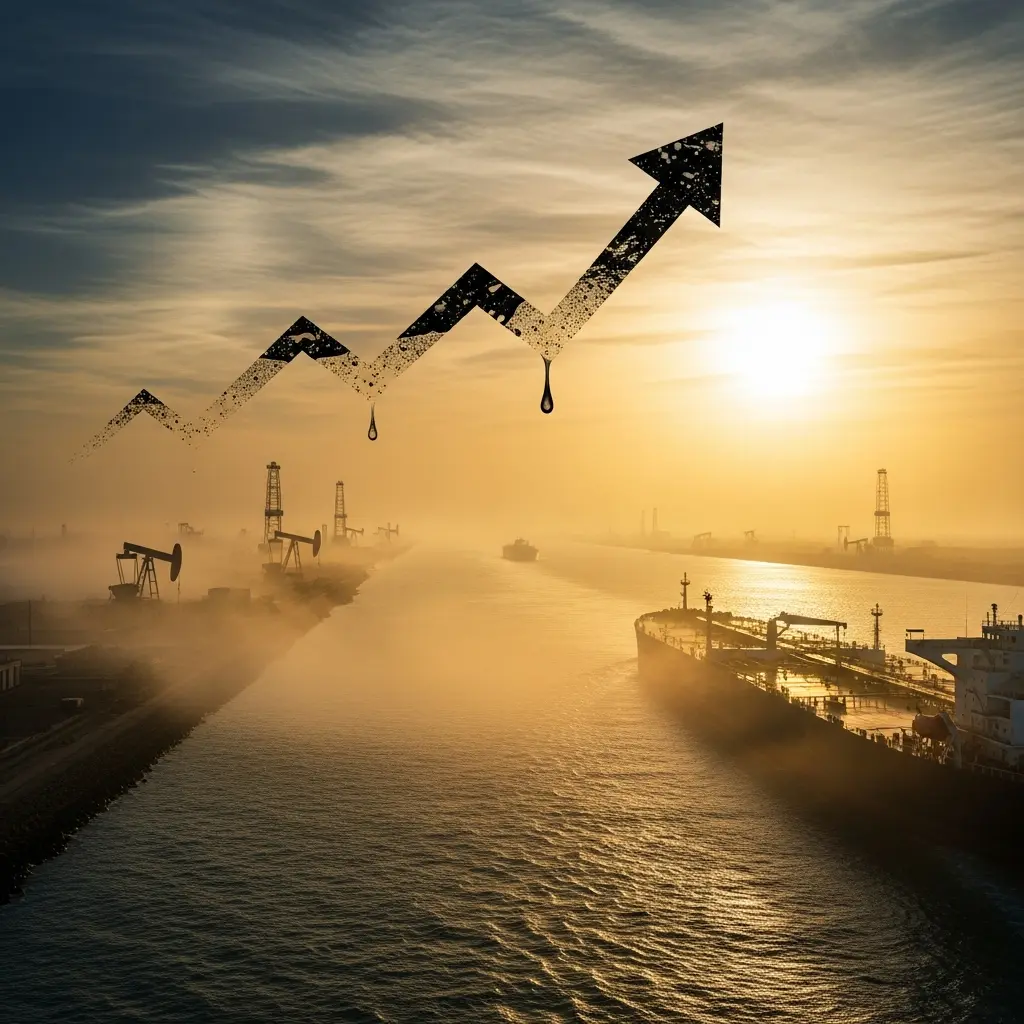
There is a stretch of water just 33 kilometers wide at its narrowest point that has the power to shake the global economy. The Strait of Hormuz doesn’t make the news every day, but when it does, financial markets listen — and right now, the world is listening very carefully.
Fresh concerns about supply disruptions through this critical chokepoint have sent ripples through the energy market, pushing crude oil prices upward and reigniting fears about inflation at a time when many economies are still recovering from earlier shocks. The anxiety is not irrational. When the flow of oil through Hormuz is threatened, the consequences don’t stay regional. They travel — through supply chains, through fuel pumps, through grocery bills — into the daily lives of ordinary people across the world.
Why the Strait of Hormuz Holds the World Hostage
To understand why analysts grow visibly nervous whenever tensions rise near the Strait of Hormuz, you need to appreciate just how much of the world’s energy supply passes through it. Approximately 20 percent of global oil trade — nearly a fifth of every barrel consumed on the planet — moves through this single corridor. On a daily basis, that translates to roughly 17 to 18 million barrels making the transit between the Persian Gulf and the open ocean.
There is no easy alternative. While some bypass routes exist — pipeline options through Saudi Arabia, for instance — they carry a fraction of the volume and cannot absorb a full disruption. The Strait of Hormuz is, in the language of geopolitics, a chokepoint in the truest sense: control it, threaten it, or disrupt it, and the pain is almost instantly global.
This is why even the suggestion of trouble in its vicinity is enough to move markets. Traders don’t wait for actual supply cuts. They price in the risk of them.
What’s Driving the Current Pressure on Oil Prices
The current upward pressure on oil prices is not happening in isolation. It is the product of several converging pressures that have made energy markets unusually sensitive to geopolitical signals.
Regional tensions involving Gulf states and Iran — which shares the Strait with Oman — have periodically escalated over the past several years. Any military posturing, naval incident, or diplomatic breakdown in that theater immediately raises questions about the safety and reliability of energy shipments. The market doesn’t need confirmation of a disruption. The possibility alone is enough to trigger volatility.
When inventories are plentiful, a temporary disruption is manageable. When the system is already running lean, the same disruption carries outsized consequences.
Add in the undercurrent of a fragile global demand recovery and you have conditions where crude oil markets are primed to react sharply to any fresh provocation.
The Domino Effect on Everyday Economies
Here is where the story moves from trading floors to kitchen tables. When crude oil prices rise, the effects don’t stay neatly contained within the energy market. They spread — and they spread quickly.
Fuel prices rise at the pump. Transport costs climb. Those costs are passed on to manufacturers, who pass them on to retailers, who pass them on to consumers. Food, household goods, and essential services all inch upward. In economies where inflation has only recently been brought under control, this kind of energy-driven price pressure is precisely what central banks dread.
For import-dependent economies — countries that consume far more oil than they produce — the exposure is especially acute. Nations across South Asia, Southeast Asia, and Sub-Saharan Africa have limited ability to insulate their populations from oil price spikes driven by distant geopolitical events. When a strait thousands of miles away experiences tension, families in these countries feel it in ways that can seem almost unfair in their directness.
The global economy, in this sense, is only as stable as its most vulnerable chokepoints.
Can Anything Cushion the Blow?
Governments and international bodies are not entirely without tools. Strategic petroleum reserves — maintained by the United States, members of the International Energy Agency, and several other nations — exist precisely for moments of supply stress. It may bring some temporary relief and give markets time to recover.
Diplomatic engagement remains the most sustainable lever. Sustained back-channel dialogue between the major powers with interests in the Gulf region has historically been what prevents sporadic tensions from becoming full-blown crises. Whether that diplomacy is currently robust enough to match the moment is a question with no comfortable answer.
Longer-term, the argument for accelerating the transition to renewable energy sources gains fresh credibility every time an incident like this unfolds. A global economy less structurally dependent on fossil fuels flowing through a single, contested strait is a more resilient one by definition. But that transition is measured in decades, and the pressures in the energy market today are measured in hours and days.
The Watch Continues
For now, the world’s attention stays fixed on a narrow band of blue water in the Middle East. Energy analysts are watching ship movements. Markets are watching headlines. Governments are watching each other.
The Strait of Hormuz has been the pressure point of global energy security for decades. Until the architecture of the world’s energy supply fundamentally changes, it will remain so — and every escalation in its vicinity will carry the same uncomfortable reminder of just how connected, and how exposed, we all are.
Oil Prices Face Upward Pressure: Why the World Is Watching One Narrow Strait.