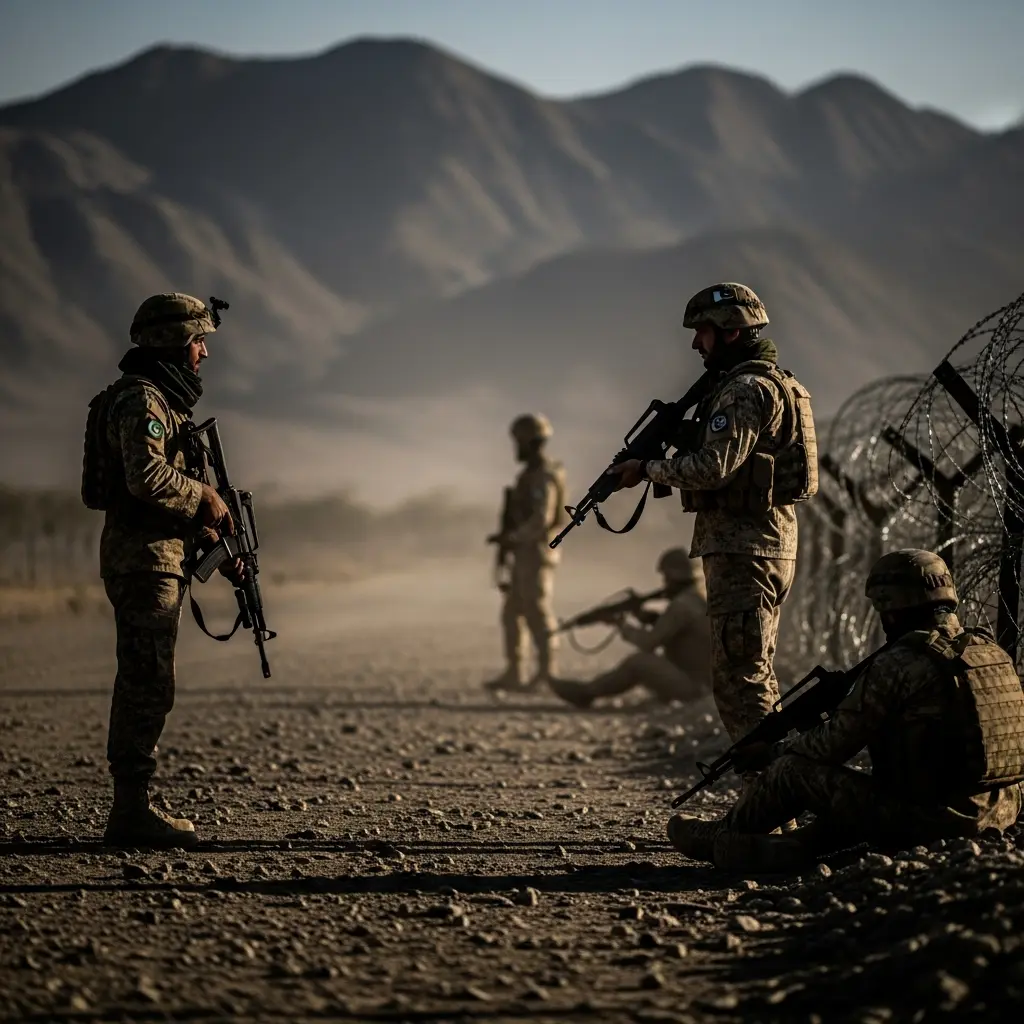
Some conflicts simmer for so long that the world almost stops noticing. The violence along the Pakistan-Afghanistan border is one of those — a slow, grinding crisis that flares into international headlines only when the casualty counts grow impossible to ignore. The latest outbreak of cross-border violence is one such moment. Civilians are dead. Communities are shaken. And the broader question of whether this frontier can ever truly be stabilized hangs in the air, unanswered as ever.
It is not just a tale of gunfire over a disputed border. It is a tale of two neighbouring countries caught in a spiral of suspicion, historical grievance and conflicting security interests – and it is ordinary people who are paying the price.
A Border That Was Never Really Settled
To understand the current border conflict, it helps to understand the ground it’s being fought over. The Durand Line — the colonial-era boundary separating Pakistan and Afghanistan — has never been fully accepted by Kabul. Drawn in 1893 by a British diplomat, it sliced through Pashtun tribal territory with little regard for the communities it divided. More than a century later, that wound has never properly healed.
For Pakistan, the border is an internationally recognized boundary that must be respected and defended. For Afghanistan — across multiple governments and ideologies — it has remained a source of nationalist grievance. This fundamental disagreement colors every security conversation between the two countries, making cooperation difficult and mistrust almost automatic.
Add to this the presence of armed non-state actors, militant networks that use the porous terrain to move men and weapons across with relative ease, and you have conditions that make sustained regional security almost impossible to achieve.
The Human Cost That Gets Lost in the Politics
When officials issue statements about “cross-border incidents” and “coordinated responses,” the language tends to sanitize what is actually happening on the ground. Villages near the frontier live under the shadow of violence that arrives without warning. Farmers, traders, children walking to school — none of them are parties to the geopolitical disputes playing out above their heads, but they absorb the consequences all the same.
The latest outbreak has resulted in civilian casualties on both sides. Families have lost members. Homes have been damaged. And communities that have already endured decades of conflict — first the Soviet war, then civil strife, then the post-2001 era — find themselves once again caught in cycles of violence they did not choose and cannot escape easily.
This human dimension rarely holds the world’s attention for long. The news cycle moves fast. But for the people living within earshot of the border, the fear doesn’t move on. It stays.
Why Both Governments Are Struggling
The relationship between Pakistan and Afghanistan has rarely been warm, but it has reached a particular low point in recent years. Since the Taliban’s return to power in Kabul, Islamabad had initially hoped for a degree of cooperative engagement — perhaps even leverage. That calculation has largely not paid off.
Cross-border attacks on Pakistani soil, many attributed to the Tehrik-i-Taliban Pakistan (TTP), have continued with troubling frequency. Pakistan holds that the Afghan side provides sanctuary to these groups; Kabul denies it. The back-and-forth of accusations has replaced any meaningful security dialogue, leaving the border conflict to fester without a credible resolution framework.
Afghanistan, for its part, has its own internal pressures. The Taliban administration is governing a country in economic freefall, cut off from international financial systems, and struggling to maintain basic order beyond Kabul. Border management, in such a context, becomes a secondary concern — even when it shouldn’t be.
The Regional and International Dimension This is no one-off for South Asia news watchers and foreign policy analysts, but a symptom of a wider regional instability with global ramifications. The Pakistan-Afghanistan corridor lies at a strategic intersection of competing interests of China, Russia, the United States, Iran and India, sometimes in contradiction to each other.
International affairs analysts have long argued that durable peace on this border requires more than military responses. It requires an economic stake in stability — cross-border trade, infrastructure connectivity, shared development — that gives communities on both sides a reason to resist violence rather than participate in it. Some of those frameworks were being tentatively explored in earlier years. Most have stalled.
International observers monitoring the current escalation are calling for de-escalation and dialogue. Whether those calls carry enough weight to shift the calculation on the ground remains to be seen.
A Crisis That Demands More Than Condemnation
It would be easy — and insufficient — to simply condemn the violence and move on. The harder work involves asking why this border has remained so volatile for so long, and what genuine regional security cooperation would actually require from both sides.
It requires Pakistan and Afghanistan to find a framework for dialogue that goes beyond blame. It requires the international community to stay engaged even when the cameras leave. And it requires the world to remember that behind every “incident” is a community of real people who deserve better than to be footnotes in a geopolitical dispute.
The guns may quiet down. The headlines will eventually shift. But until the underlying tensions are addressed with the seriousness they deserve, the next flare-up is only ever a matter of time.
Pakistan-Afghanistan Border Violence Intensifies: What’s Really at Stake.