
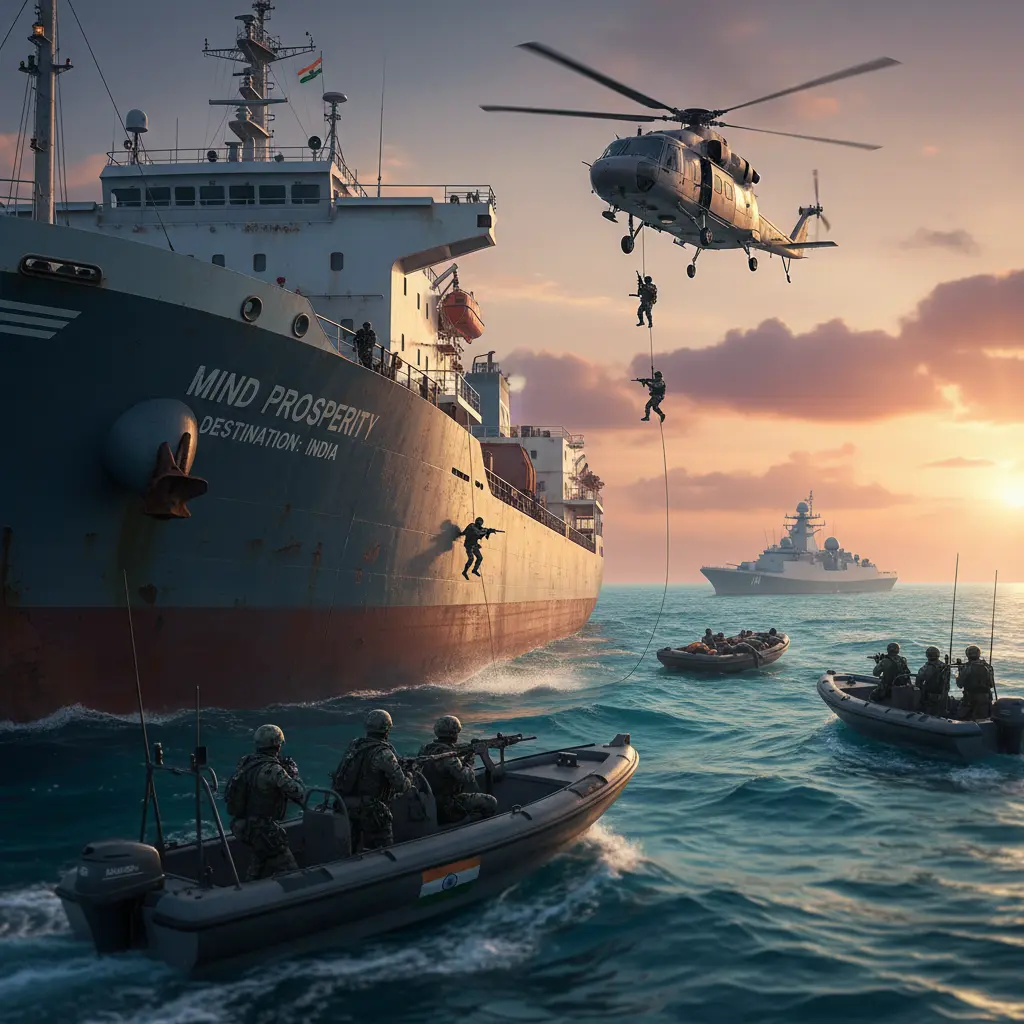
The Gulf of Aden has always been a tense stretch of water, but lately it’s been getting tenser. So when word came in that the Indian Navy had stepped in to stop a piracy attempt targeting a merchant vessel in the region, it wasn’t exactly a shock. It was, however, a solid reminder of just how much quiet, round-the-clock work goes into keeping one of the world’s busiest shipping corridors safe.
The Navy’s guided-missile destroyer INS Kolkata, which was already on patrol in the area, picked up intelligence about suspicious activity near a merchant vessel and moved fast. A helicopter was launched for aerial surveillance, and a boarding team was sent in to check the ship and neutralize the threat before it could escalate into a full-blown hijacking. The vessel and its crew came away safe, and the operation ended without serious incident, which is exactly how these things are supposed to go when they go right.
A Familiar Threat, Making an Unwelcome Comeback
For a while, it looked like Somali piracy had been largely brought under control. Years of sustained naval patrols, faster international coordination, and tougher deterrence had pushed the numbers way down from the chaos of the early 2010s. But this piracy news out of the Gulf of Aden fits into a worrying pattern that’s been building over the past year: pirate networks are showing fresh signs of life.
What’s different this time is the range. Pirate groups are no longer sticking close to the Somali coast. They’re now operating well over a thousand nautical miles out, using larger hijacked vessels as floating bases to strike further into the Arabian Sea than before. Maritime security agencies tracking the region have upgraded their threat assessments accordingly, and merchant crews transiting the area are on much higher alert than they were even a year ago.
Add to that the ongoing disruption caused by Houthi attacks on shipping in the Red Sea, and you get a picture of a maritime environment that’s simply more dangerous right now than it’s been in years. Vessels are being pushed onto longer, less familiar routes through the Gulf of Aden and the wider Arabian Sea, which unfortunately puts more ships within reach of opportunistic pirate crews.
Why the Indian Navy Keeps Showing Up
This wasn’t a one-off deployment. India’s maritime security role in this region goes back to 2008, when the Navy began continuous anti-piracy patrols in the Gulf of Aden. That commitment has never really let up. Over the years, Indian warships have escorted hundreds of merchant vessels safely through the corridor, and Marine Commandos have been called into action more than once when situations demanded a more direct response.
One of the most memorable examples came a couple of years back, when Indian commandos executed a daring operation involving a precision airdrop of raiding craft and personnel to recapture a hijacked bulk carrier and rescue its crew, an operation that drew praise from maritime security experts internationally for how it combined air power, naval assets, and special forces so cleanly.
That track record matters because it’s shaped how the region sees India today. The Navy has increasingly positioned itself as the Indian Ocean’s “first responder” and “preferred security partner,” a role that carries real weight now that so many other naval forces are stretched thin dealing with the Red Sea crisis and broader tensions across West Asia.
Protecting Cargo That Matters to India
It’s worth remembering that these aren’t abstract security exercises. The vessels moving through the Gulf of Aden often carry cargo that matters directly to Indian trade and energy needs, from crude oil to essential goods that keep supply chains running. A successful hijacking doesn’t just endanger a crew; it can ripple through markets, delay shipments, and drive up insurance costs for everyone using that route.
That’s part of why India defence planners treat maritime security as such a high priority. It isn’t only about protecting foreign-flagged ships passing through, though that matters too for India’s international standing. It’s also about safeguarding the flow of goods that Indian industries and consumers depend on every single day.
A Region Under Pressure
None of this is happening in isolation. The Gulf of Aden sits at the crossroads of some of the most strategically sensitive waters on earth, close to the Bab el-Mandeb Strait, within reach of the Red Sea, and not far from the Strait of Hormuz, all of which have seen serious disruptions recently. Naval forces from multiple countries are now juggling overlapping threats, drone attacks on tankers, missile strikes, and old-fashioned piracy, sometimes all within the same patrol zone.
For India, this complexity is exactly why maintaining a strong, visible naval presence in the region isn’t optional. It’s become a core part of the country’s broader strategic posture in the Indian Ocean, one that reinforces its credibility as a security provider rather than just a beneficiary of someone else’s naval umbrella.
The Bigger Picture
This latest operation will likely fade from headlines within a few days, as these things usually do. But it is another data point in a much longer story: India’s navy has quietly become one of the most consistent and capable maritime security forces operating in the Western Indian Ocean. Every successful interception, every safe escort, every crew rescued adds up to a record that is hard to ignore.
As the threats of piracy continue to evolve and proliferate, the pressure on navies like India’s will only grow. But if this latest response off the Gulf of Aden is any indication, the Indian Navy appears ready to continue answering that call, one patrol at a time.

