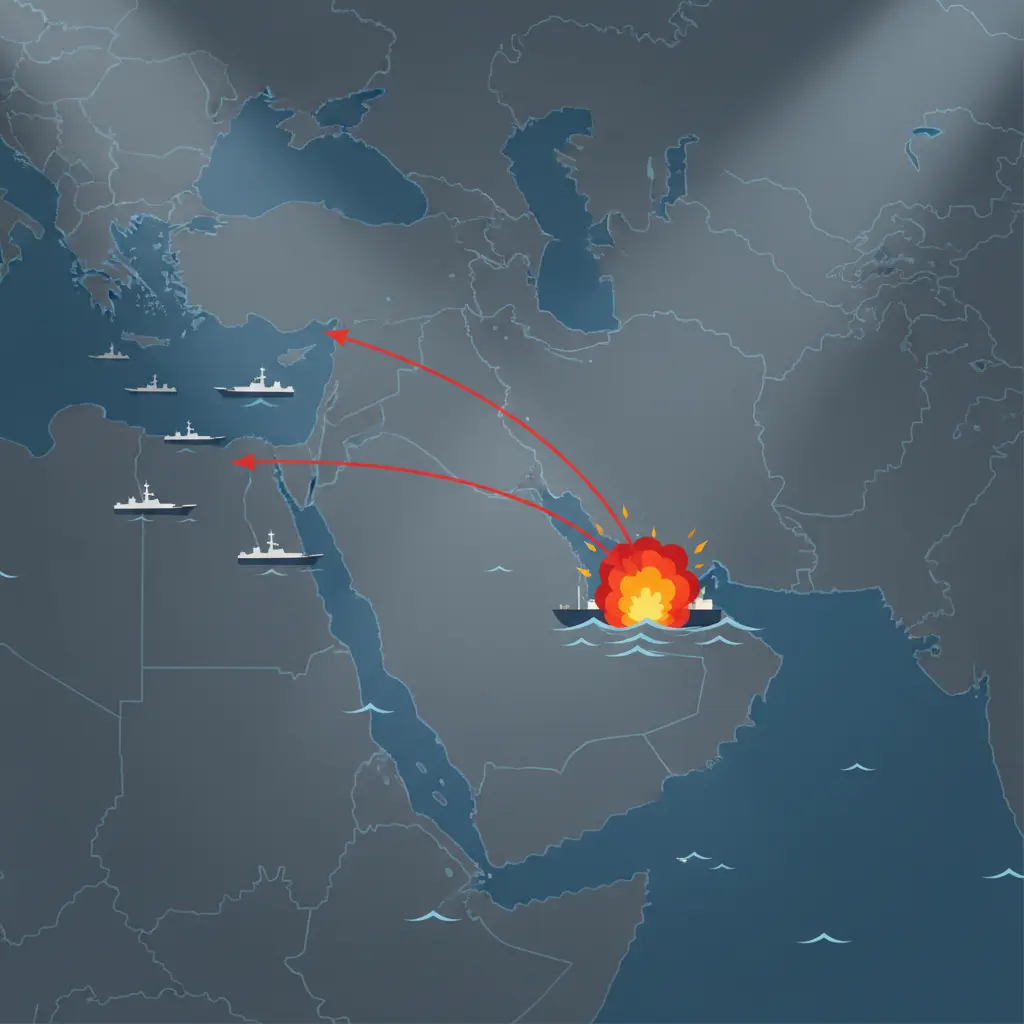
The fragile truce between Washington and Tehran cracked wide open this week, as the United States launched its most extensive round of strikes on Iran since the ceasefire brokered back in April. The message from CENTCOM was blunt: attack commercial shipping in the Strait of Hormuz, and the cost will be steep.
According to US Central Command, American forces hit more than 80 targets across Iran in a single wave, including air defense systems, coastal radar installations, anti-ship missile sites, and dozens of small boats operated by the Islamic Revolutionary Guard Corps. It’s the kind of large-scale operation that hasn’t been seen in the region in months, and it came almost immediately after Iran was accused of striking three commercial tankers as they tried to pass through the Strait of Hormuz — one of the busiest and most strategically important waterways on the planet.
The tankers involved weren’t American vessels, but that barely mattered. A Qatari-owned LNG carrier and a Saudi-flagged supertanker were both damaged, one badly enough to catch fire. A third ship was also hit shortly after. For Washington, that was the final straw. CENTCOM said the strikes were meant “to impose heavy costs” on Iran for what it called an unwarranted and dangerous violation of the ceasefire.
Iran didn’t sit still. The Revolutionary Guard responded by launching missiles and drones at American military sites in both Bahrain and Kuwait, home to the US Fifth Fleet and the Ali Al Salem air base respectively. Sirens sounded across both countries as residents were told to take shelter. It’s a sharp reminder that even when the fighting between the US and Iran quiets down, the American military footprint scattered across the Gulf states leaves plenty of targets within easy reach of Tehran’s arsenal.
Adding fuel to an already volatile situation, the US also pulled the plug on a sanctions waiver that had let Iran sell its oil on the global market. That waiver had been part of the earlier ceasefire arrangement, a small economic concession meant to keep talks alive. Now it’s gone, and more than 60 million barrels of Iranian crude are reportedly sitting without a clear buyer. Oil markets reacted almost instantly, with prices jumping as traders priced in the risk of a wider Gulf conflict and the very real possibility that the Strait of Hormuz — through which roughly a fifth of the world’s oil and gas flows — could see its traffic disrupted again.
The timing couldn’t be more awkward for the Trump administration. All of this is unfolding just as President Trump is in Turkey for the NATO summit, trying to focus allied attention on other pressing issues while the Iran situation threatens to dominate headlines instead. Turkey’s proximity to Iran only adds to the optics of a US president trying to manage a Gulf crisis from just across the border.
What makes this round of escalation especially worrying is how quickly things have unraveled since the April ceasefire. That agreement was supposed to mark a turning point, an off-ramp from months of direct conflict between the US, Israel, and Iran. Instead, it’s proven to be more of a pause than a resolution. Iranian officials have accused Washington of repeated violations, while US officials insist that Tehran’s own actions in the Strait — and its continued willingness to target commercial shipping — are what’s forcing the response.
For the shipping industry, the practical impact is already being felt. War-risk insurance premiums for vessels transiting the strait have climbed sharply, and several shipping companies have reportedly begun rerouting or pausing transits altogether given the unpredictability of the situation. Ports across the Gulf, along with Saudi Arabia, Qatar, and the UAE, have all found themselves drawn into the crossfire at various points, either through direct attacks or by being forced to speak out against strikes on their territory.
Analysts following the conflict point out that both sides seem to be testing the limits of the ceasefire rather than abandoning it outright. Neither Washington nor Tehran appears eager to declare the agreement dead, but each new strike chips away at whatever trust remained. Iran’s Revolutionary Guard has vowed a “crushing response” if further strikes continue, language that suggests this latest exchange may not be the last.
Whether this settles into another uneasy standoff or spirals into something bigger largely depends on what happens over the next few days. With Trump occupied at NATO, oil markets on edge, and Gulf allies increasingly caught in the middle, the Strait of Hormuz has once again become the fault line where a wider Middle East conflict could either be contained or reignited in full.