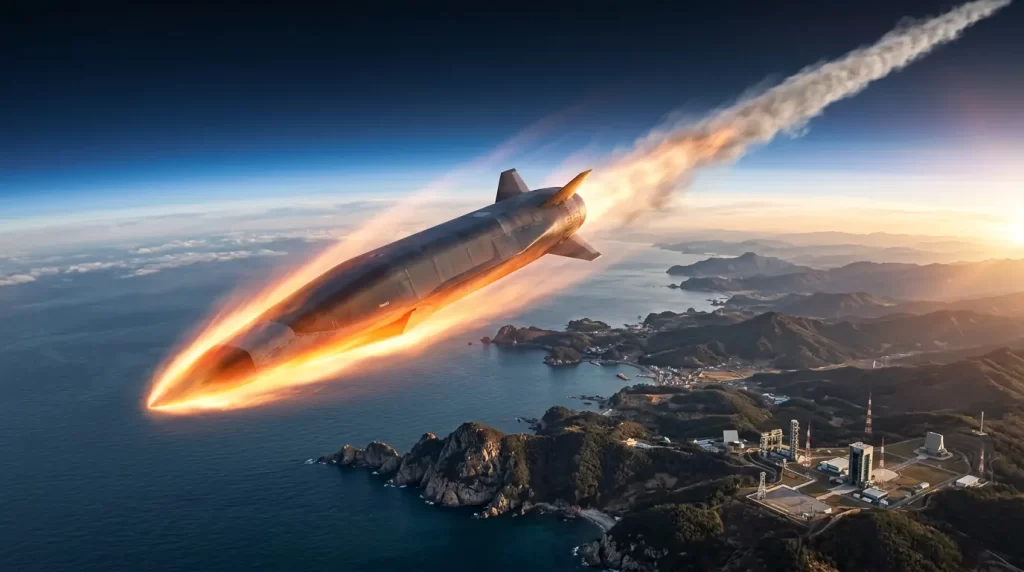
South Korea has crossed a threshold it has been working toward for years. The country has test-flown its first domestically developed hypersonic weapon, a milestone that arrives at an uneasy moment on the Korean Peninsula. The launch follows a recent hypersonic missile test by North Korea, and it comes while both sides are still trading suspicion over a separate incident near the border.
It would be easy to read the test as a simple reply to Pyongyang. The reality is more layered, and it says as much about how Seoul sees its own security as it does about the rivalry to the north.
What makes a hypersonic weapon different
A hypersonic weapon travels at more than five times the speed of sound. That alone is not new. Conventional ballistic missiles already reach those speeds during parts of their flight. What sets hypersonic systems apart is that they can manoeuvre while they fly.
A traditional ballistic missile follows a predictable arc. Once radar picks it up, defenders can calculate where it will land and position interceptors accordingly. A hypersonic weapon can change course mid-flight and often stays at lower altitudes, which shortens warning time and makes that calculation far harder. Missile defence systems built around predictable trajectories struggle against it.
That is why militaries from Washington to Beijing to Moscow have poured money into the technology. For South Korea, mastering it at home matters for a practical reason: it means relying less on foreign partners for advanced capabilities and keeping development timelines under its own control.
Why “home-built” matters
The phrase “first domestically developed” carries weight. South Korea has a strong defence industry and already produces a wide range of missiles, aircraft and naval systems. Even so, hypersonic propulsion and guidance are among the hardest engineering problems in modern weapons development. Heat, materials, and control at extreme speeds all push engineers to their limits.
Succeeding with a first test flight shows that Seoul’s research institutions and defence contractors have reached a level where they can tackle these problems independently. A single test does not mean a weapon is ready for service, of course. Moving from a successful flight to a reliable, deployable system usually takes many more trials, refinements and years of work.
It is also worth being upfront about what is not yet known. Range and performance details were not available in the reports reviewed, so claims about how far or how fast the weapon can go should be treated carefully until official figures are released.
The North Korea backdrop
The timing is hard to ignore. North Korea recently carried out its own hypersonic missile test, part of a long pattern of weapons demonstrations that have kept the region on edge. Pyongyang has repeatedly highlighted hypersonic technology as a priority, and each launch puts pressure on Seoul and its allies to show they are not falling behind.
From a deterrence point of view, the logic is simple. If one side develops weapons that are hard to intercept, the other wants a credible way to respond. South Korea’s new capability can be seen as part of that balance, a signal that any attack would meet a response that is difficult to stop.
Border tensions add to the strain
Another factor is the mood along the border. Land mine explosions recently injured three South Korean soldiers near the border, an incident Pyongyang denies being responsible for. The dispute over who is to blame has added fresh friction at a time when trust between the two Koreas was already thin.
The Demilitarized Zone is one of the most heavily fortified frontiers in the world, and it is also littered with mines left over from decades of confrontation. Soldiers patrolling the area face real physical danger even without any deliberate escalation. When injuries occur, questions about responsibility quickly become political, and in this case the two sides tell different stories.
Whatever the truth behind the explosions, the incident feeds a broader sense of unease. Weapons tests, border accidents and angry statements tend to reinforce each other, making it harder for either side to step back.
What this means for regional security
For ordinary people living on the peninsula, headlines like these can feel distant and alarming at the same time. The practical question is whether the test makes the region more dangerous or more stable.
There is no single answer. Supporters of stronger defence capabilities argue that credible deterrence prevents conflict by making aggression too costly. Critics worry that every new weapon invites a matching response, fuelling an arms race that raises the risk of miscalculation. Both views have a long history behind them, and both show up whenever a new system is revealed.
What seems clear is that hypersonic technology is spreading. As more countries acquire it, defence planners across Northeast Asia will have to rethink early warning, interception and crisis communication. Faster weapons leave less time for decision-makers to assess what is happening, which is exactly why clear communication channels matter.
What to watch next
A few developments will shape how much weight this test ultimately carries:
Official technical details. Confirmed range, speed and accuracy figures will show how advanced the system really is.
Further testing. Repeated successful flights would point to a programme moving toward deployment.
North Korea’s response. Pyongyang often answers perceived provocations with statements or launches of its own.
Border investigations. Findings on the land mine explosions could either ease or inflame current tensions.
Diplomatic signals. Any move toward dialogue, even a small one, would matter more than another round of weapons news.
The bigger picture
South Korea’s first home-built hypersonic test is a genuine technical achievement and a clear statement of intent. It also lands in a region where every military step is read through the lens of rivalry. The hardware may be impressive, but the harder challenge lies elsewhere: keeping a tense peninsula from sliding into a crisis that nobody wants.
For now, the story is still developing. More information about the weapon’s capabilities, and about the incident at the border, will likely emerge in the coming weeks. Until then, the safest conclusion is a modest one. A new capability has been demonstrated, tensions remain high, and the need for careful, steady diplomacy has not gone away.
South Korea Test-Flies Its First Home-Built Hypersonic Weapon.