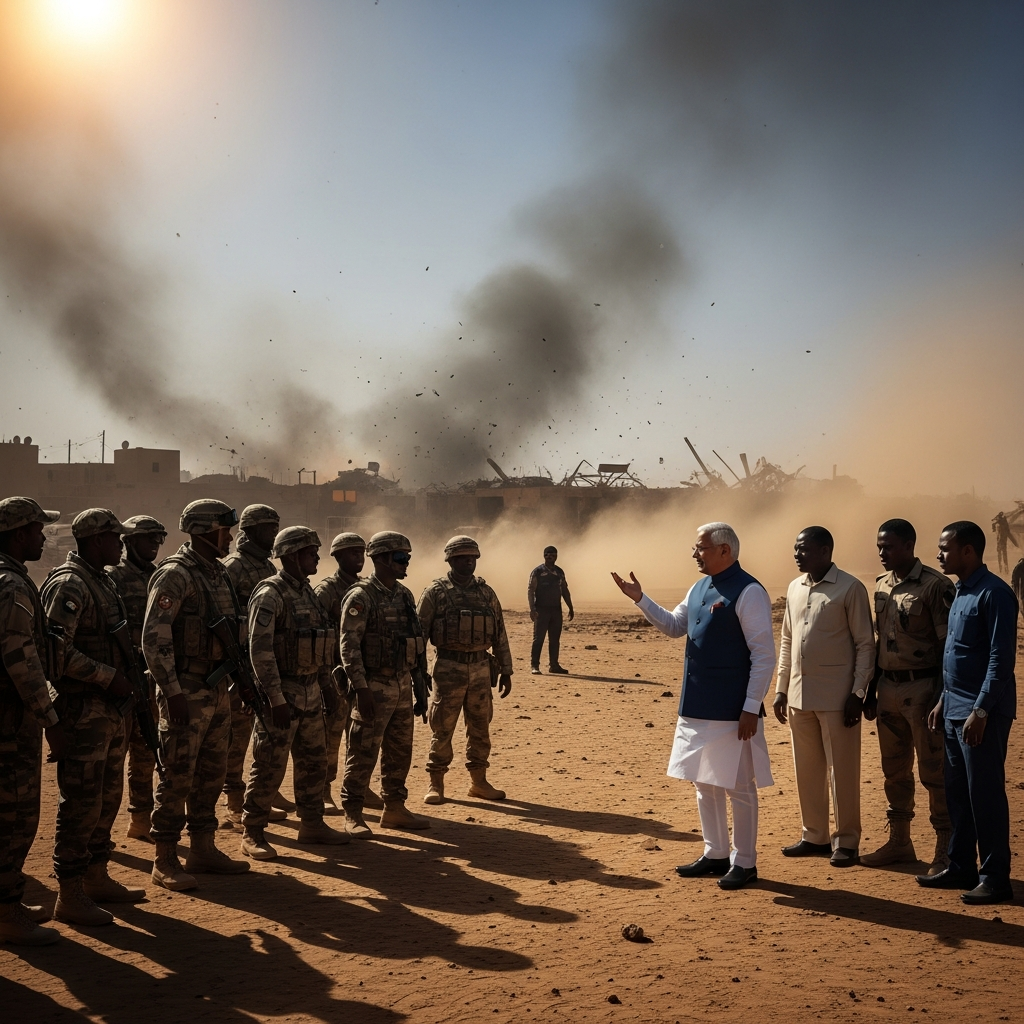
There are moments in international diplomacy that go beyond the language of formal statements.
When the Ministry of External Affairs in New Delhi issued its condemnation of the recent terror attacks in Mali — attacks that claimed the lives of senior defence officials and left a nation grieving — it was, on the surface, a routine diplomatic communiqué. But read a little more carefully, and it speaks to something deeper: a consistent, principled foreign policy stance that India has maintained across decades, and a growing relationship with the African continent that often doesn’t get the attention it deserves.
India’s reaction to the attack on Mali was prompt and unequivocal. India condemned the violence in the strongest terms and expressed heartfelt condolences to the bereaved families of the deceased and solidarity with the people of Mali. No hedging. No diplomatic ambiguity. Just a clear message from one nation to another: we stand with you in this.
What Happened in Mali
Mali has been living under the shadow of armed insurgency for years. Today, the Sahel region, a vast swathe running through West and Central Africa, is one of the world’s most dangerous areas for state actors, peacekeepers and civilians alike. Jihadist groups affiliated to al-Qaeda and Islamic State have launched devastating attacks with disturbing regularity against military convoys, government buildings and civilian infrastructure.
The Mali bombing that triggered India’s response was especially brutal because it hit the heart of the country’s defence system. The loss of senior military personnel is not only a human tragedy, but a blow to a nation already battling to uphold security and state authority in the face of ongoing extremist violence. It’s a message to those prepared to serve their country in uniform that the price for their service is steep.
For Mali’s people and government, international condemnation carries real weight. It signals that the world is watching, that the sacrifices of their officials are recognised, and that they are not alone in confronting a threat that has already consumed too many lives.
India’s Voice against Global Terrorism India’s response to the Mali attack did not come out of thin air. It reflects a foreign policy position that has been hardened by India’s own painful experience with terrorism — from the 1993 Bombay blasts to the 2008 Mumbai attacks and countless incidents in between. India knows, with an intimacy that few nations do, what it means to lose lives to coordinated terror.
That experience has made India one of the most consistent and vocal advocates for a unified global stance against terrorism. The MEA statement India issued regarding Mali is part of a long pattern — whether condemning attacks in France, Sri Lanka, Bangladesh, or now Mali, India has rarely stayed silent when terrorism strikes. And critically, it has resisted the tendency, common in international politics, to calibrate its condemnations based on geopolitical convenience.
Global terrorism news often focuses on Europe, the Middle East, or South Asia. The Sahel region, despite suffering some of the most lethal and sustained terrorist violence in the world, frequently falls below the international radar. India’s willingness to speak up — clearly and promptly — on an attack in West Africa is a statement in itself.
India and Africa: A Relationship Built on More Than Transactions
There’s a broader context here that deserves attention. India’s engagement with African nations has been growing steadily, and it is built on a foundation that goes back to the Non-Aligned Movement, shared post-colonial histories, and a genuine sense of solidarity among developing nations navigating a complicated world.
India foreign policy in Africa is not simply about securing resources or expanding trade, though those elements are certainly present. It is also about building relationships of mutual respect, the kind where a message of condolence has meaning because it comes from a country that has walked a similar path.
India has trained African military personnel, taken part in peacekeeping missions and invested in development partnerships across the continent. Condemnation of the deaths of Mali’s defence officials in that context is not just protocol — it is an expression of the kind of partnership India wishes to build with African nations.
What This Moment Should Remind the World
There is a troubling tendency in how the world responds to terrorism based on geography. Attacks in Western capitals generate wall-to-wall coverage and immediate multilateral responses. Attacks in the Sahel or sub-Saharan Africa — where the human toll is often far greater — receive a fraction of the attention and a smaller share of international resources.
India’s condemnation of the Mali bombing is a small, but significant, pushback against that imbalance. It says: these lives matter. These officials who died serving their country matter. This nation’s struggle against extremism deserves to be named and acknowledged.
The fight against global terrorism cannot be selective. It cannot be organized around which victims are visible enough to warrant outrage. If the international community is serious about defeating terrorism, it has to be serious everywhere — in Bamako just as in Brussels, in the Sahel just as anywhere else.
India, through its MEA statement and its consistent foreign policy posture, has understood this for a long time.
Whether the rest of the world catches up remains the more difficult question.
A Message Across Continents: Why India’s Condemnation of the Mali Attack Matters.