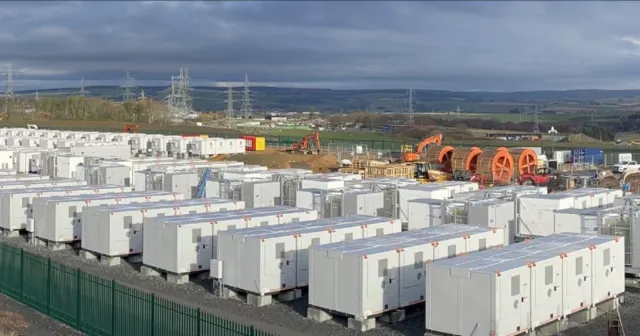
Adani Group is advancing the deployment of India’s largest battery energy storage system (BESS) at Khavda, Gujarat, marking a significant milestone in the nation’s renewable energy transition. The ambitious 1,126 MW / 3,530 MWh project is in its final stages of development and is expected to be fully commissioned by March 2026. Once operational, it will be one of the largest energy storage systems in the world, playing a pivotal role in ensuring the stability and reliability of India’s renewable power grid.
The Khavda BESS is designed to complement Adani Green Energy Limited’s (AGEL) massive solar and wind projects in the region, making Gujarat a key hub for India’s clean power generation. The facility will store excess renewable energy produced during non-peak hours and release it during high-demand periods, helping balance supply fluctuations inherent in solar and wind power. This capability is essential to achieving India’s long-term goal of 500 GW of non-fossil fuel-based energy capacity by 2030.
Industry experts view this initiative as a major advancement in India’s energy storage landscape, which has seen rapid growth in recent years. The integration of large-scale storage is critical for the nation’s push toward grid modernization and decarbonization. Adani’s Khavda project not only demonstrates technical innovation but also supports India’s ambition to become a global leader in renewable energy manufacturing and deployment.
The system’s total storage capacity of 3,530 MWh will allow it to deliver power equivalent to supporting nearly one million households for several hours. Beyond energy balancing, the BESS will enhance grid resilience, reduce dependence on fossil fuels, and enable a smoother transition to a renewable-dominated energy mix. It is also expected to reduce curtailment losses for renewable producers and optimize power dispatch efficiency.
This development aligns with India’s National Energy Storage Mission, which aims to accelerate the adoption of advanced energy storage technologies. With growing investments in green infrastructure, battery systems like Adani’s Khavda project are anticipated to form the backbone of India’s next-generation power networks. The project is also expected to create hundreds of direct and indirect jobs during construction and operation, boosting the local economy of Kutch district.
Adani Group’s initiative reinforces its commitment to sustainability and technological excellence in clean energy. By spearheading this large-scale battery deployment, the conglomerate strengthens its position as one of India’s leading renewable energy players and underscores the strategic importance of storage in achieving a net-zero future.
Once operational in 2026, the Khavda BESS will not only set a benchmark for energy storage in India but also serve as a model for future projects across Asia. It represents a defining step toward ensuring round-the-clock renewable power, marking a transformative phase in the country’s clean energy journey.