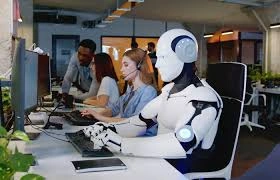
AI systems are growing swiftly in the global economy, and they pose a threat to civilization because they will change how people work, make things, and find meaning in life.
The notion of an AI revolution has materialized into a reality. Now is the moment to think about how it will affect jobs, the economy, and new ideas. The question of whether AI is the best way for people to work together or the biggest threat to their ability to compete has become a real economic issue instead of just a philosophical one. This is because more and more businesses around the world are using more advanced AI systems, like generative language models and platforms that make decisions on their own.
The most recent data displays a contradiction that highlights how hard it is to change this technology. Recent research on the labor market shows that AI technologies are helping people work better in new ways and making some job categories less relevant faster. AI is more than just a tool or a replacement; it affects how people and computers work together in many areas, including the arts, healthcare, finance, and manual labor.
The Enhancement Paradigm: How AI Can Help People Get Better at What They Do
AI is great because it can help humans do their jobs better instead of taking them over. AI-powered imaging analysis technologies have been quite helpful for figuring out what health issues people have.
There are some nice examples of the augmentation story, but there is a lot of evidence that AI is stealing jobs away from people in many parts of the economy. Customer service is one of the most obvious sectors where jobs are disappearing. Chatbots and conversational AI systems have gotten so good that they can now answer questions that only people could before. Big corporations indicate that after using AI, they were able to reduce the number of customer service agents by 20% to 40%. Only the agents who have to deal with the hardest or most emotional cases are still working.
A lot of individuals who work in transportation will lose their jobs because of self-driving cars. People are still trying to make automobiles that don’t need a driver at all, but semi-autonomous technology is already making it less necessary for people to drive them. Logistics companies use AI to plan routes and make their warehouses run on their own. It’s difficult to get work in transportation and distribution now that these new technologies are out. Millions of professional drivers around the world could lose their jobs as self-driving truck technology develops better and more beneficial for business.
AI systems do a lot of tasks right now, such entering data, processing papers, making appointments, and sending a lot of emails. A lot of administrative and clerical jobs have been lost because of this. AI algorithms can now do the same kind of analysis in a lot less time and for a lot less money than paralegals used to have to wade through thousands of pages. Entry-level staff used to do things like file taxes, check audits, and make financial reports. Now, machine learning algorithms accomplish these things.
People don’t have to do much to help generative AI systems create articles, make marketing materials, do basic graphic design, and even make movies. This is making it harder and harder to make content for businesses. Companies are testing out AI-written stories about sports and money. Marketing organizations don’t need to hire as many junior copywriters and designers now that there are systems that can make content automatically. People have to labor harder and quicker since machines are cheaper and faster.
Putting things together again and over again is only one part of manufacturing automation. It needs to be able to evolve and make great choices immediately soon. Computer vision systems can check quality faster and more accurately than people can. Predictive maintenance algorithms discover problems with machines before they happen, so you don’t require as many expert staff. In the past, people without a college degree could get solid, middle-skill manufacturing employment, but these new technologies are slowly but surely taking them away.
What it means for the economy and the job market
AI changes the way individuals work, but it also has a major effect on the whole economy. It also impacts how people look for work and how money is divided. New technologies made more employment than they took away. But the AI revolution is different in key important aspects that make this pattern less easy to follow. Automation used to largely take away jobs that required physical work and manual labor. AI systems are doing more and more things that need people to think and be creative, as well as making hard choices that people used to assume only people could make.
One terrible thing about AI is that it can influence how much money people make. People that are very skilled and know how to exploit AI technology to its fullest are paid more since they get more done. People who work in jobs that can be mechanized, on the other hand, might not earn a raise or perhaps lose their jobs. Because there aren’t as many employment for the middle class, this situation makes the economy less stable and the gap between the rich and poor bigger. Studies in economics show that machines could do 30 to 40 percent of the work that people do now. This would have a bigger effect on people who don’t have a degree.
People can’t keep up with how fast AI is getting better. AI systems learn new things and get new jobs far faster than traditional retraining programs can keep up with. People who lose their employment to automation may not be able to receive the training and education they need to get occupations that need more advanced technical abilities or creative skills that AI can’t just take over. If governments don’t improve education and support systems, a lot of workers could be out of job for a long period because they aren’t able to adapt.
When AI is made and employed in some places, the divide between the rich and the poor gets worse. Big cities and tech hubs with a lot of AI companies and smart individuals get more than their fair share of the benefits of new ways to get more done. But cities that depend on industries that are expected to become mechanized are seeing their economies get worse. This spatial inequality makes social tensions worse and political stability weaker since different communities are taking different economic trajectories, largely due of how they cooperate with AI sectors.
The Need for Skills to Change
We need to think about what important skills and traits humans have that will help them get through the AI transformation. People think that AI can’t perfectly copy skills like moral judgment, emotional intelligence, creative problem-solving, and being able to talk to people well. Instead of focusing on rote learning and standardized test scores, schools should educate kids how to be flexible, think critically, and develop their own unique human attributes that make machines better, not worse.
If you want to work in an economy built on AI, you need to know how to use computers. Knowing how to operate a computer was equally as vital as knowing how to use AI systems, what they can’t do, and how to work successfully with them. People should know how AI makes judgments, how to read data, and the moral questions that come up when AI is utilized at work.
Learning for life goes from being something you do to get ahead at work to something you have to do to keep your job. AI technologies are changing so fast that skills that were valuable for years are now useless for decades. People need to be able to learn new things all the time so that they can keep up with a changing workforce. These systems should be backed by flexible certification frameworks that recognize different ways of learning that go beyond traditional degree programs.
AI is becoming more common, therefore individuals have more choices now. They either regard technology as a partner that helps them reach their full potential, or they allow it be exploited without constraints, which would just aid a few tech elites and take millions of others out of critical employment. This decade of transformation is very significant because it will decide if AI will help people or take their jobs. It won’t happen because technology is getting better on its own; it will happen because people in communities, boardrooms, and governments throughout the world make decisions.