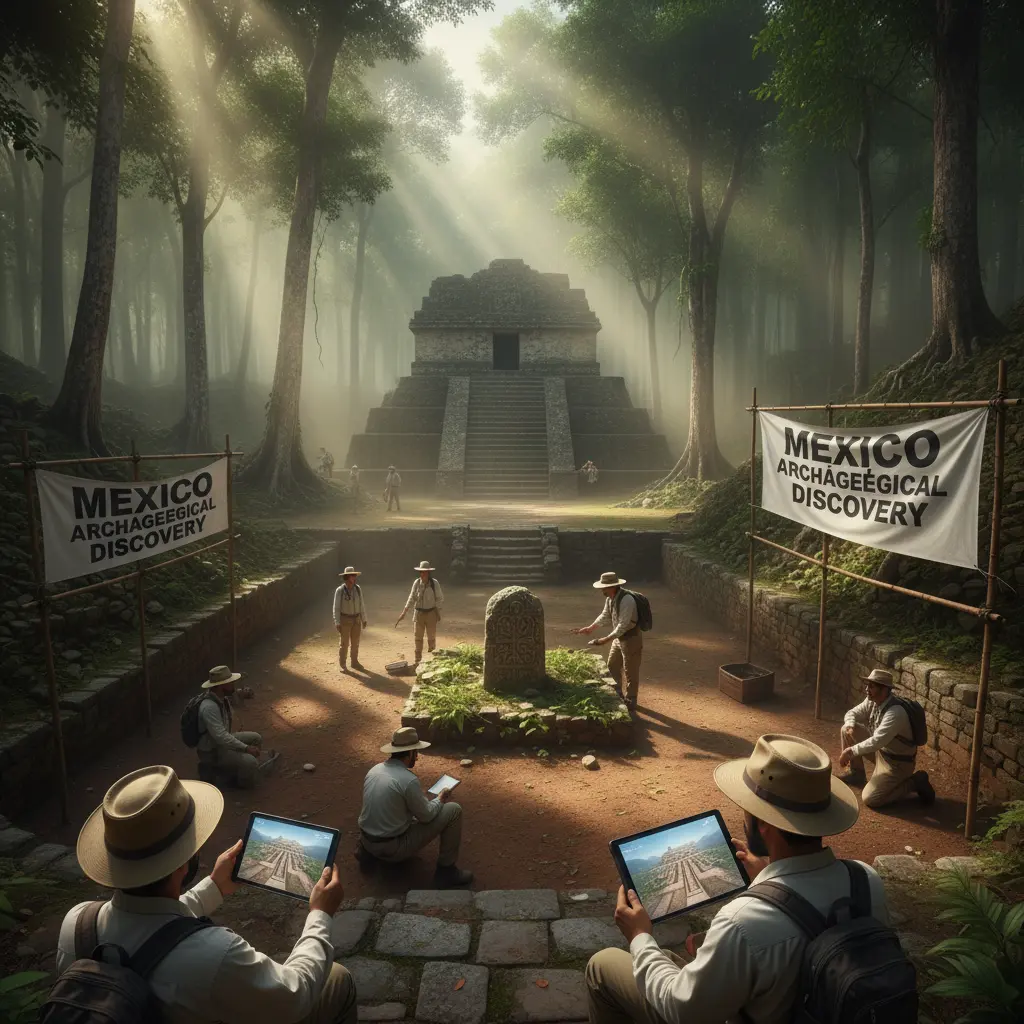
There’s a kind of magic in the moment a shovel strikes stone that hasn’t seen the light of day in over a thousand years. That’s the feeling coursing through the archaeology world right now, as researchers in Mexico have uncovered a set of ancient ruins that nobody quite expected to find. The site, located in the eastern state of Veracruz near the town of Coatepec, is already being called one of the more puzzling and exciting finds in recent memory, and it’s giving historians a fresh lens through which to view pre-Hispanic civilizations.
A Mold-Breaking Discovery
What makes this particular archaeological discovery so compelling is not just its age, and that alone is impressive. The structure and a sculpture that was found alongside it seem to date back to the Early Classic period, somewhere between 200 and 600 AD. That puts it squarely in the broader timeline of ancient civilization in Mesoamerica, a region long associated with the rise and fall of powerful cultures like the Maya, the Zapotec, and later the Aztec.
But here’s where it gets interesting. The ruins do possess definite stylistic features associated with Maya culture, but they were found in a part of Mexico where that influence has not been observed before. Archaeologists discovered a circular stone platform unlike anything ever recorded in the region, along with a flagstone and limestone platform decorated with sharp, almost geometric lines. There’s also a carved monolith depicting a figure that may carry Mayan features, though researchers are still working to confirm exactly who or what it represents.
In other words, this isn’t just another ruin added to an already long list of Mexico ruins. It’s a discovery that challenges some of the assumptions historians have held about how far certain cultural influences actually traveled, and that’s a big deal for anyone interested in historical research.
Government Support and What Comes Next
It says a lot when a discovery like this draws attention from the very top. Mexico’s president called the find “very relevant” during a recent press briefing, and her administration has pledged resources toward investigating and eventually restoring the site. That kind of backing matters, because excavation work is slow, expensive, and requires a level of care that can’t be rushed. Every layer of soil removed could either reveal a breakthrough or destroy evidence that took centuries to form.
The country’s National Institute of Anthropology and History, often referred to by its Spanish acronym INAH, is leading the investigation. This is the same institution responsible for protecting and studying countless archaeological discovery Mexico sites over the decades, from the towering pyramids of Teotihuacan to smaller, lesser-known ceremonial grounds tucked away in jungle and farmland. Their involvement signals that this Veracruz site is being treated with the seriousness it deserves.
Why This Matters Beyond Mexico
It’s easy to read about a scientific discovery like this and think, “okay, that’s neat,” and move on. But the implications extend past one dig site. Pre-Hispanic civilizations were not isolated bubbles crammed into neat little areas on a map. They traded, migrated, borrowed ideas from each other, and sometimes they fought. Every new ruin that appears with “unexpected” features makes the historians reconsider the borders they’ve established around these ancient civilizations.
This particular find suggests that Maya cultural influence, or perhaps a closely related tradition, extended further or interacted more directly with other groups than previously understood. That’s not a small correction to a textbook footnote. It’s the kind of insight that can ripple outwards and reshape how scholars interpret trade routes, religious practices and even political alliances from over a millennium ago.
The Long Road Ahead
Right now, the site is still in its early stages of excavation. Researchers have made it clear that there’s a lot more work to be done before any firm conclusions can be drawn. That’s actually how good archaeology works. We all want instant answers, but it is the painstaking process of digging, documenting and cross-referencing findings with existing records that separates solid historical research from guesswork.
For now, the world will have to wait as archaeologists continue to piece together the story behind this Veracruz discovery. But if the early signs are any indication, this site could be a meaningful chapter in the broader story of Mexico’s ancient past, one that adds nuance to what we thought we knew about the people who lived, built and worshipped on this land centuries before European contact.
Final thoughts
Findings like this are a good reminder that history is not a closed book. There are still pages being written—literally pulled from the earth—that can change how we see entire civilizations. With excavations still ongoing at Veracruz, archaeologists and historians will be watching closely, hoping this site will add more clues to the rich, layered and still-unfolding story of ancient Mexico.
Archaeological Find Adds to Historical Knowledge.