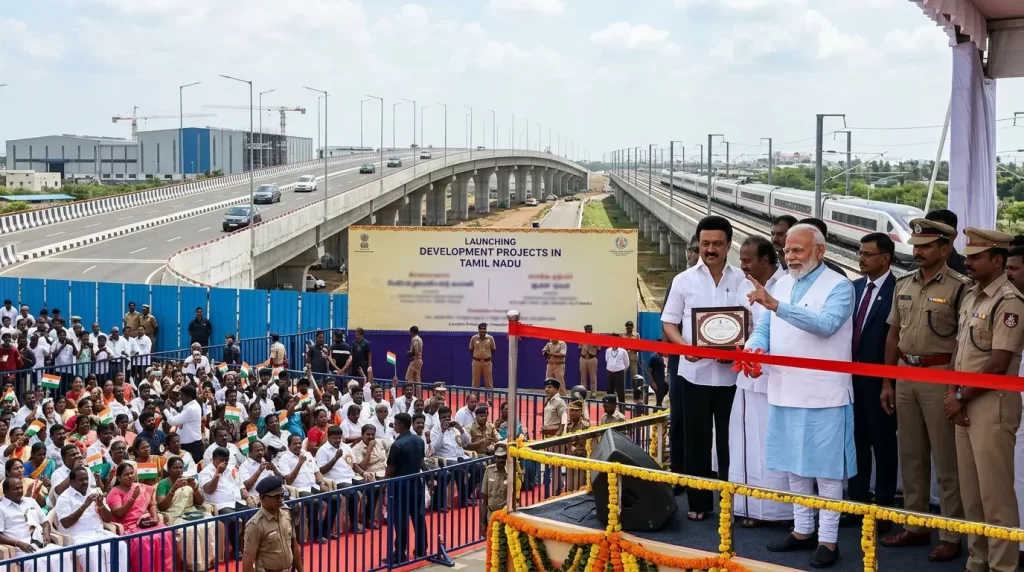
When Prime Minister Narendra Modi arrived in Tamil Nadu on Sunday, the headline number was hard to miss: projects worth over ₹13,000 crore, either inaugurated or marked with foundation stones. The list covered metro rail, highways, railways, ports, petroleum, and scientific research. It was a wide sweep, and it came with a promise of continued Central support for the state.
But in Tamil Nadu, a big infrastructure day is rarely just about concrete and steel. It is also a political moment, and Sunday was no exception.
A Package That Touches Daily Life
Strip away the ceremony and the figures, and what is left is a set of projects that ordinary people will feel in their routines. Metro lines shorten the crawl through traffic. Highways cut the time between towns. Railway upgrades and port work help goods move, which affects prices and jobs. Petroleum and scientific research projects are less visible day to day, but they shape the state’s longer-term economic strength.
For a city like Chennai, the metro is the project people watch most closely. Anyone who has sat in peak-hour traffic knows why. The Poonamallee–Vadapalani metro stretch, one of the corridors tied to the city’s expansion plans, is part of a bigger conversation about how Chennai plans to move millions of people in the coming decade. Commuters rarely care which party announced a line. They care about when it will actually open.
The Chief Minister’s Wish List
Chief Minister Vijay used the occasion to put the state’s own priorities on the table. He asked for early approval of Chennai Metro Phase 3 and the Hosur–Bommasandra metro link. He also asked the Centre to reconsider the Coimbatore and Madurai projects.
That request says a lot. Approvals for large metro projects can take a long time, and a delay of even a year can raise costs and stretch the patience of residents who have been waiting. By raising the matter publicly, with the Prime Minister present, the Chief Minister made it harder for the issue to quietly slip down the queue.
The Hosur–Bommasandra proposal is a good example of why such links matter. The two towns sit on a busy corridor connecting Tamil Nadu with Bengaluru’s industrial belt, and thousands of workers travel it regularly. Coimbatore and Madurai, both major cities with growing populations, have long argued that they deserve modern mass transit too. For their residents, hearing that the projects might be reconsidered is a small ray of hope, though hope is not the same as approval.
Who Gets the Credit?
If the day had ended there, it might have been a fairly routine story of the Centre announcing projects and a state asking for more. Instead, the credit question arrived almost immediately.
AIADMK leader Edappadi K Palaniswami said the TVK government cannot take credit for his party’s Chennai Metro project report. His point was a familiar one in Indian politics: the groundwork for a big project is often laid years before the ribbon is cut, and the party that did the early work wants to be remembered for it.
There is some truth on every side of an argument like this. Metro projects take years, sometimes more than a decade, from first proposal to running trains. They pass through several governments, several budgets, and many rounds of studies and approvals. Who deserves credit depends on which stage you choose to look at. The report, the funding, the approval, and the construction are all real contributions, yet voters tend to remember whoever is standing at the inauguration.
Why Infrastructure Is Always Political in Tamil Nadu
The dispute shows how closely Tamil Nadu politics is tied to infrastructure announcements. In a state with a strong tradition of competitive politics and a public that follows developments closely, a new flyover, metro station, or highway is more than a convenience. It is evidence, or at least a claim, of who is delivering.
That tension is also built into how the system works. Large projects often need money, clearances, and cooperation from both the Centre and the state. When both governments are involved, each has a reason to present the result as its own success, and each has a reason to point at the other when things slow down.
The Prime Minister’s pledge of continued Central support fits that picture. It reassures the state, but it also sets expectations. Tamil Nadu’s leaders will now be watching to see whether the promise turns into timely approvals and released funds.
What Residents Should Watch For
Announcements make for good headlines, but the real test comes later. A few questions are worth keeping in mind as these projects move forward:
Timelines. Are the deadlines realistic, and will they be met?
Approvals. Will Chennai Metro Phase 3 and the Hosur–Bommasandra line get the early clearance the Chief Minister requested?
Fairness across cities. Will Coimbatore and Madurai finally get a fair hearing after being left waiting?
Cost and disruption. Construction brings traffic diversions and noise, so how well will it be managed?
Those details rarely make the evening news, but they decide whether a project is remembered as a success.
Beyond the Ceremony
A ₹13,000 crore package is a serious commitment, and the range of sectors it covers suggests an effort to support the state’s growth on several fronts at once. The projects, if delivered well, could improve travel, trade, and opportunities for a lot of people.
Still, the day showed two Tamil Nadus at once. One is the practical state, asking for approvals, waiting for metro lines, and hoping for better roads. The other is the political state, where every announcement becomes a contest over who earned it.
Both are real, and neither is going away. The best outcome for residents would be a simple one: that the trains run, the highways open, and the credit argument fades long before the projects do.