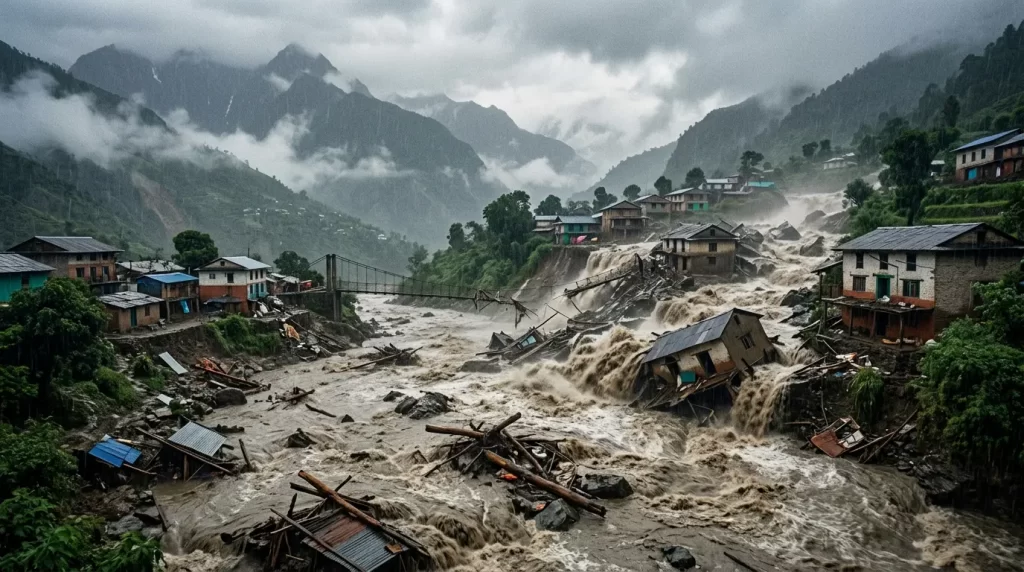
A Nepal flash flood tore through Gorkha district on Sunday. Authorities said it carried away more than 35 houses and bridges, and people living along the stream were told to move to higher ground. The flood was laden with debris, and Business Standard reported that villagers were asked to evacuate after it hit.
For anyone who has spent time in the Himalayan foothills, the story is painfully familiar. The details change from year to year, but the pattern doesn’t.
A Sudden Surge in a Quiet Valley
Flash floods in the mountains rarely give much warning. One moment a stream is running its usual course, and the next it can turn into a wall of mud, boulders, and uprooted trees. According to the reports, the flood in Gorkha was triggered by a landslide. That detail matters, because it describes how these disasters often unfold.
Heavy rain loosens steep, fragile slopes. A section of hillside gives way and slides into a narrow stream bed, blocking it for a while. Water builds up behind the debris until the pressure becomes too much. Then everything is released at once, and the surge rushes downstream at a speed that leaves almost no time to react.
Anything built near the banks is exposed. Homes, footbridges, small shops, and farm plots can all be lost in minutes. More than 35 houses and bridges swept away in a single event is a huge blow for a rural district where each house usually represents a family’s life savings and each bridge is a lifeline.
Why Bridges Matter So Much
Losing a house is devastating. Losing a bridge can quietly make everything else harder.
In a mountain district like Gorkha, bridges connect villages to markets, schools, clinics, and each other. When a bridge goes, a short walk can become a multi-day detour, or become impossible. Relief supplies, medical help, and the movement of evacuees all depend on crossings that are suddenly gone.
That is what makes this Nepal landslide and flood combination so disruptive. The damage is not only what was destroyed but also the isolation that follows. Families who lost their homes may also find themselves cut off from the help they need.
Not the First Time This Season
Sunday’s flood was not an isolated incident. On 6 September, another flood in the same district destroyed four houses and a bridge on the popular Manaslu trekking trail.
The Manaslu Circuit is one of Nepal’s best-known trekking routes, and many local families depend on the visitors who walk it. Teahouse owners, porters, guides, and farmers selling produce all rely on the trail staying open. A damaged Manaslu trek bridge is more than an inconvenience for hikers. It can disrupt the income of an entire community for weeks, especially during the autumn trekking season, when most of the year’s earnings arrive.
Two serious floods in the same district within about five weeks should get people’s attention. They suggest that parts of Gorkha are repeatedly exposed to the same kind of hazard.
The Bigger Picture of Himalayan Floods
Nepal’s geography makes it one of the most disaster-prone places for water-related hazards. The country’s rivers drop from some of the highest peaks on Earth to low plains in a very short distance. That steep drop gives water enormous force and gives landslides plenty of material to work with.
The monsoon adds to the risk, and the danger doesn’t end when the heavy rain does. Slopes saturated through the season can stay unstable for weeks afterward, and a landslide can come down even after the skies clear. That is why Himalayan floods are often described as dangerous both during and after the monsoon.
Many settlements also sit close to rivers and streams simply because that is where flat land, water, and trails are found. People live there out of necessity, not carelessness. That makes the call to move to higher ground a difficult one, since higher ground may mean farther from fields, work, and family networks.
What Needs to Happen Next
In the immediate term, the priorities are clear: keep people safe, provide temporary shelter, and restore access where bridges have been lost. Residents along the stream need dependable information about when it is safe to return, since another surge or slide is always possible in unstable terrain.
Over the longer term, a few things would help vulnerable valleys like these:
Better early warning. Even a few minutes of notice, delivered by phone alerts, sirens, or community watchers upstream, can save lives.
Smarter placement of homes and bridges. Mapping high-risk stretches along streams can guide where to rebuild and where to avoid.
More robust, more resilient crossings. Less likely to be lost are bridges built to carry flows heavy with debris.
Local preparedness. Villagers who know evacuation routes and have practiced them tend to respond faster when it counts.
None of this is simple or cheap, especially for remote districts with limited resources. But the alternative is to keep rebuilding the same houses and bridges in the same places, only to lose them again.
A Familiar Warning
The flood in Gorkha is a reminder of how thin the line is between everyday life and disaster in Nepal’s mountain river valleys. For the families who lost their homes, the numbers in a news report translate into belongings gone, routines upended, and an uncertain stretch ahead.
For everyone else, it is a call to take the repeating pattern seriously. Two floods in one district in a matter of weeks are not just bad luck. They are a signal that preparation, planning, and support for mountain communities cannot wait for the next surge.
Reports are still developing, so figures and details may change as authorities complete their assessments.
If you’d like, I can put this into a file (Word or PDF) or adjust the tone for a news site, blog, or social media.
When the Mountain Moves: Flash Flood Sweeps Away Over 35 Houses and Bridges in Nepal’s Gorkha.