
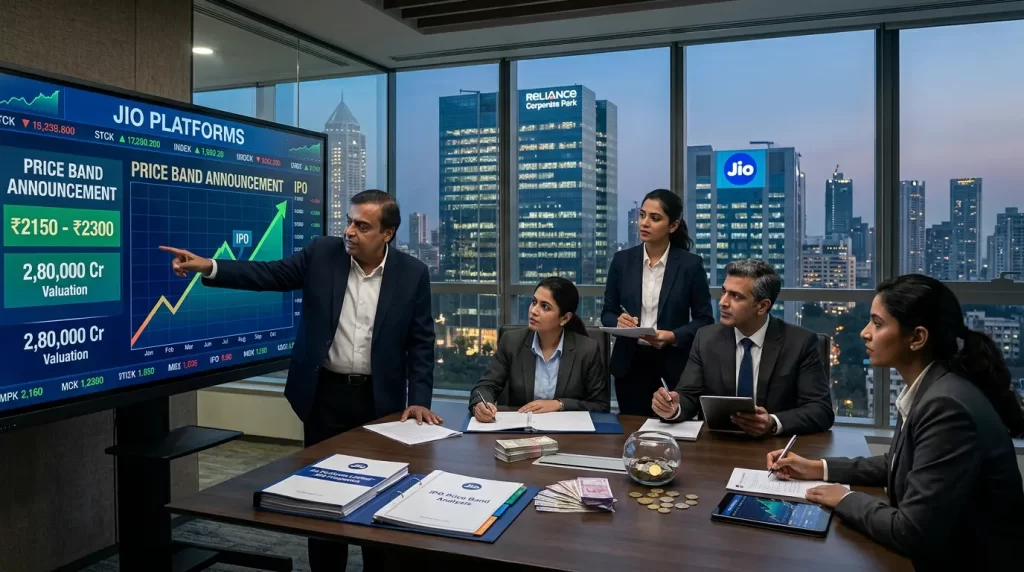
India’s stock market is about to get its biggest event yet. Jio Platforms has announced a price band of ₹1,065 to ₹1,119 per share for its much-awaited public offering. At the top end, the company is looking to raise about ₹30,200 crore, a figure that would surpass Hyundai Motor India’s 2024 IPO and make this the biggest IPO in India’s history.
For a company that most Indians use every day, whether they realise it or not, the moment feels significant. Jio changed how the country uses mobile data, and now it is asking ordinary investors to own a piece of it.
The Key Dates to Mark
If you are thinking about applying, the calendar is simple. The anchor book opens on 19 October. Public subscription for the Jio Platforms IPO runs from 21 to 23 October, which gives retail investors three days to place their bids. Trading is expected to begin on 28 October, so the Reliance Jio listing date is just over two weeks away.
The anchor book is worth a quick explanation. Before the public gets its turn, large institutional investors are allowed to commit money first. Their interest, or lack of it, often sets the tone for what follows. A strong anchor book tends to build confidence, while a weak one can make smaller investors nervous.
Understanding the Price Band and Valuation
The Jio IPO price band of ₹1,065 to ₹1,119 values the company at roughly ₹10.3 lakh crore for the fresh issue. That is an enormous number, and it places Jio among the most valuable companies in the country the moment it lists.
There is a detail here that investors should not skip. Analysts’ earlier valuations were higher than what the price band implies. In plain terms, the company appears to have priced the issue below what many market watchers had been expecting. That could be read in two ways. Some will see it as a sensible decision that leaves room for the share price to rise after listing, which is how many successful IPOs build goodwill with buyers. Others may wonder whether it reflects caution about how much the market is willing to pay for such a large offering.
Neither reading is certain. What is clear is that market appetite will be watched very closely, because the size of this issue leaves little room to hide.
Where the Money Is Going
Another important point is how the funds will be used. Up to ₹27,500 crore of the proceeds is meant to repay borrowings. That is the bulk of the raise.
This matters for how you think about the investment. Money used to pay down debt does not directly fund new towers, new products, or new businesses. What it does is strengthen the balance sheet. Lower debt generally means lower interest costs, and that can leave more room to invest in growth later. It is a more conservative use of capital than a pitch built entirely around expansion.
Some investors like that. A company that cleans up its finances before inviting the public in can look more stable. Others prefer to see fresh money go straight into growth. Which camp you fall into depends on what you want from your investment.
A Record That Carries Weight
The previous benchmark, Hyundai Motor India’s 2024 IPO, was a major moment for the market at the time. Beating it is a statement about how far India’s capital markets have come. More retail investors, more domestic institutions, and more confidence in listing large companies at home all feed into this.
It also raises the bar. A huge IPO that lists well can encourage other big companies to follow. One that struggles could make others think twice. In that sense, the outcome matters beyond Jio itself.
Questions Worth Asking Before You Apply
IPOs generate a lot of excitement, and excitement can cloud judgment. If you are considering the Jio IPO subscription, a few questions are worth sitting down with:
- Are you investing for the long term? A company of this scale is usually better suited to patient investors than to those chasing a quick listing-day gain.
- Do you understand the valuation? A high price tag is not automatically a bad sign, but you should know what you are paying for.
- How does the debt repayment change the picture? Think about what a stronger balance sheet means for future returns.
- How much of your savings are you putting in? Never commit money you may need soon.
Reading the offer documents, or at least a reliable summary of them, is time well spent. Headlines tell you what is happening, but they rarely tell you whether it suits you.
What Happens Next
Over the coming days, attention will turn to the anchor book on 19 October and then to how the public subscription fills up between 21 and 23 October. Oversubscription, especially from large institutions, would be a strong sign of demand. A slower response would be an early warning, though it does not decide how the stock behaves afterward.
For India’s markets, this is a landmark moment. The biggest IPO India has ever seen is coming from a brand that touches hundreds of millions of lives. For investors, it is an opportunity, but like every opportunity in the market, it comes with risk.
Take your time, ask questions, and decide with a clear head. The listing date is still two weeks away, and there is no reason to rush.

