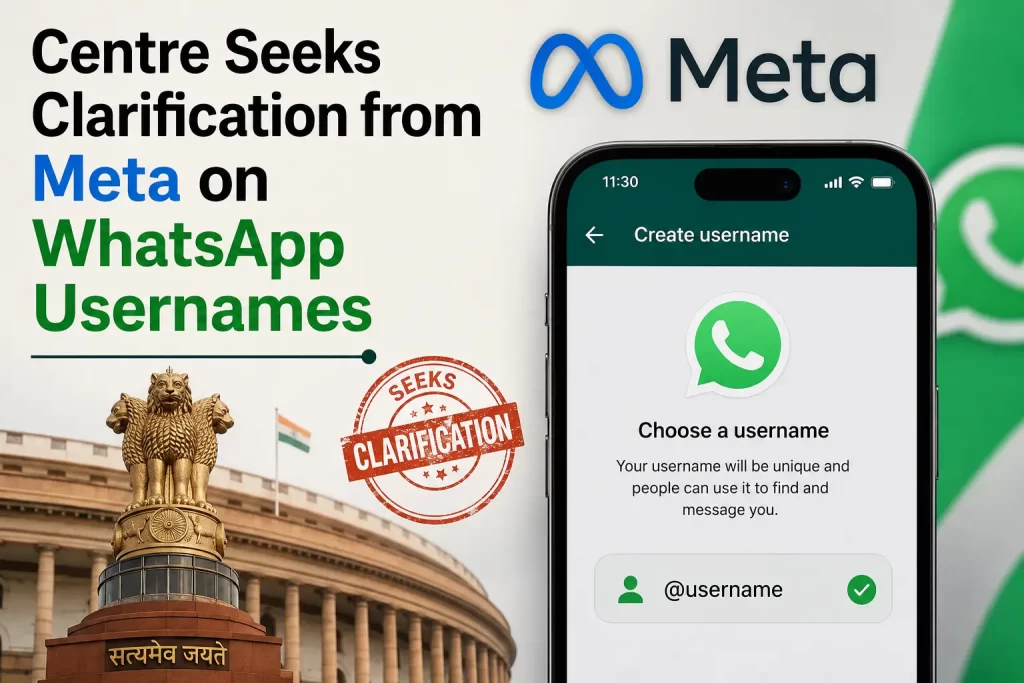
For most of us, WhatsApp is where the day actually happens. Family groups, work chats, quick calls to check if dinner is sorted, all of it runs through that one app. So when the government steps in and asks hard questions about a new feature before it even fully launches, people tend to sit up and pay attention. That’s exactly what’s unfolding right now with the Centre’s notice to Meta over WhatsApp’s new username feature.
What’s Actually Changing on WhatsApp
WhatsApp recently introduced the idea of usernames, a feature that lets people create a unique handle starting with the @ symbol, similar to what you’d see on Instagram or Twitter. The pitch is simple enough: instead of handing out your phone number to a stranger or a new business contact, you just share your username. Your number stays hidden unless the other person already has it saved.
It sounds like a reasonable privacy upgrade on paper, and honestly, apps like Telegram and Signal have offered something similar for years. But WhatsApp isn’t just any app in India. With more than 500 million users here, it’s the country’s largest market for the platform, and that scale changes the stakes considerably.
Why the Government Stepped In
The Centre didn’t waste time raising concerns once the feature started rolling out. Officials pointed out that allowing anyone to pick a username opens the door to impersonation, people creating handles that closely mimic banks, government departments, public figures, or even ordinary individuals people already trust. In a country where digital arrest scams and phishing attempts have become disturbingly common, that’s not a small worry.
The government’s notice specifically flagged how this WhatsApp update could make it easier for scammers to reach out to potential victims while posing as someone legitimate. It cited relevant sections of India’s IT Act, including those related to identity theft, cheating by impersonation and the role of platforms as intermediaries. Meta was given a tight three-day window to respond with a full explanation, backed by supporting documents, and was directed to pause the rollout until the concerns are properly addressed.
This isn’t the government simply being reactive for the sake of it. Meta’s own threat research earlier this year found that online scam networks target users in India more aggressively than almost anywhere else in the world, second only to the United States. Given that backdrop, it makes sense that India technology policy circles are treating this rollout with extra caution rather than waving it through.
How Meta Is Responding
To its credit, Meta hasn’t dismissed the concerns outright. A company spokesperson confirmed that phone numbers will still remain a core part of how WhatsApp accounts work, meaning usernames are an added layer rather than a replacement. The company also laid out several safeguards it says are already built in: limiting how many new people an account can message, blocking repeated attempts to guess someone’s username, and running detection systems designed to catch patterns typical of impersonation or abuse.
Meta India has also said that high-profile names, think celebrities, government bodies, and verified public accounts, are being reserved so they can only be claimed by their rightful owners, along with blocking obvious lookalike versions of those names. The company maintains that the feature is meant to boost digital privacy, particularly for people interacting with new contacts or navigating group chats where sharing a phone number isn’t always comfortable.
Still, WhatsApp has acknowledged that the feature isn’t fully live yet and was always meant to roll out gradually later this year. That slower timeline is now running straight into a formal review process with Indian regulators.
The Bigger Tension at Play
This whole episode captures a tension that’s becoming more familiar in the world of digital privacy. Features designed to protect users, in this case, by hiding phone numbers, can simultaneously create new openings for the very harm they’re trying to prevent. It’s a genuinely tricky balance, and experts tracking the situation have noted that drawing a clean line between sensible regulation and rules that slow down useful innovation is easier said than done.
There’s also a broader pattern worth noticing here. Indian regulators have grown noticeably more assertive with global tech platforms over the past few years, and this notice fits right into that trend. It signals that features can’t simply be dropped into the Indian market without prior scrutiny, especially when the platform in question touches half a billion people’s daily lives.
What Happens Next?
Right now the ball is in Meta’s court. The company must answer the government’s questions within the stipulated time frame and depending on how convincing that explanation is, the rollout of username in India could either go through with additional safeguards or face further delays. Given how central WhatsApp has become to everyday communication and even financial transactions in India, it’s unlikely the government will settle for vague reassurances.
Whatever the outcome, this back-and-forth is a useful reminder that even small-looking features on massive platforms can trigger serious policy conversations. As WhatsApp usernames make their way toward a wider rollout, both Meta and Indian regulators will need to keep working through the details, because getting this one wrong could carry real consequences for millions of users.